Efficient Cultivation and Planting Methods and Key Technical Points for Medicinal Trichosanthes kirilowii
Trichosanthes kirilowii is the dried fruit of the Cucurbitaceae plant Trichosanthes kirilowii Maxim. or Trichosanthes rosthornii Harms. The seeds, peel and roots are also used medicinally after drying. The medicinal use of Trichosanthes kirilowii was first recorded in the Eastern Han Dynasty text "Shennong Bencao Jing," originally named Gualou and listed as a middle-grade drug; its taste is sweet and slightly bitter, and its nature is cold. It enters the Lung, Stomach and Large Intestine meridians. It has the effects of clearing heat and eliminating phlegm, relieving chest tightness and dissipating nodules, and moistening dryness and lubricating the intestines. It is used for lung heat cough, thick yellow turbid phlegm, chest impediment and heart pain, clumping chest and stuffiness, breast abscess, lung abscess, intestinal abscess with swelling and pain, and constipation. Trichosanthes kirilowii is distributed in most regions of the country and is a traditional commonly used Chinese medicinal material in China, with a long history of application and a long-standing reputation at home and abroad. So, how should Trichosanthes kirilowii be cultivated and planted to achieve high efficiency and high yield?
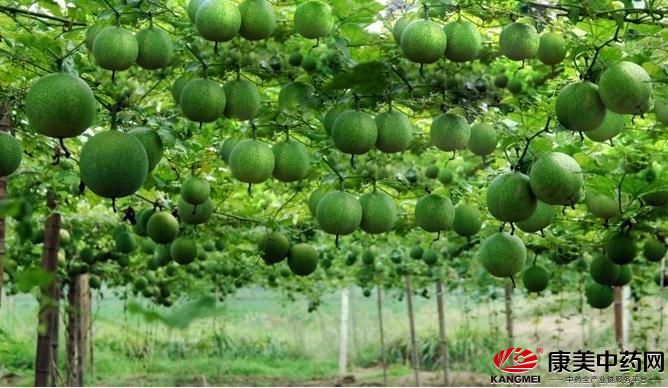
(1) Variety Classification
Trichosanthes kirilowii includes wild species and cultivated species. Cultivated species can be divided into kernel Trichosanthes kirilowii and sugar Trichosanthes kirilowii. Kernel Trichosanthes kirilowii is the superior variety. In addition, there are also Trichosanthes rosthornii, Sichuan-Guizhou Trichosanthes kirilowii, southern Trichosanthes kirilowii, and others.
((2) Growth Habits
Trichosanthes kirilowii prefers a warm and humid environment, is relatively cold-tolerant and not drought-tolerant, so it is advisable to choose a place with relatively abundant rainfall and convenient irrigation for cultivation.
(3) Planting Techniques
1. Land Selection and Preparation
Select a sandy loam plot with good ventilation and light transmission, deep soil layer, loose and fertile soil, and good drainage. Apply 2000-3000 kg of farmyard manure, 40 kg of cake fertilizer, and 30-40 kg of phosphate fertilizer per mu. Carry out deep plowing in late autumn and early winter, harrow fine, level the land in the following spring, and make beds ready for sowing.
2. Planting Methods
(1) Seed propagation. In northern production areas, sowing is mostly carried out between Qingming and Guyu. Before sowing, soak the seeds in warm water at 40°C for 24 hours, remove them, and let them dry slightly. Open holes and sow at a row spacing of 20 cm and a plant spacing of 12 cm. The holes are 4 cm deep, place 1-2 seeds in each hole, cover with soil, and water immediately. Keep the ground moist frequently before emergence. At a humidity of about 20°C, seedlings generally emerge in about 20 days. Transplant in the following spring at a plant-row spacing of 120×150 cm.
(2) Root division propagation. Select good seed plants. For the purpose of harvesting roots (Trichosanthes root), male plants are mostly selected. During the period from Qingming to Lixia, dig out the roots, cut them into small sections of 6-9 cm, and smear the wounds with plant ash. Be careful not to damage the fibrous roots. Any section with a fresh white cut surface can be used as seed root; those with yellow fibers on the cut surface are not suitable as seed. On the already prepared bed surface, dig holes at a plant-row spacing of 120×150 cm, place the seed roots flat, cover with 5-10 cm of soil, and press slightly. Cover the top with 25 cm of soil to preserve moisture. If the climate is normal, they will sprout half a month after planting; level the covering soil, and the seedlings can then grow. In drought, open furrows and water.
(3) Vine layering propagation. Because Trichosanthes kirilowii has the characteristic of growing adventitious roots, in summer when rain is abundant and the temperature is high, pull healthy vines to the ground and press soil at the leaf base. After rooting, the stem branches can be cut off to form new plants. However, this method grows slowly and is generally only used for filling gaps.
3. Field Management
(1) Management before emergence. About half a month after planting, uncover the soil mound. If the seed root has sprouted and the soil is not dry, level the soil mound to facilitate seedling emergence. Before emergence, if there is heavy rain, lightly loosen the soil when the ground surface is slightly dry after the rain, but do not go too deep, to prevent damaging the young buds.
(2) Management during the seedling stage. After planting, if the soil is dry, open a furrow 9-12 cm away from the seed root and water. After each fertilization, make a bed ridge 30 cm away from the plant and irrigate by releasing water. Keep the soil moist throughout the entire growth period. Drain water promptly after rain to prevent water accumulation. During the growth period, weed frequently and loosen the soil 2-3 times. From the second year after cultivation, pruning and bud thinning are needed every year to improve ventilation and light penetration and reduce the occurrence of pests and diseases.
(3) Guiding seedlings onto the trellis. When the stems are about 30 cm long, insert sorghum stalks beside each Trichosanthes kirilowii plant, tie them together with fine rope, and tie the upper ends to the trellis so as to guide the stems and vines to climb onto the trellis. The seedlings should not be pulled or tied too tightly, so that the trellis is not moved by the wind and damages the stems and vines. Select 2-3 healthy stems per plant and guide them onto the trellis. Remove excess stems and branches to help concentrate nutrients and improve ventilation and light penetration. Three rows of Trichosanthes kirilowii share one trellis. Excess branches and axillary buds on top of the trellis should be pinched off promptly.
(4) Topdressing. In the first year after planting, if the base fertilizer is insufficient, topdress once in June. From the second year onward, topdress twice each year: the first time when the seedlings are 30 cm high, and the second time in mid-June (before flowering). Both should be mainly organic fertilizer, using 500-1000 kg of decomposed night soil or 50 kg of soybean cake, 15 kg of urea, and 15 kg of superphosphate per mu. Trichosanthes kirilowii likes heavy fertilizer. The amount of farmyard manure is not limited, and other organic fertilizers may also be applied. Open furrows about 15 cm away around the plant, apply the fertilizer, cover with soil and level it, make beds and water.
(5) Artificial pollination. Appropriately plant some male Trichosanthes kirilowii between the rows or beside the trellis (wild Trichosanthes kirilowii are mostly male plants). During the flowering period, at 8-9 in the morning, use a new writing brush or cotton to dip male flower pollen grains and apply them to the stigmas of female flowers; the pollen grains can also be soaked in water, put into an eye drop bottle, and dropped onto the stigmas. Artificial pollination can increase the fruit-setting rate; cross-pollination in particular is a yield-increasing measure used by local medicinal farmers.
(6) Wintering management. After picking all the Trichosanthes kirilowii, before the soil freezes, cut off the stems about 30 cm above the ground, leaving the stem disc on the ground, then dig up the soil between the plants and pile it over the Trichosanthes kirilowii to form a mound about 30 cm high to prevent freezing damage.
(4) Harvesting and Processing
1. Harvesting:Around the Autumn Equinox, when the fruits are still green but the seeds have matured, they can be picked. If there is not enough time to pick them, the Trichosanthes kirilowii can be cut off from the root so that the fruits hang on the trellis for a period, but the hanging time must not be too long. Picking too early means the fruits are immature, with less sugar and poor quality; picking too late means high water content and difficulty in drying. Harvesting method: cut off the fruits with about 30 cm of stem and vine, and evenly braid them into strands. Do not let two fruits touch each other, to prevent mildew. Handle them gently during operation, and do not shake or bump them.
2. Processing: