Detailed Explanation of Key Technical Points for Artificial Cultivation of Polyporus umbellatus
Polyporus umbellatus is the dried sclerotium of the fungus Polyporus umbellatus (Pers.) Fries, belonging to the family Polyporaceae. It is a commonly used fungal medicinal material in China, with a medicinal history of more than 2000 years, and enjoys a high reputation at home and abroad. Polyporus umbellatus is widely distributed in China, and is cultivated in Hebei, Shanxi, Henan, Liaoning, Jilin, Hubei, Sichuan, Yunnan, Guizhou, Shaanxi, Gansu and other provinces. In Shaanxi Province, wild plants are found in the Qinling and Bashan mountain areas of Ankang, Hanzhong, Shangluo, Baoji, Xi'an, Weinan and other places. The artificial cultivation techniques are introduced as follows:
(1) Site Selection and Land Preparation
Site selection: Choose a shady slope under forest, with fertile and moist sandy soil rich in humus and well-drained.
Land preparation: Under the selected tree species, dig a pit 60 cm long, 50 cm wide and 45 cm deep near the roots, or plow and harrow the land flat and open holes for planting.
(2) Planting Methods
Cultivating fungal material: Select tree species such as red oak, water oak, linden, and tree of heaven as fungal material. Before new leaves emerge, collect branches or wood segments about 10 cm in diameter and chop fish-scale notches every 3-5 cm. Armillaria mellea strains are widely distributed in natural secondary forests. Collect the brownish-red rhizomorphs growing under the forest as spawn, then place the prepared wood segments and the collected fungal material alternately and neatly in a 3:1 ratio during March and April. Then sprinkle chopped young Armillaria mellea rhizomorphs on top, fill the gaps with humus soil and cover, just enough so the wood segments are not exposed, and then cover with a layer of leaves. According to these requirements, pile up to a height of about 1 m, cover the surroundings with about 10 cm of soil, and then cover the top with branches, wormwood or leaves. In dry weather, water appropriately to maintain a certain humidity. The fungal material can be cultivated well in the same year and used the following year.
Selection of seed sclerotia for cultivation: Dig wild Polyporus umbellatus to use as seed sclerotia. Select tender sclerotia weighing more than 15 g each, lighter in color and grayish-brown, and break them into small pieces.
Cultivation time: Both spring and autumn are suitable. In spring from April to May, in autumn from September to October.
Cultivation method: First loosen the bottom of the pits prepared in the two seasons, spread a layer of leaves, place the cultivated fungal material in the bottom layer at intervals of about 6 cm, place 5-8 pieces of seed sclerotia between the fungal sticks, close to the fish-scale notches where Armillaria mellea grows more abundantly, then fill the gaps with leaves. According to these requirements, plant 2-3 layers per pit, then cover with humus soil and press lightly. Some also plant Polyporus umbellatus while cultivating the fungal material. In this method, new wood and spawn wood are placed alternately in the pit, and then planted according to the above requirements, which can shorten the production cycle. The amount of fungal material depends on its thickness.
(3) Field Management
Polyporus umbellatus has relatively strict requirements for soil moisture during growth. In dry spring weather, water appropriately. When there is heavy rain in autumn, drain promptly to prevent water accumulation. When the summer temperature is too high, cover with branches and wormwood to lower the temperature in the pit.
(4) Harvesting and Processing
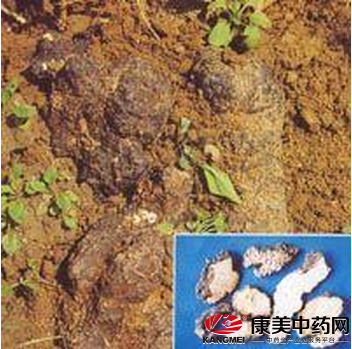
Polyporus umbellatus is a perennial species. The yield is not high within one or two years; it is only in the third or fourth year of cultivation that it enters the vigorous propagation period. During harvest, pay attention to the sclerotia in the surface soil layer. It can be harvested throughout the year, but summer and autumn are preferable. Those that are black and hard are called old sclerotia; these are the commercial Polyporus umbellatus, that is, first-generation and second-generation Polyporus umbellatus. Fresh and tender grayish-brown or yellow Polyporus umbellatus generally have soft sclerotia and can be used as seed sclerotia.
At harvest, remove the old and keep the young. Remove impurities from the harvested Polyporus umbellatus sclerotia, scrub and wash them clean, then dry them naturally in sunlight. After drying, they can be packed, transported and sold. Pack in gunny bags or bamboo baskets and store in a dry place.
Polyporus umbellatus with a glossy black outer skin, heavy weight, firm texture, and a white or yellow cross-section is considered superior.