Cinnamon is a treasure from head to toe, with high cultivation value
Cinnamon is the dried bark of the Lauraceae plant Cinnamomum cassia Presl, also known as Mugui, Jiangui and Yugui. It is a famous traditional Chinese medicinal herb, mostly stripped in autumn and dried in the shade. It mainly grows in tropical regions, and is cultivated in China, India, Laos, Vietnam and Indonesia, with Vietnamese Thanh Hoa cinnamon being the best. In China it is mainly distributed in Guangdong and Guangxi, Yunnan and Fujian, with the most in Guangdong and Guangxi. The cinnamon tree is a treasure from head to toe: its young fruit (cinnamon seeds), tender branches (cinnamon twigs) and bark (cinnamon bark) can all be used as medicinal herbs. Cinnamon bark is a precious Chinese medicine and seasoning, with the effects of warming the kidney and supplementing yang, and dispelling cold to relieve pain. Cinnamon oil distilled from cinnamon branches and leaves is a precious spice and a synthetic raw material for various organic spices, and can also be used medicinally. Today cinnamon oil is widely used in the food and beverage industry. Its wood is a fine material for furniture. Cinnamon has so many uses, so what are its cultivation methods and harvesting and processing methods?
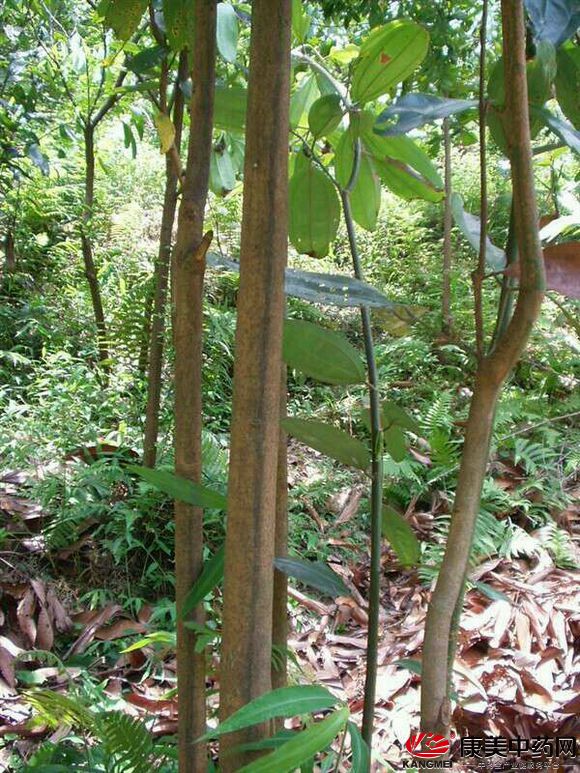
(1) Site selection and land preparation
The best choice is yellow soil that is deep, loose in texture and well drained. It should not be propagated and raised in soil with a high groundwater table or a large sand content. For land preparation, the whole area should be plowed and sun-dried; after the topsoil has been sun-bleached white, make beds 1.2 m wide with ditches 40 cm wide, break up the clods and level with a rake. For planting, hillside land should be chosen, because hillside land is mostly yellow soil, and the soil is loose and deep, which is good for the growth of deep-rooted plants.
(2) Planting methods
1. Seed collection and seed treatment
In February to March, when the peel of the cinnamon seeds turns purplish black, they can be harvested in batches. The harvested fresh fruit should be put in a water tank and washed to remove the peel and flesh, then taken out and dried until the surface moisture is gone, and then they can be sown. Seeds should not be exposed to the sun or stored for a long time. If buying from the market, choose fresh, plump ones with large fruit, wash and treat them immediately after buying, dry them and put them in the ground.
2. Sowing method
About 50 kg can be sown per mu, either by dibbling or broadcasting, with a seed spacing of about 6 cm. After sowing, cover the surface with a thin layer of soil, water it and then directly cover with fern grass.
3. Seedling management
Twenty days after sowing, when the seedlings have grown to 6-7 cm tall, the fern grass can be removed and a shade shed about 1.2 m high can be built. After 30 days, when the leaflets of the seedling buds are as big as a fingertip, potassium dihydrogen phosphate foliar fertilizer can be sprayed, and thereafter sprayed once every 15 days; it can also be sprayed together with insecticides and fungicides. After 80 days, when the seedlings have grown 5-6 leaflets, 50 kg of compound fertilizer can be applied per mu. After the winter solstice, when the seedlings have grown to 30-35 cm tall, the shed frame can be removed, and water and fertilizer controlled to sun-harden the seedlings, letting the leaf tips sun-harden to a mature waxy yellow, so as to ensure a relatively high survival rate when transplanted in February to March of the following year.
4. Planting and management
A plant spacing of 80-100 cm is suitable; after planting, water thoroughly. Thereafter, hoe weeds and apply fertilizer once each quarter. In the first three years, focus on applying nitrogen and phosphorus fertilizers to promote growth; in the fourth year, add potassium fertilizer. In the fifth year, when the tree has reached 3-4 m tall and about 10 cm in diameter, it can be harvested for the first time. After harvesting, new shoots will grow from the roots; keep 2-3 robust ones and prune the rest. Every winter, in addition to clearing weeds, it is also necessary to prune drooping side branches and diseased and pest-infested branches, so that the trunk is straight and thick, ensuring a bumper harvest the following year. Between December each year and March of the following year, in conjunction with the winter and spring harvest of cinnamon bark, cinnamon twigs and cinnamon leaves, the cut diseased and pest-infested branches and fallen branches and leaves should be removed from the cinnamon plot and burned in a centralized manner to clean the orchard.
(3)Pest and disease control
(1) Root rot: in the moldy rainy season, it is severe on the surface in poorly drained nurseries. Control methods: ① prevent waterlogging; ② promptly find diseased plants and pull them out and burn them, and disinfect the bed surface with quicklime.
(2) Cinnamon leaf brown spot: occurs in April to May, damaging new leaves; Bordeaux mixture can be sprayed.
(3) Cinnamon wood moth: one of the main pests of cinnamon. Control methods: ① during the larval hatching period, spray with 50% phosphamidon emulsifiable concentrate at 1000-1500 times dilution or 2.5% decamethrin at 4000 times dilution, once every 10 days, for a total of 2-3 sprays; ② dust with Beauveria bassiana for control; ③ in conjunction with pruning, cut off the infested branches.
(4) Leaf roller: the larvae, in summer and autumn, roll several leaves into a nest and hide inside, feeding on seedling leaves. Control method: spray with trichlorfon at 1000 times dilution or 80% dichlorvos emulsifiable concentrate at 1500 times dilution.
(5) Cinnamon brown longhorn beetle: the larvae damage the trunk. Control methods: ① in summer and autumn, insert a wire into the larval borehole in the trunk to stab the larvae to death, or plug cotton soaked in dichlorvos into the insect hole to kill them; ② in early April, when adults are found, carry out manual capture and killing.
(4) Harvesting and processing
The purpose of coppice management is to harvest leaves for oil distillation and to produce products such as Guitong and Guixin. After 3-5 years of afforestation, an average of 40-50 kg of cinnamon bark can be stripped per mu, and at the same time 1.5-1.7 kg of cinnamon leaf oil can be harvested each year. The best time for stripping cinnamon bark is late March, when the bark is easy to peel off and roots and shoots grow quickly.
The purpose of high-forest management is to cultivate cinnamon bark, cinnamon seeds and seeds. After afforestation, harvest and strip the cinnamon bark at 15-20 years. That harvested in February to March is called spring cinnamon and is of poor quality; in late June, a ring of bark can first be stripped from the base of the tree. This can both increase the accumulation of oil in the phloem and facilitate bark stripping.
After the cinnamon bark is harvested, it should be processed. The processing specifications are:
Quanbian cinnamon: strip bark from cinnamon trees over 10 years old, trim both ends evenly, clamp it in wooden concave-convex boards and sun-dry.
Bangui: clamp the cinnamon bark in a cinnamon clamp, sun-dry until 70-80% dry, take it out, stack it crosswise, press and dry, and it is done.
Guangui (Guitong): strip the trunk bark and thick branch bark of 5-6 year old young trees, air-dry for 1-2 days, roll into tube shapes and dry in the shade.