Growth habits and cultivation techniques of the Chinese medicinal herb Guan Yuzhu
Yuzhu is also known as Goudanggen, Weirui, Yushen and Weishen. Its rhizome is used as medicine and has functions such as nourishing yin, promoting body fluid and quenching thirst, moistening dryness and relieving restlessness. It is the preferred good medicine for treating yin damage from febrile disease, dry mouth and throat, and diabetes. Wild Yuzhu is distributed in most provinces in China. By region, the Yuzhu distributed in the three northeastern provinces and the Inner Mongolia region is called Guan Yuzhu.
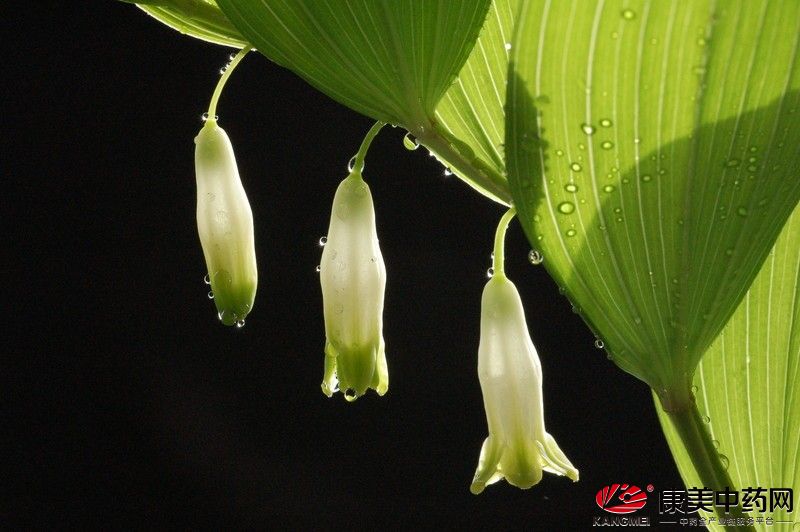
Guan Yuzhu has strong growth adaptability and does not have strict environmental requirements. It can be cultivated on barren slopes and in open fields. Interplanting it in orchards and using trees for shade gives even better results and a high land utilization rate. Vigorously developing Guan Yuzhu cultivation has very good social, economic and ecological benefits. Although Guan Yuzhu is a shade-loving and moisture-loving plant, after artificial domestication and breeding it is already very suitable for open-field cultivation. It does not need shade frames, has strong disease resistance, is easy to manage and requires little investment. From sowing to harvest, Guan Yuzhu generally needs 7 to 8 years.
Cultivation techniques for Guan Yuzhu:
1 Propagation of Guan Yuzhu
Guan Yuzhu cultivation and production can adopt two propagation methods: rhizome propagation and seed propagation. At present, if propagation materials are not in short supply in production, asexual propagation is mostly used, which has the characteristics of a short production cycle and quick results.
For rhizome propagation, transplanting is done in late March in spring and in late September in autumn. For seed propagation, sowing can be carried out in spring and autumn. In both cases, seedlings do not emerge in the same year because Guan Yuzhu seeds have the characteristic of deep dormancy. Whether sown in spring or autumn, the seeds all take an interval of one year to emerge completely.
2 Land selection and land preparation
For Guan Yuzhu seedling raising and production fields, choose mountain land or farmland with deep soil and rich humus. Fertile, loose and well-drained sandy loam is best. After selecting the land, apply 2,500 to 3,000 kg of decomposed farmyard manure per mu. First spread the manure evenly on the ground, then plow deeply 25 to 30 cm, harrow finely and level to make beds. Generally the bed width is 1.6 m, the operation path width is 30 to 40 cm, and the bed height is 15 to 30 cm. The bed length depends on the terrain, with drainage and ease of operation as the criteria.
3 Sowing and planting of Guan Yuzhu
Transverse bed drilling. On the prepared bed, open shallow furrows across the bed, with a furrow depth of about 3 cm and a row spacing of 10 cm. Sow the seeds evenly into the furrows, cover with loose soil 2 to 3 cm, with no need to press down. After raking level, cover the bed surface with conifer needles, weeds or rice straw to retain moisture. Sow about 10 kg per mu.
Broadcasting. When making the bed, first set aside loose covering soil for later use, then rake the bed surface level, spread the seeds evenly on the bed surface, cover the bed evenly with the reserved covering soil, and then use conifer needles, weeds or rice straw to retain moisture. Broadcasting uses about 15 kg of seed per mu.
Rhizome propagation. Select seed rhizomes. At autumn harvest, choose rhizomes that are plump, have many fibrous roots and have buds as seed rhizomes. The seed rhizomes are 3 to 7 cm long.
Planting. Before planting, reserve 15 cm on each side of the bed surface for sowing corn in spring for shade. On the bed, open furrows with a row spacing of 25 cm and a furrow depth of about 10 cm, with a plant spacing of 15 cm, then cover with soil and water. About 150 kg of planting material is needed per mu (667 sq m).
4 Field management for Guan Yuzhu cultivation
Management before seedling emergence. Check the bed surface covering. From after sowing to before seedling emergence, frequently check the bed surface covering. If any bare areas are found, cover them promptly to keep the bed soil constantly moist. Prevent drought and drain waterlogging. Frequently check the soil moisture status of the bed surface. If drought is found, replenish water promptly, and do a good job of drainage in the rainy season. Remove the covering when seedlings emerge. Remove the covering promptly when seedlings emerge, so as to avoid damaging young seedlings if removal is delayed. If pine needles are used as cover, a thin layer can be retained for long-term covering, which can keep the bed surface moist, prevent weeds from growing densely, and also eliminate the need for shallow hoeing.
Thinning and final spacing. According to emergence and seedling growth, if seedlings are found to be too dense, carry out appropriate thinning when the seedlings are 8 to 10 cm tall.
Cultivation and weeding. During seedling growth, do a good job of weeding, and pull weeds as soon as they appear. When the soil is dry, pull them by hand. After rain or when the soil is too wet, it is not suitable to pull weeds.
Topdressing. When sufficient base fertilizer has been applied, no topdressing is needed after one year of seedling raising. After two years of seedling raising, when the aboveground plants have withered and the soil freezes in late autumn and early winter, apply a layer of decomposed barnyard manure. After seedlings emerge in the third spring, small amounts of frequent watering can be used, and urea and superphosphate can also be applied at 15 kg each per mu. Thereafter, management is the same every year, and after 4 to 5 years of cultivation they can be replanted.
Irrigation. During seedling growth, the seedlings are small, the root system goes shallowly into the soil and is not tolerant of drought. If drought occurs, water promptly.
Other field management. Tall crops such as corn can be planted around the bed to provide shade for the seedlings. Before the rainy season arrives, dig drainage ditches around the seedling field, and do a good job of drainage in the rainy season so that water does not accumulate in the field. Every year after the young seedlings wither and before freezing, apply cold protection materials, covering with leaves, grass or manure soil.
5 Harvesting and processing of Guan Yuzhu
Harvesting can be done in both spring and autumn. At harvest, remove the stems and leaves, shake off the soil, remove the fibrous roots, wash clean and dry in the sun. Rub once every 6 hours of drying, repeating this until there is no hard skin inside the rhizome, and finally dry in the sun for medicinal use. The finished Guan Yuzhu is yellow and translucent, with a dry product yield of 300 kg per mu.