Key Cultivation Techniques and Pest and Disease Control Methods for Pseudostellaria heterophylla
Pseudostellaria heterophylla, also known as Tongshen, Siyeshen, Siyecai, and Mishen, is the dried tuberous root of Pseudostellaria heterophylla (Miq.) Pax ex Pax et Hoffm., a plant in the carnation family (Caryophyllaceae). Its taste is sweet and slightly bitter, and its nature is neutral. It enters the spleen and lung meridians. It has the functions of tonifying qi and strengthening the spleen, promoting fluid production and moistening the lungs. It is used for conditions such as spleen deficiency with bodily fatigue, poor appetite, weakness after illness, insufficiency of qi and yin, spontaneous sweating and thirst, and dry cough due to lung dryness. It is the main raw material for Chinese patent medicines such as Jianwei Xiaoshi tablets, and is mainly produced in Fujian, Shandong, Anhui, Jiangsu and other provinces. In recent years, with the improvement of people's living standards and health awareness, the demand for Pseudostellaria heterophylla has continued to increase, and domestic and international market prices have continued to rise, prompting a rapid expansion of cultivation area. Before planting Pseudostellaria heterophylla, we must clearly understand its cultivation techniques and how to prevent and control pests and diseases, so as to grow high-quality Pseudostellaria heterophylla with abundant yield. So, what are the key cultivation techniques for Pseudostellaria heterophylla? And how should pests and diseases be prevented and controlled?
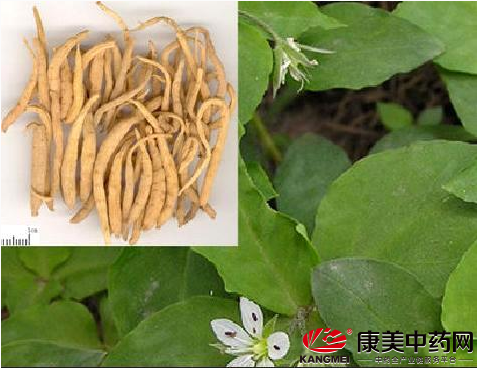
The original plant of Pseudostellaria heterophylla
Cultivation Techniques
I. Site Selection and Land Preparation
Select hilly sloping land with a superior surrounding ecological environment or flat land with relatively high terrain. The soil should be loose, fertile, well-drained, and rich in humus sandy loam. Implement crop rotation and avoid continuous cropping. The preceding crop should preferably be a grass-family crop. The field should be plowed in advance to allow the soil to mature, and then beds should be made. The bed width is 1.3-1.5 m, the bed height is 20 cm, the drainage ditch width is 30 cm, and the bed surface is shaped like a turtle back. For plots with low terrain and poor drainage, high beds should be used; otherwise, flat beds should be used, which is conducive to watering. 15 d before sowing, formalin at 100-150 times dilution or 50% phoxim emulsifiable concentrate at 7.5 kg/hm2 formulated into an 800-times solution can be used for soil disinfection to control underground pests. Make an isolation belt of about 9 m, and the surrounding environment must not contain hosts of mosaic virus such as tobacco, tomato, cowpea, potato, green vegetables, Chinese cabbage and other crops, so as to cut off the transmission route.
II. Planting Methods
1. Tuberous Root Propagation
Pseudostellaria heterophylla is mostly propagated by tuberous roots. Before planting, dig out the seedlings from the seed field kept over summer. During harvesting, select seeds while collecting. Use tuberous roots with complete buds, plump tubers, and no damage or pests and diseases as seedlings; process the others as commercial products. For seedlings dug back and stored at home, also select those with complete buds, plump and robust tubers, and no diseases or pests as seedlings.
2. Cutting Propagation
During vigorous growth, cut aboveground branches 5-6 cm long, each with 2-3 internodes, insert all the internodes into the ground, with the top leaves exposed above the ground; roots form 7-10 d after cutting.
3. Seed Propagation
The capsules of Pseudostellaria heterophylla crack easily, and the seeds are not easy to collect. Therefore, naturally scattered seeds are used for seedling raising in the original place. After harvesting the roots in the original cultivation field, rake the ground level, apply fertilizer once, plant a crop of radish or Chinese cabbage, and after harvesting, rake level again. In the second spring, the seeds that have fallen to the ground germinate and emerge. When 3-4 leaves have grown, they can be transplanted or used as planting material in autumn. With seed propagation, only 1 conical root is formed in the current year.
4. Transplanting and Field Planting
On the prepared bed surface, open flat-bottomed furrows lengthwise along the bed, 5-6 cm deep. Place the seed roots obliquely on one side of the furrow, with the bud positions uniform and 6 cm from the soil surface, commonly known as "even at the top, uneven at the bottom." Open a new furrow at a row spacing of 12-15 cm, cover the soil dug out onto the furrow where the seed roots have been placed, then place seeds in the new furrow, and plant in sequence. Finally, shape the bed surface into a turtle-back form. Use 30-40 kg of seed roots per 667 m2. This method is called oblique planting or vertical planting. The seed roots can also be placed flat in the furrow, end to end, with the same row spacing, and covered with 6 cm of soil; this is called flat planting or lying planting. The soil covering thickness for root propagation is very important. If too deep, the roots are large, few in number, and the yield is low; if too shallow, the roots are small and the quality is poor; 5-6 cm is appropriate. This method gives high yield and is mostly used in production.
III. Field Management
1. Weeding
After the seedlings emerge, shallow hoe and loosen the soil once; at other times, pull weeds. After the Beginning of Summer, when the rows have closed, only pull large weeds, and do not hoe or loosen the soil, so as to avoid damaging the roots and affecting growth.
2. Topdressing
Determine the number of topdressings according to plant growth conditions. Pour diluted human urine and excrement mixed with water (1:5) or broadcast compound fertilizer before rain (50 kg/667 m2) to promote growth.
3. Earthing Up
After emergence in early spring, while cleaning the bed ditches, scatter soil onto the bed surface, or use borrowed soil for earthing up. The earthing thickness should be less than 1.5 cm to promote root development.
4. Drainage and Irrigation
Pseudostellaria heterophylla fears waterlogging. Once water accumulates, rot easily occurs, so after rain the bed ditches must drain smoothly. In dry seasons with little rain, attention should be paid to irrigation to keep the soil moist, which is beneficial to germination and plant growth. Prevent trampling that causes foot-pit water accumulation, so as to avoid root rot and death.
Pest and Disease Control
1. Diseases
Root rot:This disease easily occurs in hot, humid, stuffy weather.Control methods:Choose well-drained and ventilated plots to reduce the occurrence of this disease; irrigate diseased plants with 50% carbendazim or thiophanate-methyl at 1000 times dilution.
Root rot of Pseudostellaria heterophylla
Leaf spot:This disease easily occurs in rainy spring, and in severe cases plants wither and die.Control methods:In the early stage of the disease, spray with Bordeaux mixture at 1:1:100 for control, or spray with 65% amobam wettable powder at 800 times dilution, once every 7-10 d, for 2-3 consecutive sprays.