Jujube is seen everywhere, what are the cultivation methods?
Jujube is a relatively commonly used traditional Chinese medicinal material, the dried ripe fruit of the Rhamnaceae plant jujube Ziziphus jujuba Mill. The fruit is harvested in autumn when ripe and dried in the sun. Its taste is sweet; its nature is warm; it enters the spleen, stomach and heart meridians; it has the effects of tonifying the middle and benefiting qi, nourishing blood and calming the mind, and is mainly used for spleen deficiency with little food intake, fatigue and loose stools, women's visceral agitation and other conditions.
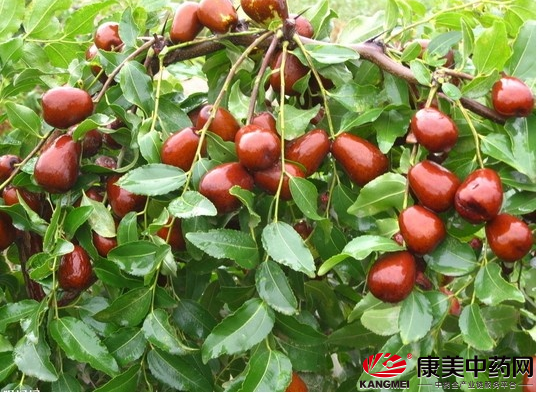
Jujube originated in China, and has a cultivation history of more than four thousand years in China. Since ancient times it has been listed as one of the “five fruits” (peach, plum, apricot, plum, jujube). Jujube is a temperate crop with strong adaptability, drought tolerance, barren tolerance and strong disaster resistance. Because jujube comes from sour jujube, it does not demand much from soil conditions. Whether in mountains, plains, hills or barren beaches, its adaptability to natural conditions is rare among fruit trees. So, how is jujube cultivated?
(1) Site selection and land preparation
Jujube trees are not strict about soil, but when developing high-quality jujube production in large contiguous areas, sandy soil or sandy loam soil that is relatively fertile and convenient for drainage and irrigation is required for planting. The orchard site should be more than 100m away from industrial and mining enterprises and major traffic roads, and the content of harmful heavy metal elements in the soil and the quality of irrigation water should meet relevant standards.
(2) Planting methods
1. Planting techniques
(1) Jujube trees are planted in autumn after leaf fall and before the soil freezes, or in spring after the soil freezes and before bud break. Strong selected seedlings should be used. Before planting, the overall planning of the orchard should be done well, and the arrangement of supporting facilities should be reasonable and orderly. For fresh-eating varieties of jujube, dwarfed close planting and intensive cultivation should be adopted, generally with a plant-row spacing of 2~3m×4m, and 625~1245 plants/hm2 is appropriate. Plant densely first and thin later, in order to achieve high yield in the early stage.
(2) When planting, dig a 1m deep tree pit, use 20-30kg/plant of farmyard manure, mix the farmyard manure evenly with the topsoil dug out, then backfill it at 50-60cm in the tree pit, and then fill in 10cm of soil as an isolation layer. When planting, water thoroughly, and after the water seeps down, straighten the seedling and cover the soil to preserve moisture.
(3) After planting, head the trunk at a height of 1m. If there are secondary branches below it, the first secondary branch below the cut should be removed, and the remaining secondary branches should be shortened or removed according to their growth vigor, leaving 1-2 nodes.
2. Fertilizer and water management
Although jujube is tolerant of barren soil and bears fruit early, without good water and fertilizer conditions it will be slow to enter the period of heavy fruiting, or will show flowers but no fruit. Jujube trees have a relatively high fertilizer requirement, and are especially sensitive to nitrogen fertilizer. For normally fruiting trees in full fruit period, the fertilizer amount is calculated according to yield. For every 100kg of yield, apply 1.6-2kg of pure nitrogen, 0.9~1.2kg of phosphorus pentoxide, and 1.3~1.6kg of potassium oxide throughout the year. Long-acting base fertilizer should be the main part (it can account for more than 1/3 of the annual fertilizer amount). Topdressing is applied before budding (mainly nitrogen fertilizer) and during the young fruit stage (mainly phosphorus and potassium fertilizer), ensuring that the annual growth of vegetative branches reaches 50~80cm. In addition, before flowering, during flowering and during the young fruit stage, 0.3% urea, 0.2%~0.5% borax and 2% superphosphate, and 5% plant ash extract can be used for foliar topdressing. Before germination, at the early flowering stage, and during the jujube fruit swelling stage, topdress with ternary compound fertilizer. At each major phenological stage, irrigate according to soil dryness and wetness and topdressing. Where water sources are scarce, loosen the soil and cover with grass (or film) on the tree plate or tree row before the dry season to reduce drought damage
3. Training and pruning
(1) For dwarfed close planting trees, the small-crown sparse-layer shape or the central-leader shape is most suitable. The former trains two layers of scaffold branches, while the latter trains several lateral branches on the trunk without layering. When training scaffold branches, it is necessary to comprehensively use methods such as heading, branch bending, bud notching, pinching and branch thinning, so that the scaffold branches are properly positioned, grow robustly, have moderate vigor and are moderately dense. After shaping, the whole tree canopy is full, and the tree height is controlled at about 3m. In places with weak trunk tendency and relatively barren soil, the natural open-center shape can be used. The tree shape in the whole orchard should be basically consistent.
(2) Pruning should be light in the young tree stage, making full use of jujube heads and permanent secondary branches to form a large number of jujube spurs, which produce bearing branches and bear fruit each year. After the full fruit period, it is necessary to timely control and renew the base branches, and even retract some scaffold branches, to prevent the tips from drooping. In addition to winter pruning, during the growing season it is also necessary to do well in bud removal and branch thinning, as well as pinching and directing vigorous jujube heads. High-yield trees require an average of more than 80-100 jujube spurs per cubic meter of canopy space.
4. Measures to increase fruit set rate
Jujube has a large number of flowers, and the natural fruit set rate is mostly below 1%-2% of the total flower number. The causes of bud drop, flower drop and fruit drop include insufficient tree nutrition and abnormal climate during the flowering period (such as dry hot wind or daily average temperature<21℃)两方面。保花保果措施有:①在树势健壮基础上,于盛花初期对主干进行环剥,剥皮宽度约为树干径粗1/8~1/10,剥口在 30~40天内愈合。②旺长树在结果枝上长有 7~9 叶时喷0.1%~0.2%多效唑溶液(15%可湿性粉剂),以调节全树养分分配,防止结果枝的2次生长。③花期放蜂,促进授粉机会。遇干旱可灌水或对树冠喷水,或用10~15mg/ kg的赤霉素溶液,或5~10mg/ kg的2, 4-D溶液喷花。④弱树以增施肥水、提高叶片功能、增加树体营养积累为本。大枣平均在每个结果树上着0.4~0.5个果实,即可满足丰产要求(小枣数量可多些)。
(3) Harvesting and processing
Harvesting:Jujube is harvested in autumn when the fruit is ripe.
Processing:Take the raw material, remove impurities, and dry in the sun. Or bake until the skin is soft, then dry in the sun. Or first boil once in water, so that the fruit flesh is soft while the skin has not shrunk, then take it out and dry in the sun.