Tussilago Flower Cultivation Methods: How to Grow Good Flowers?
Tussilago flower, also known as winter flower, jiujiu flower, or kuandong, is the unopened flower bud of the Asteraceae plant Tussilago farfara L., which is dried for medicinal use. It has effects such as relieving cough and reducing phlegm. It treats new and chronic cough, wheezing, blood-streaked sputum, pulmonary tuberculosis, asthma, and chronic bronchitis. It is mainly distributed in North China, Northwest China, and the provinces of Sichuan, Hubei, and Henan, mostly cultivated. It is mainly produced in Xingxian and Jingle counties of Shanxi Province, and is also found in Henan, Shandong, and Hebei provinces.
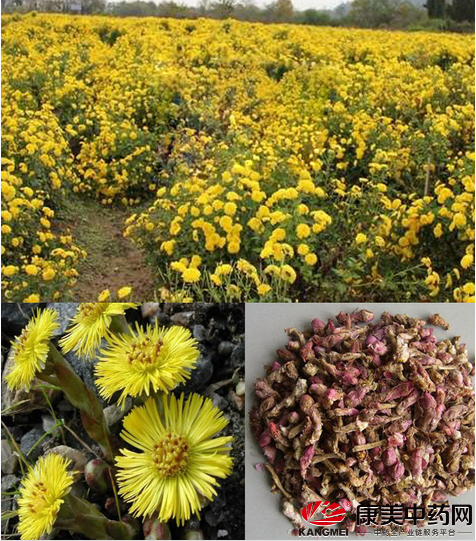
[Plant Morphology] Perennial herb. Plant height 10-15 cm. Basal leaves, with long petioles; leaf blade round-cordate, apex obtuse-acute or nearly rounded, with wavy sparse serrations, dark green above, smooth and hairless, densely covered with white down on the underside. Flowers open before leaves emerge. Capitulum solitary, terminal; flower stems number from several to several dozen, covered with down; more than 10 bracts, alternate on the flower stem; involucre in 1-2 layers; marginal flowers are female ligulate florets, central flowers are male tubular florets. Achene. Flowering period February to March.
[Biological Characteristics] Tussilago flower is highly resistant to severe cold, afraid of heat, afraid of drought, and also afraid of waterlogging. It is suitable for a cool climate, well-ventilated, semi-shaded and semi-sunny environment. It does not like strong direct sunlight. When the temperature exceeds 36°C, the leaves tend to collapse or the plant dies. It grows well in loose, moist, fertile sandy loam rich in humus. Heavy clay, waterlogged low-lying land, and continuous cropping land are not suitable for planting. Light saline-alkali land can also be planted.
[Cultivation Techniques]
1. Land Selection and Preparation:It is advisable to choose sandy loam that is loose, fertile, moist, well-drained, and equipped with irrigation and drainage conditions for planting. In Shandong, the soil commonly known as "night-moist soil" is the best choice. Avoid continuous cropping to prevent severe disease. When preparing the land, apply about 4000 kg of barnyard manure or farmyard manure per mu, break it up finely and plow it into the soil. Plow to a depth of about 20 cm, harrow finely, level, and make beds in preparation for planting.
2. Propagation Methods:Propagate with underground rhizomes. When harvesting flowers in winter, store the rhizomes in sand and soil, keeping some rhizomes as seed stock. In mid-to-late March of the following year, or for winter planting, preferably in early-to-mid October to early November; for spring planting, select from stored rhizomes those that are free of pest and disease damage, thick and strong, and yellow-white as seed stock. Rhizomes that are too tender and slender, as well as rhizome tips, are not suitable as seed stock. Winter planting uses the method of planting immediately after digging. Whether spring planting or winter planting, cut the rhizomes into 7-8 cm segments, each segment retaining 2-3 nodes, and cover them well with moist sandy soil to prevent air-drying; they can be taken as needed for planting.
Planting is often done by row planting or hole planting. For hole planting, open furrows at a row spacing of 30-35 cm, furrow depth 7-10 cm, with hole spacing of 23-27 cm. In each hole, arrange in a triangle, place 3 rhizome segments, lay them flat in the furrow, cover with 4 cm of soil, and press firm. For row planting, use a row spacing of 27 cm, furrow depth 7-10 cm, place one rhizome segment every 10-13 cm, cover with soil and press firm. When temperature and humidity are suitable, seedlings generally emerge in 15-20 days. Use about 35 kg of rhizome seed stock per mu. After planting, appropriately interplant corn for shading to benefit the growth of Tussilago flower.
3. Field Management
(1) Watering and Loosening Soil: Before seedlings emerge, if the soil is dry, water appropriately. When dryness and moisture are suitable, loosen the surface soil to help preserve moisture and promote seedling emergence.
After seedlings emerge, loosening the soil should be shallow to avoid damaging the roots. After all seedlings have emerged, generally water less to harden the seedlings. If it is too dry and the leaves collapse, water appropriately. Loosen the soil after rain or watering to keep the soil loose and free of weeds. During the rainy season, pay attention to timely drainage to prevent waterlogging and prevent water accumulation in the field. Especially after rain in the hot summer, well water should be applied promptly to lower the temperature and prevent the plants from being scalded to death.
(2) Thinning Leaves and Ventilation: From June to July, temperatures rise. Tussilago leaves expand very quickly. At this time, scissors can be used to cut off yellowed, withered, and overly dense overlapping leaves from the base of the petiole to improve ventilation and light penetration. When cutting leaves, never tear them by hand. If overly dense leaves grow later, they should still be thinned. In early-to-mid September, old leaves can be cut off, leaving only 3-4 heart leaves.
(3) Topdressing: Tussilago flower likes fertilizer, but no topdressing is applied in the early stages of spring and summer to avoid excessive vegetative growth of stems and leaves. After "Start of Autumn," in early August, topdressing can be carried out. Apply about 1500 kg of barnyard manure per mu and about 50 kg of phosphorus and potassium fertilizer to promote flower bud formation. Spread the fertilizer beside the plants, then earth up to cover the fertilizer.
(4) Earthing Up: To prevent flower buds from being exposed above the ground, earth up frequently. The first earthing up is around "White Dew," before flower buds have formed, in early-to-mid August, carried out together with topdressing and covering the fertilizer with soil, preferably without covering the leaves. The second earthing up is in early October, taking soil from between the rows and mounding it on the main stem, without covering the leaves. The third earthing up is in early November, mounding soil to completely cover the entire plant.
(5) Intercropping for Shade: Tussilago flower likes cool shade. In an east-west oriented Tussilago field, one row of corn can be planted every two rows to provide shade for Tussilago flower, achieving a double harvest of grain and medicine.
4. Pest and Disease Control
(1) Atrophic Leaf Blight: The pathogen is a type of imperfect fungus, which damages leaves. Diseased leaves show irregular dark brown spots, causing the leaves to wither and dry up. Control methods: Remove diseased leaves and burn them; spray with 1:1:120 Bordeaux mixture or 65% wettable zineb 500-fold solution, once every 10 days, for 3 consecutive sprays.
(2) Brown Spot: The pathogen is also a type of imperfect fungus. This disease is prone to occur after summer rain followed by sudden clearing, with excessive water accumulation. It damages leaves. The spots on diseased leaves are round, 5-20 mm in diameter. The center is brown, and the edge is purplish-red. Control methods: Pay attention to timely drainage; in the early stage of the disease, spray equal-strength Bordeaux mixture or 50% thiophanate-methyl wettable powder 1000-fold solution.
(3) Silver-marked noctuid: The larvae damage the plants. When they occur, spray 2.5% trichlorfon powder.
(4) Aphids: When they occur, spray 40% dimethoate emulsion 2000-fold solution.
(5) Weevils and ground beetles: When they damage seedlings, broadcast trichlorfon poison bait to kill them.
[Harvesting and Processing]
Due to different climates in various regions, the harvesting time of Tussilago flowers varies. Generally, between "Cold Dew" and "Start of Winter," that is, from October to late November to December, harvest before the ground freezes and before flower buds emerge from the soil. Dig out the whole plant, remove the soil, pick off the flower buds, and clean off the soil and flower stems. The picked flower buds should be placed in baskets, and never in cloth bags, to prevent compression and rubbing. If there is soil on the flower buds, never wash them with water or rub them with hands, so as to avoid blackening and affecting quality. Replant the old clump rhizomes after the flower buds have been picked back into the ground, cover with soil, and in the following spring a second crop of flower buds can be harvested. Spread the picked flower buds thinly on a mat and place them in a ventilated place to dry. Never expose them to the sun or turn them by hand, which would cause the flower buds to change color, blacken, or mold, affecting quality. When half-dry, sift gently to remove all soil and flower stems. Then dry until completely dry for medicinal use. They can also be dried at 40-50°C. Those dried by heat have bright color, good quality, and a high dry yield. The yield per mu is 60-70 kg of dried flower buds. Generally, 4 kg of fresh flowers can be dried into 1 kg of dry product.