What is the plant on the flag of Hong Kong, China actually called: Bauhinia blakeana or Bauhinia purpurea?
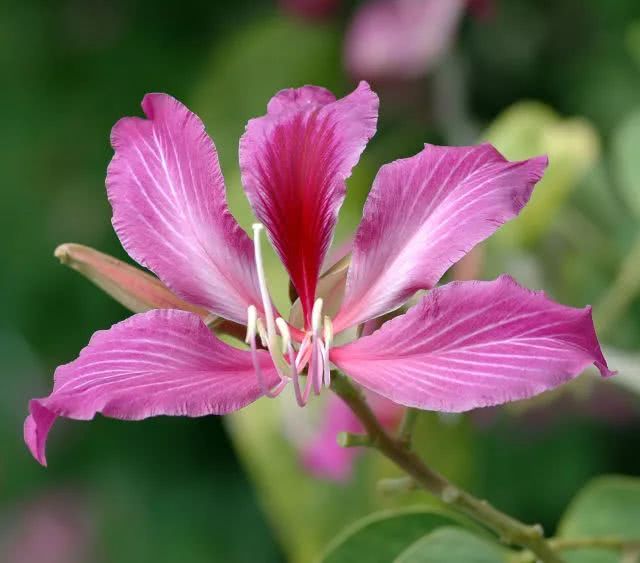
Every year as July 1 approaches, "bauhinia" comes into people's view. Bauhinia × blakeana belongs to the genus Bauhinia in the Fabaceae family; the genus name commemorates the Swiss-French botanist brothers Bauhin, while the Chinese genus name "Bauhinia genus" describes its nearly roundleaf tipbilobedin the shape of a goat's hoof。
Bauhinia × blakeana, also known as Hong Kong orchid tree. Image: Ianare / wikipedia
In China, there are many species of the genus Bauhinia commonly used for ornamental cultivation. In the south, besides Bauhinia × blakeana, B. purpurea and B. variegata are also commonly used for street greening. The names recorded for these three in the Flora of China differ from the translated names accepted in Hong Kong, China and Taiwan, China. For example,what people in Hong Kong, China call "bauhinia" corresponds to what the mainland calls "honghua yangtijia" (Bauhinia purpurea), while what Hong Kong, China calls "honghua yangtijia" refers to what the mainland calls "yangtijia"。
For ease of understanding, this article will uniformly introduce them using the Hong Kong, China version of the names.
The trick to telling them apart: look at the flowers
Bauhinia purpurea (B. p.)is a tree or erect shrub, widely cultivated for ornamental purposes in subtropical regions around the world. The species epithet "purpurea" means "purplish red", describing its more or less purplish-red petals.
The slightly purplish-red flowers of Bauhinia purpurea B. p. (All right, I know some people want to complain that "slightly" is really pushing it, but Bauhinia purpurea really does have very pale color...). Image: Dinesh Valke / flickr
Among the three Bauhinia species,Bauhinia purpurea has the palest flower color, its petals have obvious claw-like stalks, and most of its stamens are reducedleaving only three fertile stamens(the other two both have five), making it the easiest of the three to distinguish.
Bauhinia variegata B. v.andBauhinia × blakeana B. × b.are a bit trickier to tell apart.
Bauhinia × blakeanagenerallydoes not set fruit after flowering, and among its five fertilestamens, two are noticeably shorter, and its raceme is extremely compact and short. But these three features are only so reliable, because: looking at fruit, you might also come across a B. variegata that has not yet entered its fruiting period; looking at stamens, B. variegata sometimes also has the exception of two slightly shorter stamens; looking at the inflorescence, when it is not blooming densely enough, you really cannot tell.
Bauhinia × blakeana, with three long and two short fertile stamens and a compact overall inflorescence. Image: Pauk / flickr
The petal features, however, are relatively obvious.Bauhinia variegatathe single petal nearest the axis in the centeris broad, and on it there are alsovivid purple veins mixed with yellow-green markingsthe species epithet "variegata" (meaning mottled) describes exactly this feature.
Bauhinia variegata, with five fertile stamens of roughly equal length and a broad, marked petal nearest the axis in the center. Image: Krzysztof Ziarnek, Kenraiz / wiki commons
WhileBauhinia × blakeanathe petal nearest the axis in the center is dark purplish red from the middle to the base,with no markings(the species epithet "blakeana" commemorates Sir Henry Blake, the 12th Governor of Hong Kong, China, and his wife, who loved botanical research, and has nothing to do with its features).
From left to right: Bauhinia purpurea B. p., generally pale in color, with long petal stalks and three fertile stamens; Bauhinia variegata B. v., with a broad, mottled petal nearest the axis in the center (generally also paler in color); Bauhinia × blakeana B. × b., with the petal nearest the axis in the center dark purplish red at the middle and below, and two noticeably shorter stamens. Image: ArcherEmiya; australianseed.com; wikipedia
The design on the flag of Hong Kong, China abstracts the five stamens and five petals of Bauhinia × blakeana.
So, when does it bloom?
What? You ask how to tell them apart when they are not blooming?
Can't we just obediently wait for them to bloom...
A tree full of Bauhinia × blakeana. Image: J.M.Garg / wikipedia
Bauhinia purpurea B. p. generally blooms inautumn and winter; while Bauhinia variegata B. v. and Bauhinia × blakeana B. × b. bothmay bloom at any time throughout the year, with an extremely long flowering period, usually peaking in late winter and early spring. At that time, the scene of a tree of purple clouds covering green is truly spectacular.
Especially when a whole row of Bauhinia × blakeana is in bloom. Image: TreeWorld Wholesale / flickr
Why do they look so alike?
Actually, the similarity of flowers within the genus Bauhinia is not very high; within the genus, flower shapes range from radial symmetry to bilateral symmetry, and there is also a rich variety of flower colors. So why are these three Bauhinia species so similar to one another?
The leaves of Bauhinia × blakeana; the leaves of plants in the genus Bauhinia all resemble goat hoofprints. Image: Mokkie / wiki commons
Because,Bauhinia × blakeana is anatural hybridof Bauhinia variegata and Bauhinia purpurea (B. v. × p. "Blakeana"). Due to reproductive isolation, the pollen of Bauhinia × blakeana, as a hybrid offspring, is sterile and cannot complete fertilization, which explains why it does not set fruit after flowering.
Beautiful as it is, Bauhinia × blakeana "flowers but does not fruit". Image: Dinesh Valke / flickr
Bauhinia purpurea, by contrast, can set fruit normally, and the shape of the fruit nicely preserves the characteristics of the Fabaceae family:the legume, a type of fruit developed from a single-carpel ovary (specifically, it belongs to the dehiscent fruits among dry fruits among simple fruits). All kinds of bean pods, whether flat or swollen, whether segmented or not, however many beans are inside, and whether they split open when mature, all belong to this type of fruit.
This article is from the 2015 Species Calendar, by Species Calendar author @ArcherEmiya.
All the fun is here
Let us help you learn a little more about plants
Calendar Lady's avatar today
Fabaceae Soybean