How to grow Huaimi (Sophora japonica flower buds)? Key points of planting techniques and introduction to its effects
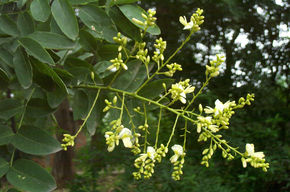
Huaimi, also known as Huaihua, Huaihuami, Baihuai and Huaizi, is the dried flower and flower bud of the leguminous plant Sophora japonica L. (Japanese pagoda tree). It is harvested in summer when the flowers open or the flower buds form, dried immediately, and the branches, stems and impurities are removed. The former is customarily called “Huaihua” and the latter is customarily called “Huaimi”. It is bitter in nature and slightly cold; it enters the Liver and Large Intestine meridians, and has the effects of cooling blood and stopping bleeding, clearing the liver and purging fire. It is mainly used for bloody stool, hemorrhoidal bleeding, bloody dysentery, abnormal uterine bleeding, vomiting blood, nosebleed, red eyes due to liver heat, headache and dizziness, etc. It is native to China and is now widely cultivated in all provinces and regions of the north and south, and is especially common in North China and the Loess Plateau region. It is also distributed in Japan and Vietnam, grows wild along the Korean border, and has been introduced and planted in countries in Europe and the Americas. So, how is Huaimi grown? The following is an introduction to Huaimi planting methods:
(1) Site selection and land preparation
The seedling-raising land should be relatively flat, with good drainage and irrigation conditions, fertile humus-rich soil, and deep loam or sandy loam.
(2) Planting methods
1. Seed collection and seed treatment
Propagation is by sowing. Seeds can be collected from October through winter, choosing trees that are more than 30 years old, robust in growth and free of pests and diseases. After collection, soak them in water, rub off the fruit skin, wash clean and dry in the shade to obtain clean seeds. In early March, soak them in 80°C water for 5-6 h, take them out, mix them evenly with twice their volume of sand, spread them flat indoors to a thickness of 20-25 cm, sprinkle some wet sand on top and cover tightly to avoid exposing the seeds, then cover with a layer of plastic film to retain moisture and warmth and promote seed germination, and turn them frequently so that the temperature and moisture of the upper and lower layers of seeds are consistent and germination is uniform. From late March to early April, sow once 1/3 of the seeds have cracked open.
2. Sowing method
Generally, field ridge sowing is used, with ridges made at a row spacing of 50-65 cm. When sowing, open a shallow furrow in the ridge soil, with a furrow depth of 7 cm and a sowing width of about 10 cm for drilling. After sowing, apply base fertilizer, then cover with 5 cm of soil and press firm.
3. Seedling stage management
After sowing, take care to keep the soil moist, and at the seedling stage take care to prevent damage by seed maggots. After the seedlings emerge completely, thin them 2-3 times in April-May, and set the final spacing at 10-15 cm between plants; from May to August, remove weeds as needed to keep the nursery clean, and in the rainy season take care to drain water and prevent waterlogging. After the seedlings shed their leaves and before the ground freezes, dig up the seedlings and grade them, and heel them in in trenches to overwinter, in preparation for transplanting the following year.
4. Planting and management
After the soil thaws the following spring, transplant the 1-year-old seedlings at a row spacing of 70×40 cm, and carry out management such as fertilizing and watering. Usually after 2 years of cultivation, in the third year before budding, select large seedlings 1 m tall for final planting; small seedlings that do not meet the standard are left to be cultivated for another year and planted in the fourth year. Sophora japonica is mostly used as a greening tree species around homes, roads, villages and water, and in various parts of North China it is cultivated as a courtyard tree, street tree and environmental protection forest belt, with a planting spacing of 4-5 m. Before planting, dig a pit, mix the excavated pit soil evenly with base fertilizer and fill it back into the pit; when planting the tree, the backfilled soil should be tamped firm, water thoroughly, and after the water seeps down, level the flooded soil.
(3) Pest and disease control
(1) Canker disease: occurs at the seedling stage or after transplanting when there is drought, and damages branches and trunks. Control methods: ① strengthen management, apply sufficient water and fertilizer, and enhance disease resistance; ② mix lime:sulfur:salt:water at 5:1.5:2.36 and apply it to the trunk; ③ for seriously diseased seedlings, cut back the trunk in time and regrow the trunk.
(2) Sophora geometrid: damages leaves and mostly occurs during the period of luxuriant foliage. Control method: spray with deltamethrin 1000-fold solution or 50% phoxim emulsion 1000-2000-fold solution.
(3) Aphids: generally occur in late spring and early summer, damaging tender shoots, tender leaves and flower buds, with the peak period in July-August. Control method: spray with 2.5% deltamethrin emulsion 3000-5000-fold solution or 40% omethoate 800-fold solution.
(4) Harvesting and processing
Harvest in summer when the flower buds form, dry in time, and remove branches, stems and impurities to obtain medicinal Huaimi. After processing and drying, Huaimi is oval or elliptical, 2-6 mm long and about 2 mm in diameter. In case of cloudy and rainy days, it can be dried by baking or by heated kang, with the baking temperature at about 40°C. The fruit matures in autumn; after harvesting, remove impurities and process and dry it to obtain Huaijiao (Sophora japonica fruit).