What are the planting methods and precautions for the Chinese medicinal herb Salvia miltiorrhiza?
Salvia miltiorrhiza is the dried root and rhizome of the plant Salvia miltiorrhiza of the Lamiaceae family. It has the effects of promoting blood circulation and removing blood stasis, unblocking meridians and relieving pain, clearing the heart and relieving restlessness, and cooling the blood and dispersing abscesses. Its uses are very extensive, and it is often used to treat chest impediment and heart pain, epigastric, abdominal and hypochondriac pain, abdominal masses and accumulations, painful heat impediment, heart vexation and insomnia, irregular menstruation, dysmenorrhea and amenorrhea, and sores with swelling and pain. Since Salvia miltiorrhiza has such wide uses, what are its planting methods? And what should be noted?
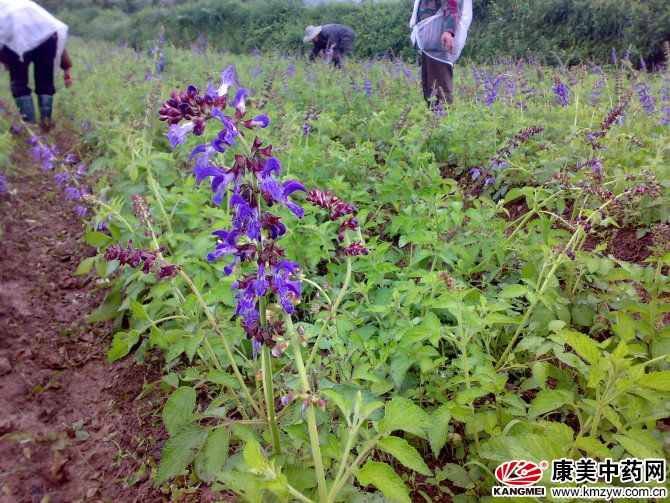
Key points to note when planting Salvia miltiorrhiza:
Salvia miltiorrhiza prefers warmth and moisture, tolerates cold but fears waterlogging, and has strong adaptability. Except for land with excessively heavy clay soil or low-lying waterlogged areas, it can generally be planted on ordinary land. It is best to choose land with deep, fertile, loose soil and good drainage for planting. When preparing the land, plow deeply, break up the soil, and make beds.
Salvia miltiorrhiza is mainly propagated by root division. Thick, strong new roots can be selected as seed material, and the root strips cut into 5 cm long root segments and planted between November and December. When planting, they should be upright, and never upside down; after planting, cover with 3 cm of soil. The root strips can also be placed horizontally in the sowing furrow and covered with 5 cm of soil, with 25 cm row spacing and 20 cm plant spacing. Seed propagation can also be used, and sowing must be done in the season with abundant rainfall in the same year the seeds are collected; after sowing, cover with grass and frequently water to keep moist, and seedlings will emerge after 7 days; transplant after the seedlings are strong.
When planting Salvia miltiorrhiza, as much base fertilizer as possible should be applied, and fertilizer should also be applied several times during the growing period. Timely cultivation and weeding should be carried out, and attention should be paid to opening drainage furrows and removing flower stalks in stages. Except for plants retained for seed, the inflorescences should be cut off in several stages during the flowering period to benefit root growth.
The pests and diseases that need to be guarded against when planting Salvia miltiorrhiza are:
(1) Leaf spot disease: during the onset period, spray with 1:1:150 Bordeaux mixture.
(2) Root rot: the preventive method is to choose plots with higher terrain and good drainage for planting. During the rainy season, dredge ditches in time so that no water accumulates. During the onset period, drench the roots with a 1000-fold dilution of 50% carbendazim powder. Leaf spot disease: during the onset period, spray with 1:1:150 Bordeaux mixture.
(3) White grubs: generally harmful in autumn; a 1000-1500-fold dilution of 90% trichlorfon crystals can be poured onto the roots, or they can be caught by hand.
(4) Root-knot nematode disease: the main control method is to practice crop rotation, avoid continuous cropping, and avoid continuous cropping with crops susceptible to this disease; retain seeds and raise seedlings in disease-free plots. After one growing season, Salvia miltiorrhiza can be harvested from late November to the end of December. At harvest, dig up the whole plant (be careful not to break the roots), shake off the soil, cut off the root strips, discard the rhizome crown, and then sun-dry or oven-dry. The dug fresh roots should be dried as soon as possible to prevent freezing damage and rot.
(5) Cutworms: they can be caught in the early morning, or 100 grams of 90% trichlorfon crystals and 5 kg of roasted rapeseed cake can be made into poison bait per mu and scattered in the field to trap and kill them.