Dendrobium officinale cultivation methods: can you really make money just by hanging it on trees?
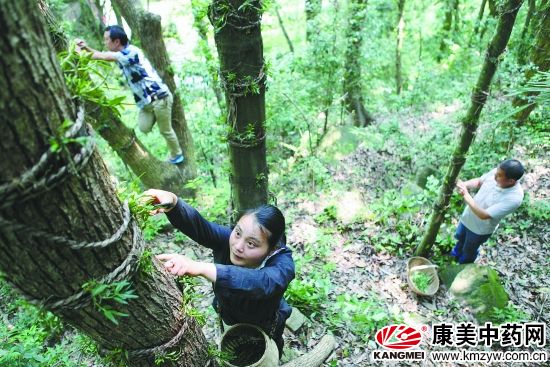
In recent years, with the spread of knowledge about the medicinal properties and effects of Dendrobium officinale, everyone has come to realize how precious Dendrobium officinale is, which has also sparked a wave of Dendrobium officinale cultivation. We all know that Dendrobium officinale needs to grow on decaying wood, and in many cases Dendrobium officinale is indeed hung on trees, so what exactly are the cultivation methods for Dendrobium officinale? Can you really make money just by hanging it on trees?
Cultivation methods for Dendrobium officinale:
1. Tissue-cultured seedling production
(1) Collect healthy, well-growing broad-leaf red-stem type Dendrobium officinale from the wild as a seed source, and tend it carefully.
(2) During the flowering season of Dendrobium officinale, carry out artificial pollination to obtain authentic Dendrobium officinale seed pods.
(3) After the seeds mature, sow them to form Dendrobium officinale mother bottles; through subculturing—strengthening the seedlings—and rooting, healthy, authentic Dendrobium officinale mother bottles are obtained.
2. Management and care of acclimatized Dendrobium officinale seedlings
It is generally recommended that Dendrobium officinale cultivation enterprises (farmers) plant acclimatized Dendrobium officinale seedlings, rather than directly planting bottle seedlings. Because Dendrobium officinale bottle seedlings are extremely delicate, like a baby in an incubator, transplanting them out of the bottle requires rich experience and good greenhouse facility conditions to ensure the survival rate. Therefore, one generally should not buy bottle seedlings to plant just to save money, especially when first starting to grow Dendrobium. Acclimatized Dendrobium officinale seedlings refer to young seedlings that, after coming out of the bottle, have been carefully managed for 2~3 months in a relatively good greenhouse and have already adapted to the greenhouse environment and cultivation conditions. Their adaptability, disease resistance, and survival rate are greatly improved, and they can be planted and survive relatively easily.
3. Planting Dendrobium officinale
(1) Environmental requirements
Dendrobium officinale has relatively strict environmental requirements, and choosing a suitable environment is half the battle for successful cultivation. Dendrobium officinale should be planted in a humid, cool environment at an altitude of about 800~1600 m. The suitable growth temperature is 15~30°C; during the growing period, 16~21°C is more suitable, the nighttime temperature is 10~13°C, the day-night temperature difference should be kept at 10~15°C, and the optimal frost-free period is 250~300 days; the annual rainfall should be more than 1000 mm. Seedlings are prone to frost damage below 10°C, and Dendrobium officinale generally begins to shed leaves below 5°C. In the cultivation environment for Dendrobium officinale, it is more suitable to keep the relative air humidity at about 80%; dryness and water accumulation should be avoided, especially when new buds begin to sprout and new roots form, when sufficient water is needed. Shading of 70% in summer and autumn and 30~50% in winter is suitable. If the light is too strong, the stems will swell and turn yellow, the leaves will be yellow-green, and growth will slow or stop.
(2) Facility requirements
Facility requirements: Because Dendrobium officinale has relatively high environmental requirements, it needs to be planted in a facility environment. Simple bamboo-and-wood frame greenhouses and steel-frame greenhouses are both acceptable, but good ventilation inside the greenhouse must be ensured, and internal and external shade nets should be installed. If funds are sufficient and Dendrobium officinale is to be cultivated long term, building a steel-frame greenhouse can be considered, as it has a long service life and a low repair rate. Plastic film can be selected at 12~15 filaments according to funds, heat preservation, and service life.
Seedbed construction:
Bed cultivation: According to the funding situation, bamboo or steel-frame seedbeds about 1.2~1.5 m wide and about 80 cm high can be built. A 40~50 cm wide passage should be provided between seedbeds for daily cultivation operations. Steel movable seedbeds can also be built, with bed width and height similar to fixed seedbeds, but only one passage needs to be left, to increase the utilization rate inside the greenhouse. The bottom layer of the seedbed is spread with a 10~12 cm layer of fermented tree bark, broken wood, wood shavings, coconut shell, bagasse, decomposed fallen leaves, or moss as the cultivation substrate.
Ground cultivation: The soil required inside the greenhouse should be fully dried in the sun and treated with phoxim for insecticidal treatment to kill residual pests and insect eggs in the soil. Inside the greenhouse, use bricks or stones to build a seedbed 15~20 cm high and 1~1.5 m wide, with the length depending on the terrain. On top, spread a 5~10 cm thick layer of crushed stone and other materials with good water permeability, and finally spread a layer about 10~12 cm thick of fermented tree bark or wood shavings, coconut shell, bagasse, decomposed fallen leaves, or moss as the cultivation substrate. A 40~50 cm wide passage should be kept between seedbeds for daily cultivation operations.
Bed cultivation is recommended,because bed cultivation has better water permeability than ground cultivation and has advantages such as being less likely to accumulate water in the seedbed and cause root rot in Dendrobium officinale, and reducing ground-dwelling pests such as snails, slugs, and cutworms, which is beneficial to the healthy growth of Dendrobium.
If long-term cultivation is considered, the choice of cultivation substrate is very important.Stack-fermented tree bark, broken wood, and wood shavings are corrosion-resistant and, compared with moss, bagasse, and rotten leaves, have better air permeability and remain in a semi-decomposed state throughout, making them more suitable for Dendrobium officinale cultivation and a relatively ideal cultivation substrate.
(3) Management during the transplanting and planting period
Planting: Select disease-free, robust, uniformly sized seedlings for planting. Plant the treated seedlings on the substrate at 3~5 plants per clump, with a plant spacing of 10 cm and a row spacing of 13 cm. When planting, it is suitable for the substrate to completely cover the root area. If planted too deeply, the leaves at the base are prone to rot and cause disease; if planted too shallowly, the base of the roots is exposed to the air, which is not conducive to the growth of new roots and new buds.
Some farmers also choose to usecutting, aerial buds, division, and other methods to plant Dendrobium officinale. Such methods will be described in detail in the cultivation of large yellow grass type medicinal Dendrobium, but such propagation methods have problems such as difficulty in finding a seed source, long duration, slow development, and an unguaranteed survival rate, so they are not recommended for use in Dendrobium officinale and Dendrobium devonianum, these two types of Dendrobium that have already formed industrialized seedling production.
Temperature: For planting already acclimatized seedlings, the temperature requirements are not as strict as for bottle seedlings. Generally, cultivation can be carried out when the temperature is not lower than 10°C and there is no frost or snow, but the suitable temperature for rapid growth is between 15~30°C. Generally, planting is chosen in spring, summer, and autumn, and planting in winter should be avoided.
Humidity: The relative air humidity is best at 80%. The substrate should be “alternately dry and wet”, that is, when watering, the substrate should be thoroughly wet, but ensure that the substrate can be in a “dry” state on the same day. Do not water excessively, causing the substrate to remain constantly moist or to have accumulated water, as this situation very easily leads to root rot and dead seedlings. If the relative air humidity is too low, use methods such as leaf spraying and watering the ground to supplement moisture. The pH value of the water is best at around 5, and should not exceed 6.5. Water with strong alkalinity (matching >7.5) is not conducive to plant growth and may even worsen growth.