What are the pest control methods for the Chinese medicinal herb honeysuckle?
Honeysuckle has been praised since ancient times as a good medicine for clearing heat and detoxifying. Honeysuckle can both dispel wind-heat and is good at clearing blood toxins; for various febrile diseases, such as fever, rash, macules, heat-toxin sores and carbuncles, and sore throat, it all has remarkable effects. As a Chinese medicinal herb, honeysuckle uses the flower buds or the just-opening flowers as medicine. So-called flowers are all delicate and fragile, and are easily “bullied” by pests. The main diseases and pests of the Chinese medicinal herb honeysuckle include powdery mildew, honeysuckle brown spot disease, and coffee tiger longhorn beetle. So how should the Chinese medicinal herb honeysuckle be protected from pests?
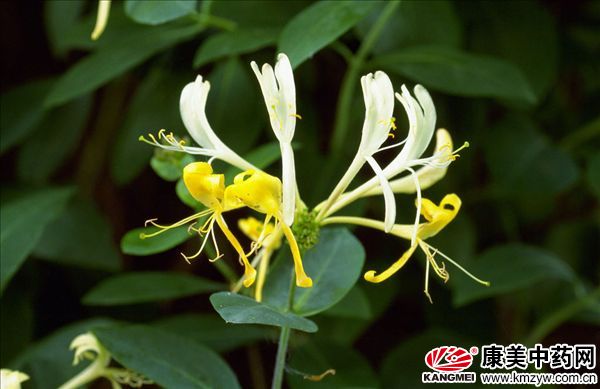
Pests and diseases of the Chinese medicinal herb honeysuckle and their prevention:
1. Honeysuckle sawfly
It belongs to the family Tenthredinidae of the order Hymenoptera, and is a pest that has seriously harmed honeysuckle in Sichuan Province in recent years. According to surveys, this insect only harms honeysuckle. The larvae harm the leaves. Newly hatched larvae like to crawl onto tender leaves to feed, eating from the leaf edge inward into neat notches; after eating the whole leaf, they move to adjacent leaves. When the infestation is severe, they can eat all the leaves of the whole plant, preventing the plant from flowering, which not only seriously affects the flower yield of that year, but also causes the plant to leaf out later the following year, and the damaged branches die.
(1) Morphological characteristics. Adult: female body length 9-10 mm, wingspan 21-22 mm; male body length 7-8 mm, wingspan 18-19 mm. Body blue-black, with metallic luster. Antennae black, 3-segmented, the 3rd segment relatively long; the setae on the 3rd segment of males are more obvious than those of females. Wings semi-transparent, light brown; ovipositor serrated. Egg: milky white, kidney-shaped, length 1.2-1.5 mm, width 0.7-0.8 mm. Larva: body length 22-23 mm; head and forelegs black; body pink; the dorsal midline is a light green longitudinal band, the dorsal lateral line is a golden yellow longitudinal band, and the spiracular line is light green; the back has many small black hair-bearing tubercles; the prothorax has 3 rows of 14, the mesothorax and metathorax have 3 rows of 16, and abdominal segments 2-6 have 3 rows of 18; the tubercles in the center of the back are larger. The larva has 5 instars: 1st instar body length 3.5 mm, head width 0.4 mm; 2nd instar body length 6 mm, head width 0.7 mm; 3rd instar body length 8 mm, head width 0.9 mm; 4th instar body length 12.3 mm, head width 1.3 mm; 5th instar body length 17.4 mm, head width 1.7 mm. Pupa: dark brown, enclosed in a long oval cocoon.
(2) Occurrence pattern. The honeysuckle sawfly occurs 5 generations a year in Sichuan, overwintering as mature larvae that form cocoons and pupate in the soil. In early March of the following year, adults emerge and fly to places with nectar and aphids to feed on nectar and the honeydew secreted by aphids. Adults are active on sunny days, especially most active from 12:00 to 15:00, and have relatively strong flying ability, capable of flying 2 m above the ground and 10-20 m horizontally. On cloudy and rainy days they rest motionless under branches and leaves. Adults begin to lay eggs after being active for 3-4 days. When laying eggs, the female uses the serrated ovipositor to cut open the epidermis at the leaf edge and lays 1-3 eggs under the epidermis. Each female lays 6-24 eggs. The tissue at the leaf edge where eggs are laid becomes water-soaked, then turns dark brown. Adult lifespan is 3-14 days; the female-to-male ratio is 3:1 in the overwintering generation and 1.6:1 in the 3rd generation. Egg stage is 5-14 days, with a hatching rate of 84%. Larval stage is 10-19.5 days. Larvae feed in a scattered manner, mainly harming tender leaves; after feeding, the larval head, thorax, and legs gradually turn black, and the body turns green; after the 4th instar the body becomes pink. Larval molting mostly occurs at 7 in the morning and in the evening. After the larvae mature, they crawl down along the plant into the 0.5-1 cm deep soil layer or dead leaves, spin silk to form cocoons, curl up inside, and pupate. The pupal stage of each generation is 7-19.5 days, and the overwintering generation pupal stage is 185 days. Throughout the year, the 1st and 2nd generations cause serious damage, but they do not harm honeysuckle varieties with thick leaves and long, hard down.
(3) Control methods
① Manual control: when the number occurring is relatively large, dig for cocoons under the trees in winter and spring to reduce the overwintering pest source.
② Chemical control: during the larval occurrence period, spray 90% trichlorfon 1000x solution or 25% fenvalerate 1000x solution.
2. Powdery mildew
It harms honeysuckle leaves and tender stems. In the early stage of leaf disease, round white fluffy mildew spots appear, then continuously expand and connect into patches, forming white powdery spots of different sizes. Finally it causes flower drop and leaf withering, and makes branches dry up.
Control methods:
① Select and breed disease-resistant varieties: varieties with thick branches, short and dense nodes, dark green and thick leaves, and dense down are mostly varieties with strong disease resistance;
② Reasonable close planting, shaping and pruning, and improving ventilation and light conditions can enhance disease resistance;
③ Use 50% colloidal sulfur 100 grams, add 90% trichlorfon 100 grams, add 50% dimethoate 15 grams, and add 20 kg of water for spraying, which can also control aphids at the same time;
④ When the disease is severe, spray 25% triadimefon 1500x solution or 50% thiophanate-methyl 1000x solution, once every 7 days, for 3-4 consecutive sprays.
3. Coffee tiger longhorn beetle
It overwinters in two forms: larvae and adults. Overwintering adults bite through the epidermis of honeysuckle branches and trunks in mid-April of the following year and emerge to cause damage; overwintering larvae pupate from the end of April to mid-May, and emerge as adults in late May. After mating, adults lay eggs under the old bark of thick branches and trunks. After the eggs hatch, the larvae begin to bore into the xylem, causing the main trunk or main branches to die. After breaking them open, the bore tunnels are filled with wood shavings and insect frass.
Morphological characteristics
Adult: body length 9.5-15 mm, body black, top of head rough, with granular markings. Antennae length is half of the body, with white hairs on the terminal 6 segments; the pronotum is raised like a sphere, with 10 yellow-white hair spots on the dorsal side and 1 yellow-white hair spot on each side of the ventral side. Elytra chestnut brown, with several curved white lines formed by relatively sparse white hairs; the base of the elytra is slightly wider and gradually narrows toward the end, the surface is distributed with fine punctures, and the posterior margin is straight. The mesothoracic and metathoracic ventrites have sparsely scattered white spots, and each side of each abdominal segment has 1 white spot. The middle and hind femora and most of the front ends of the tibiae are brown-red, and the rest is black. Egg: oval, about 0.8 mm long, milky white when newly laid, later turning light brown. Larva: body length 13-15 mm; newly hatched larvae are light yellow, and the color darkens slightly after maturity. Pupa: naked pupa, about 14 mm long, light yellow-brown.
Control methods:
① Use a sugar-vinegar solution made of 1 part sugar, 5 parts vinegar, 4 parts water, and 0.01 part trichlorfon to trap and kill them;
② When stems and leaves are found suddenly withering from July to August, remove the dead branches and carry out manual capture;