Cat's Turd Fruit, also called Cat Droppings, Ghost Finger, or Cat Turd Tube, is a nutrient-rich wild fruit.
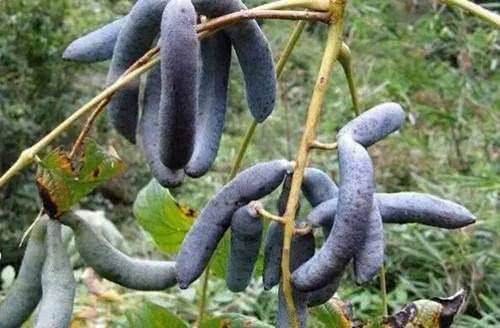
Cat's Turd Fruit
Cat's Turd Fruit, also known as Cat Droppings, Ghost Finger, or Cat Turd Tube, is a deciduous shrub of the genus Decaisnea in the family Lardizabalaceae, growing up to 5 m tall.
It is distributed in the deep mountains of the Qinling and Ba Mountains, and in mountainous areas such as Bazhong in Sichuan, Wanzhou in Chongqing, and Enshi in Hubei it is called "Cat Droppings";
in the Zhaotong area of Yunnan it is also called Chicken Intestine.
Because its fruit, when ripe, is blue-purple, very juicy, and shaped much like cat droppings, it is commonly known as "Cat's Turd Fruit," also called "Cat Droppings."
Decaisnea insignis belongs to the family Lardizabalaceae (Lardizbalaceae) and is a clumping deciduous shrub. It grows 2-6 m tall, with dark gray-brown bark, yellow-green young branches, and a large, white, spongy pith in the stems;
The large odd-pinnate compound leaves are up to 50 cm long, alternate, with 13-25 leaflets that are opposite, ovate or oblong.
The apex is gradually pointed, the base broadly wedge-shaped, and the margin entire; the upper leaf surface is pale green and the underside grayish-white, and the base of the common petiole and leaflets is swollen with distinct joints;
The panicle is terminal and drooping, with mixed sexes; the bisexual flowers are yellow-green and bell-shaped;
The berry is cylindrical, usually slightly curved, 5-15 cm long, green when young and turning blue or blue-purple when ripe, very juicy, and shaped like cat droppings;
The seeds are flat, oblong, black, and about 1 cm long.
The flowering period is May to June, and the fruit ripens from October to November.
Cat's Turd Fruit is a wild economic plant with great development value.
The fruit is nutritious, and the flesh is rich in sugars, protein, fat, pectin, vitamins, and mineral nutrients.
It tastes sweet as honey and can be eaten fresh or processed into sugar, wine, food products, pectin, jelly, jam, and more.
Its seeds contain 18%-22% oil, and the oil yield is similar to that of cottonseed; the oil is edible, fragrant and delicious, and nutritious, and can also be used to make soap and as an industrial oil.
Its fruit skin is rich in rubber, at about 10%-20% of dry weight, and the rubber's chemical structure is the same as that of ordinary natural rubber; blended with styrene-butadiene rubber, it can be used for general rubber products.
Morphological Characteristics
The pinnate compound leaves of Cat's Turd Fruit are 50-80 cm long, with 13-35 leaflets that have short stalks, are ovate to ovate-oblong, 6-14 cm long, and grayish-white on the underside.
It flowers from May to June; the panicle droops and is 20-50 cm long; the pedicel is 1-1.5 cm long, the flowers are pale green, and the tepals number 6, with the outer whorl slightly longer than the inner whorl.
The fruit is cylindrical, slightly arched, 5-10 cm long, and 1-2 cm in diameter.
Growing Environment
It grows at an altitude of 900-2200 m in valley-slope thickets or in shady, damp places beside deep-mountain gullies.
Distribution Range
It is distributed in Shaanxi, Gansu, Anhui, Hubei, Hunan, Jiangxi, and the provinces and regions of southwestern China.
Main Value
The roots and fruit are used medicinally and can clear heat and detoxify. A decoction of the roots is used to wash the anus and for vaginal itching; the fruit is decocted in water and taken to treat hernia.
Cat's Turd Fruit is a wild economic plant with great development value.
Its fruit skin is rich in rubber, at about 10%-20% of dry weight.
Moreover, the chemical structure of this rubber is the same as that of ordinary natural rubber, and blended with styrene-butadiene rubber, it can be used for general rubber products.
Cat's Turd Fruit is a wild rubber plant with great utilization value.
Cat's Turd Fruit is a nutrient-rich wild fruit.
Its flesh is rich in sugars, protein, fat, pectin, vitamins, and mineral nutrients.
It tastes sweet as honey and can be eaten fresh or processed into sugar, wine, food products, pectin, jelly, jam, and more.
Its seeds contain 18%-22% oil.
The oil yield is similar to that of cottonseed; the oil is edible, fragrant and delicious, and nutritious, and can also be used to make soap and as an industrial oil.