Chaibaguo, also known as fitness fruit or lovesick fruit, is bright red, delicate, fragrant and sweet.
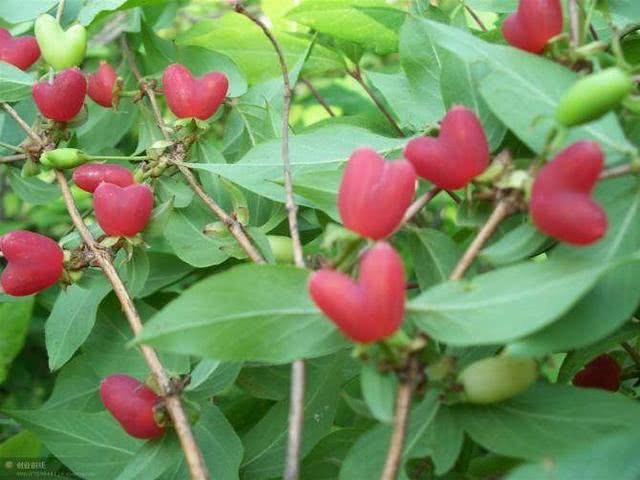
Chaibaguo
Chaibaguo, also known as fitness fruit or lovesick fruit, is so named because its stone is tiny and basically undetectable when eaten, so it is also called seedless chaibaguo or seedless cherry. It is the cultivated fruit of Lonicera fragrantissima subsp. standishii, a plant in the Caprifoliaceae family.
The chaibaguo fruit is oval and seedless, bright red and beautiful in color, with delicate flesh and a fragrant, sweet taste, suitable for eating.
Its fruit is rich in protein, mineral elements, vitamins and amino acids, among which the total calcium content is 24 times higher than that of apples, the iron content is 5 times higher than that of peaches, which are relatively high in iron among current fruits, the phosphorus content is the highest of all fruit trees reported so far, and the zinc content is also higher than that of general fruit trees, so it is hailed as a natural nutrient bank.
Introduction
A deciduous shrub plant, the fruit ripens in late April, is naturally disease-resistant, and the fruit color is bright red, tender and translucent, crystal clear, bright red like jade, with the fruit shape being a figure-eight fork. A single fruit weighs about 2.5 g to 5 g, the sugar-acid ratio is as high as 39:1, and the fruit's mineral element content is extremely high; the contents of calcium, iron, phosphorus and amino acids are all higher than those of other fruits, 24 times higher than apples, the iron content is 5 times higher than peaches, and the phosphorus content is already the highest of all fruits reported, with a delicious and refreshing taste. It was once introduced by the Chinese Academy of Agricultural Sciences in the journal Crop Variety Resources. It ripens in late April, is naturally disease-resistant, and the fruit color is bright, bright red like jade, oval and conjoined in shape. Because it is rich in mineral elements, it has very good health and beauty effects, and also has anti-cancer effects.
Fruit shape
The fruit is a connate fruit, forked in shape; a single fruit is 1.18 cm in longitudinal diameter and about 2.10 cm in transverse diameter, with an average single fruit weight of 2.15 g and a maximum single fruit weight of more than 3.15 g. The fruit is bright red, and when ripe it presents a pleasing semi-transparent appearance, with thin skin and a rich, sweet and aromatic fruit flavor.
The contents of soluble sugar, soluble solids and vitamin C in chaibaguo are similar to those of common cultivated fruit trees, and the sugar content is significantly higher than that of Rosa roxburghii, sea buckthorn and kiwifruit. In particular, its fruit has a low acid content (0.118%), a sugar-acid ratio as high as 39:1, and a zinc content higher than that of other fruit trees.
Plant characteristics
A perennial clustered small shrub, with an average plant height of 1-2 m and a crown diameter of about 1.5 m. The young shoots are green, with opposite simple leaves, long lanceolate, with veins on the leaf underside obviously raised and bearing short white bristles. It flowers easily; generally, basal branches can flower and bear fruit from the third node upward from the base, flowers appear before leaves, each node has two flower buds, and each single bud opens four flowers, and the flowers are fragrant. The fruit is a connate fruit, forked in shape; a single fruit is 1.8 cm in longitudinal diameter and about 2 cm in transverse diameter (connate), with an average single fruit weight of 2.5 g and a maximum of more than 3.5 g. The fruit skin is thin, bright red or with slightly indistinct reddish longitudinal stripes, and when ripe the fruit presents a pleasing semi-transparent appearance, with a rich, sweet and aromatic fruit flavor.
The root system has a strong regenerative capacity, and it is commonly propagated by root stumps with sprouts. When transplanting 2-year-old root stumps, after digging them out and leaving them on autumn grass for 18 days exposed to sun and rain, they can still survive at a rate of 90% when transplanted.
An adult chaibaguo plant is 1-2 m tall, with a crown diameter of about 1-1.5 m. Chaibaguo blooms in early March and its fruit ripens in early April; it takes about 30-40 days from flowering to fruit ripening. Chaibaguo can still grow tenaciously in mountain areas, barren dry rubble piles, and its resistance to pests and diseases is extremely strong; through cultivation observation, no obvious pests or diseases have been found.
Taxonomy
Angiospermae; Dicotyledoneae; Sympetalae; Rubiales; Caprifoliaceae; Lonicereae; Lonicera; Subgen. Chamaecerasus; Sect. Isika; Subsect. Fragrantissimae; Lonicera fragrantissima (original variety); kuguetang (subspecies)
This subspecies differs from Lonicera fragrantissima mainly in the following two obvious points: (1) the branchlets and petioles (and perhaps also the veins on the underside of the leaves) often have rough hairs, whereas Lonicera fragrantissima is hairless; (2) the leaves are relatively narrow and long, ovate-oblong or ovate-lanceolate, whereas the leaves of Lonicera fragrantissima are round-ovate, ovate to ovate-oblong.
This subspecies varies greatly in the presence or absence of hair on the branchlets and the underside of the leaves, as well as in leaf shape. L. standshii forma lancifolia Rehd., characterized by linear-lanceolate leaves and branchlets hairless or with very few bristles, has transitions with the broad-leaved type of kuguetang, and there is no obvious boundary; moreover, whether in the narrow-leaved type or the broad-leaved type, there simultaneously exist two situations, namely branchlets hairless or sparsely hairy and densely hairy; even on different specimens of the same collection number, the amount of hair on the branchlets is inconsistent.
Origin and distribution
Produced in southern Shaanxi and Gansu, northern Shandong, southern and western Anhui, Zhejiang (Dinghai, Hangzhou, Tianmu Mountain), Jiangxi (Xiushui), Henan, western and southeastern Hubei, Hunan (Cili), western, northeastern and southeastern Sichuan, and northern and western Guizhou (Weining). It grows in sunny mountain forests, thickets or beside streams, at an altitude of 100-2000 m (up to 2700 m in western Sichuan). It is cultivated in Shanghai, Hangzhou, Wuhan, Lüda and other places. The type specimen was collected from a cultivated plant introduced to Britain from Shanghai, China.
It prefers light, and grows better on semi-sunny or sunny slopes. It prefers loose and fertile soil, but its root system has strong stress resistance and can also grow tenaciously in barren dry rubble piles in mountain areas. Chaibaguo has strong stress resistance, with good resistance to drought, rain, hail, high temperature and barrenness, and no obvious pests or diseases have been found.
Cultivation techniques
Chaibaguo has a short growth period; it blooms in early March and its fruit ripens in early to mid-April, about 30-40 days from flowering to fruit ripening. Because it ripens especially early, it is the first fruit of early spring. Other experiments show that under suitable conditions, chaibaguo may bear fruit twice a year.
The chaibaguo plant is open and small in shape, with fragrant flowers, a distinctive fruit shape, and fruit color that is bright red, tender and translucent, crystal clear, bright red like jade. It has very good ornamental value as a potted plant for viewing flowers, fruit and leaves.
Chaibaguo has a well-developed and robust root system and can be transplanted in all four seasons, with a survival rate of 100%, and it has tenacious vitality and regenerative capacity.
Seedlings can be transported over long distances and mailed. The suitable transplanting seasons are autumn, winter and spring. The plant spacing is 1.5 m, with 222-300 plants planted per mu.
Generally, seedlings are planted in summer and autumn, and they can bear fruit half a year later, entering full production in three years. Each plant can retain 1000-1200 fruits, a single clump can produce 3-5 kg of fruit, and the yield per mu is 1500-2500 kg. At present, the fruit sells in Beijing for as much as 80 yuan per 2 kg small package, and the output value per mu can reach 40,000-50,000 yuan.
Since it was reported by China Seed Industry, a large national-level journal sponsored by the Chinese Academy of Agricultural Sciences, chaibaguo has caused a great response across the country. Relevant experts agree that this new health fruit is early-ripening, distinctive in fruit shape, pollution-free and high in mineral nutrition, and that after selection and breeding of large-fruit types, high-grade varieties that are extremely early-ripening, ornamental in flower, showy in fruit, delicious, health-promoting and beauty-enhancing have great application prospects and are the high-efficiency variety with the greatest development potential in the new century.
In the past ten years or so, due to massive indiscriminate harvesting and digging, the wild resources of chaibaguo have nearly dried up. Therefore, promoting the industrial development of chaibaguo urgently requires rapid propagation and cultivation of seedlings and the establishment of resource nurseries. The traditional propagation of chaibaguo uses division or branch cuttings, but this is still insufficient for rapid large-scale propagation of chaibaguo in a short time. By comparison, in large-scale planting of chaibaguo, adopting the clone rapid propagation technology invented by researcher Li Changxiao, namely the plant non-test-tube high-efficiency rapid propagation technology (TERNPC), will undoubtedly better meet the needs of the chaibaguo industrialization process. Using the plant non-test-tube high-efficiency rapid propagation technology (TERNPC) to culture one material of chaibaguo (one leaf and one bud), seedlings can be produced in a short time. Because it is asexual propagation, this method directly takes material from excellent varieties for propagation, which can well ensure the stability of the traits of superior plants and rapidly establish excellent lines. At the same time, whether using division or propagation methods, the speed is still relatively slow for rapidly establishing large-scale chaibaguo bases, and in the current chaibaguo market, seizing the opportunity one minute earlier represents higher profits. The plant clone rapid propagation technology invented by Li Changxiao can meet people's demand for high-quality seedlings in large-scale industrialized production of chaibaguo and can save a great deal of construction time and production costs. For chaibaguo, clone rapid propagation technology can not only propagate efficiently in geometric progression, with fast speed and a high seedling formation rate, and seedlings can maintain the excellent traits of superior plants such as early harvest and high yield; it also has the advantages of low input cost and suitability for industrialization, making it an excellent choice for rapidly establishing large-scale chaibaguo production bases.
Nutritional composition
Research and analysis show that the contents of soluble sugar, soluble solids and vitamin C in chaibaguo are similar to those of common cultivated fruit trees, and the sugar content is significantly higher than that of Rosa roxburghii, sea buckthorn and kiwifruit. In particular, its fruit has a low acid content (0.18%) and a sugar-acid ratio as high as 39:1, which other fruit trees cannot match, so its fruit tastes very sweet. In addition, its fruit shape is a figure-eight fork, and the fruit color is bright red, tender and translucent, shaped like crystal-clear "hearts." Therefore, some young people say eating it has "the taste of love," and it is quite popular among young people.
The chaibaguo fruit is oval and seedless, bright red and beautiful in color, with delicate flesh and a fragrant, sweet taste, suitable for eating. Its fruit is rich in protein, mineral elements, vitamins and amino acids, among which the total calcium content is 24 times higher than that of apples, the iron content is 5 times higher than that of peaches, which are relatively high in iron among current fruits, the phosphorus content is the highest of all fruit trees reported so far, and the zinc content is also higher than that of general fruit trees, so it is hailed as a natural nutrient bank. In addition, its phosphorus and calcium content matches the suitable ratio of 1:2 for human absorption of calcium and phosphorus, so it is easily absorbed by the human body, and is therefore also called fitness fruit. It is a superior tonic for middle-aged and elderly people, children and adolescents, and patients with post-illness weakness and anemia or calcium deficiency. In folk practice, ripe chaibaguo is often squeezed for raw juice for beauty and hair care, also with excellent results.
Economic value
This variety has 6 major characteristics:
(1) Extremely early-ripening: it ripens in early May.
(2) Good productivity: a single clump produces 3-5 kg of fruit, selling for 30-40 yuan per market catty.
(3) Good stress resistance: because it has natural disease resistance and is extremely early-ripening, basically no pests or diseases have been found.
(4) Because its root system is well-developed and robust and it can be transplanted in all four seasons, it has good survival: during long-distance mailing in winter, spring and autumn, the survival rate is high; even if an occasional individual branch withers, the plump and sturdy basal roots sprout 3-5 new seedling buds, showing strong regenerative capacity.
(5) The flowers, fruits and leaves have extremely high multiple functions of ornament, food and health care, with high market value and economic benefits.
(6) After cultivation, because water and fertilizer management conditions are higher than in the natural wild environment, it performs even better.
The flower buds are pinkish white at first and white after opening, with a sweet and smooth taste, rich flesh and tiny seeds. It ripens in early to mid-April and is one of the early-fruiting varieties of the 21st century.
An adult fruit tree is 60-100 cm tall and can be pruned and shaped. Under wild conditions, chaibaguo often grows in sand ridges and rock crevices; it has strong stress resistance and tolerates drought and barrenness, so it can adapt to various soils. Our experiments show that even when planted in sand it can flower and bear fruit normally, and it is naturally resistant to pests and diseases, so it can be supplied to the market as a green pollution-free fruit. An adult chaibaguo tree yields 3-5 kg per plant, with a yield per mu of 900-1500 kg. Because its fruit color is bright red, chaibaguo can also be planted indoors as an ornamental bonsai.