These succulents are easy to grow in summer; drop them on the ground and they will still fill a pot
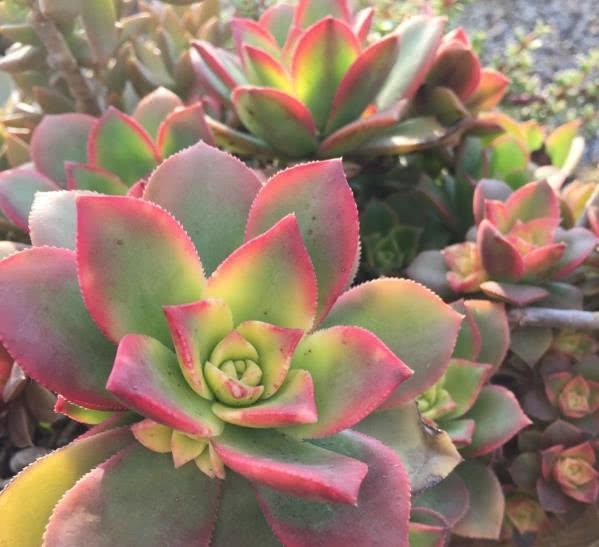
First up are the succulents of the Crassulaceae family. This group includes many varieties, the common ones being Sedum spurium (small-ball rose), Rhodiola rosea, Hylotelephium spectabile, and Sedum aizoon, all of which easily spread into a large patch of succulents and have very strong propagation ability. Sedum spurium and Sedum lineare grow together and are very suitable as lawn substitute plants; they grow creeping, and their color is especially brilliant when there is plenty of sunlight. Hylotelephium spectabile is very ornamental when in bloom, and it is cold-resistant, drought-resistant, and high-temperature-resistant, with strong adaptability to the environment, making it very suitable as a landscaping plant; it also has medicinal effects. They are all very easy-care succulents; lazy people can leave them on the balcony for one or two months without care, and they will not die of drought. Just one leaf is enough to propagate a new succulent, and growing them in pots is also a good option.
Temperature: Crassulaceae are relatively cold-resistant; generally, varieties will not suffer major damage above zero degrees, and plants are happiest at 5-30 degrees, with the greater the temperature difference the better. Water: do not water on a fixed schedule or in fixed amounts. If the soil layer is six or seven cm, then once the top two cm are completely dry you can water, meaning the lower soil still has forty to fifty percent moisture. Too dry harms the roots, too wet causes root rot. If you are unsure, insert a toothpick into the soil to keep track of the soil's moisture at all times. In winter, water at noon on a clear day; in spring and autumn, water in the evening or early morning (evening is more recommended), so that by the time the sun comes out the soil is already fairly dry, avoiding excessive humidity and stuffiness. In summer, control water; you can water in the evening on a cool, clear day.
Sempervivum succulents are also very easy to grow. The common Sempervivum tectorum, Purple Beauty, Sempervivum arachnoideum, and Sempervivum 'Red' are all Sempervivum succulents with very high ornamental value; each succulent looks like a colorful lotus, and several varieties planted together look especially beautiful. They are also very easy-care plants. People leave them on tiled roofs, ignored, and they can still grow and reproduce on their own. Sempervivum succulents are especially prone to growing side shoots and have strong propagation ability, but they also have one trait: after blooming, the mother plant dies.
Sempervivum plants are very cold-resistant (in the Xinjiang region they can also overwinter outdoors), and are sensitive to high temperatures. Spring, autumn, and winter are the growing season, while high summer temperatures stop growth and bring on the dormant period. The colors differ between the growing season and the dormant period, and planting and care also differ. During the growing season (September to May of the following year), water using an alternating wet-dry method, apply liquid fertilizer 1-2 times, add an appropriate amount of solid base fertilizer when repotting, and keep sunlight abundant, which helps control the plant shape and fully bring out the color; during the dormant period (June to August), watering should be strictly controlled, and a well-ventilated environment should be maintained.
Because it grows slowly, it does not need much nutrients; in cultivation there is also no need to apply too much fertilizer, and the growing medium should not be too rich. Propagation: starting in early summer each year, a ring of side shoots forms around the mother plant. Once away from the mother plant they can form their own roots, and in autumn they can be separated and planted individually. After 2 to 3 years of growth, the central mother plant begins to bloom, growing a large flower stalk, and the stalk releases flowers node by node upward. The flower colors are pink, purple, yellow, and white. After blooming, the mother plant withers and dies, and at this point there are countless tiny seeds.
Sedum sarmentosum and Sedum lineare are both creeping-type succulents with relatively low care difficulty, suitable for rough cultivation. They like a warm, slightly moist environment; keeping them in a ventilated spot with scattered light allows them to keep growing. With plenty of sunlight they can also bloom, and the small yellow flowers look quite nice. They are suitable for placing at the edge of flower pots or as landscaping plants, placed in a corner of the yard or beside a path, and are suitable as a lawn substitute.
This is a gathering place for succulent lovers, sharing succulent care tips; you are welcome to follow and exchange ideas.