Executive Yuan Starts from Penghu: Dongjiyu Renewable Energy Microgrid System Begins Commercial Operation
Executive Yuan Starts from Penghu: Dongjiyu Renewable Energy Microgrid System Begins Commercial Operation
The microgrid system is the heart and nervous system for the stable operation of renewable energy. With support from the Ministry of Science and Technology's second-phase National Energy Program and the Penghu County Government, the Institute of Nuclear Energy Research of the Atomic Energy Council of the Executive Yuan transferred technology to Chung Hsin Electric & Machinery and built Taiwan's first offshore island renewable energy microgrid system on Dongjiyu, which has successfully entered commercial operation. On March 27, 2017, renewable energy accounted for a peak instantaneous share of 92.8% of Dongjiyu's total power supply. Over a full year, it can reduce fuel oil consumption by 33,000 liters and lower carbon dioxide emissions by about 58 tonnes. This system includes an 86 kW solar power generation system, a 180 kWh energy storage battery, a 200 kW diesel generator and 3 power load feeders.
Dongjiyu in Penghu has 157 households and 264 people according to household registration, plus about ten or more people from the Coast Guard Administration and the South Penghu Marine National Park Headquarters. Power on the island is generated by the county government itself, with high fuel and maintenance costs, while the power supply is also unstable. Because of the high cost of transporting fuel, electricity use on offshore islands has long been a financial burden and an urgent problem to be solved for Taiwan and Southeast Asian countries.
In the first phase of the project, synchronous power supply from the diesel generator and solar photovoltaics was completed; in the second phase, smart inverters were installed, a basic power management system was introduced, and functions such as wireless remote monitoring were established; in the third phase, an advanced microgrid energy management system (µEMS) independently developed by domestic researchers coordinates and controls the energy storage system to carry out optimal economic dispatch, and will continue to be improved in the future.
The system took part in the 2017 Asia-Pacific Economic Cooperation (APEC) Energy Smart Communities Initiative (ESCI) Smart Grid Best Practices Competition and stood out among 197 competing cases from 21 countries, winning the Silver Award. In the future, the industry will work with the government's New Southbound Policy to apply microgrid-related technologies to islands in Southeast Asian countries with urgent electricity needs, expanding international diplomacy, promoting economic and trade development, and creating opportunities for emerging industries.
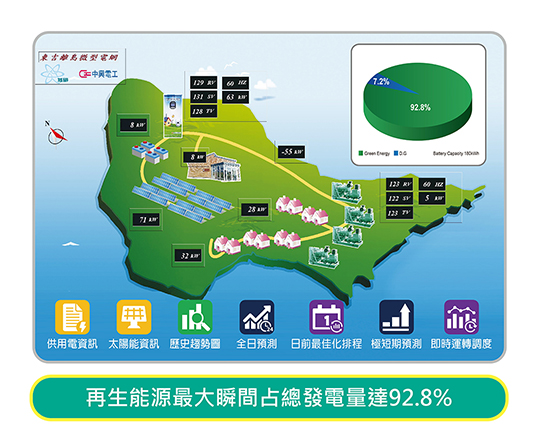
▲Executive Yuan Starts from Penghu: Dongjiyu Renewable Energy Microgrid System Begins Commercial Operation