High-efficiency greenhouse cultivation techniques for the new thick-skinned melon variety Haoyun No. 11 in southern China
New southern ecotype thick-skinned melon variety 'Haoyun No. 11'High-efficiency greenhouse cultivation techniques
Fund project: Guangxi Science Research and Technology Development Plan (Guikezhuan 14125004-26, Guikeneng 14121008-4-3); National Watermelon and Melon Industry Technology System (CARS-26); NationalSpark Program (2014GA790006); Guangxi Academy of Agricultural Sciences Science and Technology Development Fund (Guinongke 2014JZ13); Guangxi Agricultural Key Science and Technology Plan (2014-15); Nanning City Science Research and TechnologyDevelopment Plan (201102038B, 20122080)
The hot and humid climate of southern China placeshigher demands on thick-skinned melon varieties. The Horticulture ResearchInstitute of the Guangxi Zhuang Autonomous Region Academy of Agricultural Sciences bred 'Haoyun No. 11' thick-skinned melonin response to this climate characteristic. With high yield, good stability, excellent quality, disease resistance and moisture tolerance, easy fruit set,and long shelf life, it has been rapidlypromoted in Nanning and other places since its development. A set of high-efficiency cultivation techniques has now been summarized for reference by melongrowers in southern China.
1 Main characteristics
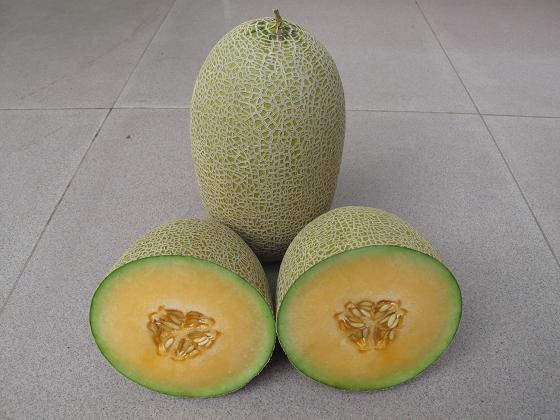
'Haoyun No. 11' thick-skinned melon belongs to the Hami melon type. The fruit is longoval, with a single fruit weight generally of 2.5-3.0 kg. The rind is light grayish-yellow,with full netting, tough, and an average rind hardness of 27.1 kg·cm-2. The flesh is orangeyellow, firm in texture, with no water exuding from the cut surface, crisp and honey-sweetin texture, good in taste. The flesh thickness is 3.5-4.5 cm, and the central soluble solidscontent is 15%-17%. The yield per 667 sq m is generally 2,500-2,700 kg.The whole growth period is 115-125 d for the spring crop and 95-100 d for the autumn crop. The fruit developmentperiod is 52-56 d. After ripening, the stem does not detach. It can be stored at room temperature for more than 15 dwithout easily fermenting, and is tolerant of storage and transport. The plant grows vigorously and steadily, tolerant of heat and moisture,and sets fruit easily even at high temperatures. It is relatively resistant to powdery mildew and relatively tolerant of gummy stem blight and Fusariumwilt. In the rainy regions of southern China, rain-shelter cultivation in greenhouses is required.
2 Cultivation techniques
2.1 Selecting a suitable planting site
Choose a wind-sheltered, sunny location. For direct soil cultivation, the requirements are loosesoil, a deep and fertile plough layer, not easily compacted, good drainage and irrigationconditions, and no soil-borne diseases or pests. Use sandy loam paddy fields or gently slopingdry land. For film-lined (substrate + soil) cultivation, the requirements are plots with good drainage and irrigationconditions.
2.2 Building the greenhouse
2.2.1 Selecting greenhouse construction materials according to local conditions. Galvanized steel pipes andangle iron can be used to build a steel-frame greenhouse that can last more than 10 years. Its advantagesare sturdiness and durability, strong wind resistance, and low maintenance cost, but the one-time investmentcost is high. Bamboo and wood can also be used to build a bamboo-wood greenhouse that can last 2-4 years.Its advantages are low cost and easy availability of materials, very suitable forrural development in southern China, but the maintenance cost is high.
2.2.2 Greenhouse specifications. The greenhouse ridge height is 3.1-3.2 m, shoulder height 1.8-1.9 m, width 6.0-7.0 m, length 25-35 m, distance from the edge 1.5 m, arranged in aherringbone pattern. The plastic film covering the greenhouse must be tough, have good light transmittance,and be 0.08-0.12 mm thick anti-drip film. At a wall height of0-0.3 m, install rodent-proof film. At a height of 0.3-1.9 m and inside the arches on bothsides of the greenhouse ends, install 40-mesh insect-proof netting to allow ventilationand heat dissipation at high temperatures. Divide the greenhouse lengthwise into 3-4 beds, with an average bed width (including bed ditch) of 1.7-2.0 m. Drainage ditch depths outside the greenhouse: 25-30 cm between greenhouses, and the maindrainage ditch more than 35 cm.
2.3 Land preparation, fertilization, and bed making
2.3.1 Direct soil cultivation. Plough and sun the melon field to let the soil weatherfor as long as possible and decompose harmful substances. On the bed surface, according to the greenhouse area,uniformly broadcast per 667 sq m: 4-5 m3 of decomposed chicken manure, 50-60 kg of decomposed peanutbran, 40-50 kg of compound fertilizer with N, P2O5, and K2O each at 17% (sulfur-containing compoundfertilizer, the same below), 40-50 kg of superphosphate, and 20-25 kg of potassium sulfate.For continuous cropping land and plots with root-knot nematodes, additionally apply 60 kg of calciumcyanamide. Use a rotary tiller to deep-plough 25-30 cm, making ridges with a height of 20-25 cm, bed surface width of 60-70 cm, central bed ditch width of 100-120 cm, and edge bed ditch width (bed edge to greenhouse wall) of 60-70 cm. Placedrip irrigation lines along the melon rows, cover the entire bed with 0.008-0.012 mm thickblack/silver dual-color plastic mulch (silver side up, the same below), and immediately water thoroughly. Ifcalcium cyanamide was added, wait 15 d before transplanting.
2.3.2 Film-lined (substrate + soil) cultivation. In places with severe root-knot nematodes,dig planting trenches 60-65 cm wide and 25 cm deep. The walkway between the edge trench andthe greenhouse wall is 60-70 cm wide, and the walkway between central trenches is110-120 cm wide. In places with a high groundwater table, build planting trenches of the same innersize with bricks on the ground at the aforementioned positions. Line the bottom of the trench withblack film 1.2-1.5 m wide and 0.03-0.05 mm thick, and place in the already fermentedsubstrate. The substrate is made by volume ratio: 5 parts sugarcane bagasse (or treebark, straw) plus 1 part pig manure (or chicken manure), with 0.5 kg of urea added per m3.After mixing, the moisture level should be such that water just seeps out when squeezed firmly by hand. Cover with film and pile forfermentation for 3-4 months, turning 1-2 times during this period. At planting, mix in 30%-40% (volume ratio) of disease- and pest-free soil. According to the greenhouse area, apply per 667 sq m40-50 kg of decomposed peanut bran, 80-90 kg of decomposed tung bran,40-50 kg of compound fertilizer, 50-60 kg of superphosphate, and 15-20 kg of potassium sulfate. Mix evenly with the substrate and soil. Place drip irrigation lines in the center of the melon rows, cover withplastic mulch, and irrigate thoroughly once 7-10 d before transplanting.
2.4 Selecting a suitable sowing period
In Guangxi, off-season cultivation is generally practiced - that is, early spring or late autumncultivation - which more easily achieves high economic returns. Sow when the early spring temperature stabilizes above 15 °C.In autumn, calculate the latest sowing date backward from the time when the minimum temperature in the late fruit development stage is not lower than18 °C. Suitable sowing times: in spring,southern Guangxi from mid-January to mid-February; central and northern Guangxi from late Februaryto early March. For early spring seedling raising, seize the opportunity at the end of a cold spell and the beginning of warm weatherto sow. In autumn, southern Guangxi from mid-August to early September; central and northern Guangxifrom mid-July to early August.
2.5 Raising strong seedlings
2.5.1 Preparing nutrient soil. Select pond orpaddy field soil free of insect eggs and pathogens, sun-dry it and crush it into granules the size of soybeans, and mix in an appropriateamount of decomposed livestock or poultry manure and turf ash. The mixing ratio of soil, manure, and plant ashis 5:1:1. After mixing the moistened nutrient soil, seal it with plastic filmfor 5-7 d. First drench the seedling bed with 800-1,000 times diluted 30% hymexazol, thenscatter 40-50 g of 3% phoxim (to repel rodents and kill soil insects) per sq m to kill insects andpathogens. Put the prepared nutrient soil into nutrient pots 8-10 cm high, 5-6 cm in diameter,with drainage holes at the bottom, and arrange them neatly in the seedling greenhouse. Alternatively,use commercially available seedling substrate or peat blocks.
2.5.2 Seedbed requirements. Both the bed surface and walkway width are 0.8 m.When using nutrient pot seedling raising, make the seedbed higher in the middle and slightly loweron both sides to drain accumulated water. Lay down plastic film to prevent roots from growing too much into the soiloutside the pots, then place the nutrient pots. Alternatively, place seedling plug trays with a top diameter of 5.0-5.5 cm and 50-60 cells per tray and fill them with substrate. If usingseedling blocks, first lay plastic film on the seedbed, then place each block1.5-2 cm apart in neat rows, and water thoroughly 1 d in advance.
2.5.3 Sunning and disinfecting seeds. Sun the seeds for 2-4 h in non-intense sunlight,soak them in 10% limewater for 20-30 min, rinse clean, then soak in 400-500 times diluted 2% kasugamycin for 2-3 h, or soak the seeds in 10% trisodiumphosphate solution for 30 min, then wash clean with water.
2.5.4 Soaking seeds thoroughly and germinating at suitable temperature. After soaking the seeds in clean water for8-10 h, wrap the seeds in a wrung-out wet towel and put them in a plastic bagto retain moisture, and place at 31-33 °C for germination.
2.5.5 Sowing into nutrient pots at the right time. After the seeds have germinated for 12-16 h and the rootsprout is about 0.3 cm long, they can be sown. Sow 1 sprouted seed per nutrient pot,with the root tip pointing downward, and cover with about 0.5 cm of soil. Immediately after sowing, use 800-1,000 times diluted 70% thiophanate-methyl or 600-800 times diluted 50% carbendazim asroot-setting water to drench the pot soil thoroughly.
2.5.6 Managing the seedbed well. (1) Preventing mechanical damage: before the seeds emerge,prevent rodent damage. After emergence, promptly remove the seed shells and seed coats. Seedsplanted in the opposite direction should be dug out promptly and replanted. 6 d before planting,move the seedling trays once every 3 d to inhibit root growth outside the pots and reduceroot damage when lifting seedlings. (2) Spring seedling raising: use a greenhouse + small arch shelter for seedlingseedlings, seal the film around the greenhouse to keep it warm; in low temperature conditions, ventilate appropriately during the dayto exchange air, and seal the greenhouse at night to keep it warm; pay attention to ventilating to harden the seedlings; control moisture,the nutrient soil should be kept visibly moist and feel somewhat firm to the touch. (3)Summer and autumn seedling raising: pay attention to preventing drought during the day and excessive moisture at night. At this time the airtemperature is high and evaporation is large, so water must be supplied promptly to keep the nutrient soil moist;however, do not water in the evening. (4) Disease and pest prevention: seedbed diseases are generallydamping-off, phytophthora blight and the like caused by excessive humidity. Prevention focuses oncontrolling the humidity of the nutrient soil, ventilation and hardening the seedlings. Chemical control:spray the plants with chlorothalonil, thiophanate-methyl, carbendazim or other fungicides.
2.6 Timely field planting and rational close planting
The seedling raising period is about 25-30 d in spring and about 10-12 d in autumn.For group seedling raising, transplanting can be done at the 1.5 true leaf stage; for nutrient pot seedling raising, it mustwait until the seedlings grow 2 complete true leaves before transplanting to the field.Sowing in the high temperature season is advocated with group seedling raising, which can significantly shorten the seedling recoveryperiod. Transplanting should be done in the afternoon when the sun is not intense, using a wooden stick 1-1.5 cm larger in diameter than the nutrient potor group to punch holes directly in the film,place the seedlings in and fill the gaps. Use a double-row planting method, that is, a largerow spacing of 120-130 m and a small row spacing of 40-50 cm (70-80 cm after trellising),plant spacing of 55-65 cm, planted in a triangular arrangement, with 1 000-1 200 plants per 667 m2.When planting, the surface of the nutrient pot should be 1.5-2 cm above the bed surface,or the group surface level with the bed surface. After planting, drench the bed surface thoroughly with settling water, andpress the opening of the plastic film firmly with soil. When cultivating in summer and autumn, only cover the plastic filmover the center of the bed, leaving the 5-10 cm position of the melon row uncovered.
2.7 Management after field planting
2.7.1 Timely training the vines onto the trellis and rational pruning When the melon vines grow 40-50 cmlong, begin hanging strings to guide the vines to coil up onto the trellis, until the melon vines climb past the upper end of the hanging stringsonto the support. Keep only 1 main vine per plant, and keep only the side vines from the 10th to the 16thnode as fruiting vines. Generally, in fine weather, keep only 3 side vines from the 12th to14th node per plant as fruiting vines, and remove the remaining side vinesas early as possible when they just sprout. When the main vine grows to the 24th-26th node, pinch off the growing tip, and keep the last 2nodes with 1-2 side vines to supplement new leaves; the fruit-bearing side vines are pinched off after keeping 2-3leaves. Bud removal and pinching off should be done on sunny days.
2.7.2 Adopt artificial supplementary pollination or bee pollination Greenhouse cultivationhinders pollination by external insects, so artificial supplementary pollination must be carried out,using the pollen of male flowers every day from 6:00 to 10:00 to gently and evenly apply it tothe stigma of female flowers. To reduce labor costs, bees can be placed in the greenhouseto help with pollination. To ensure fruit quality, hormone substances such as fruit-settingagents and melon-setting agents are prohibited to help fruit set. Before flowering and pollination, spray 1-2 timeswith 0.2% monopotassium phosphate and borax to help fruit set.
2.7.3 Timely selecting and keeping fruit, and hanging fruit After the fruit has set firmly, select and keep only1 fruit with a proper shape and bright color per plant, and remove the other young fruits.When the fruit reaches 0.5 kg, hang the fruit, using a nylon rope loop with a circumference of about 40 cm, pull itlong and pass it through the junction of the fruit stalk and the melon vine, then use another section of nylon ropethrough the upper part of the loop to hang the melon up, so that the fruit-bearing branch and the main vine form a 45°-60° angle. In windy places, use mesh bags to hang the fruit.
2.7.4 Strengthen water and fertilizer management Through drip irrigation, water and fertilizer are quickly suppliedto the plants at any time, carrying out integrated water and fertilizer management. Some pesticides can alsobe applied through the drip irrigation. The principle of water and fertilizer supply throughout the growth periodis less in the early and late stages and more in the middle stage. Keep the soil or substrate moist at all times,and as the plant grows, the amount of water and fertilizer supplied to the roots must gradually increase, especiallyensuring sufficient and balanced water and fertilizer in the early and middle stages before fruit set. During the fruit-setting period,the soil or substrate must never be allowed to alternate between dry and wet. If sufficient base fertilizer is applied, onlywater supply is needed before flowering.
Haoyun No. 11 thick-skinned melon
Haoyun No. 11 thick-skinned melon
When the fruit is the size of an egg, begin applying large amounts of water and fertilizer to push the melon, generally starting4-5 d after pollination, irrigating once every 2-7 d with a rapidly effective commercially available water-solublefertilizer rich in organic matter, nitrogen, phosphorus, potassium, calcium, magnesium, zinc, manganese, boron and other elements(water-soluble fertilizer containing humic acid or water-soluble fertilizer containing amino acids), and after pollinationfrom 12-45 d, increase the application of high-potassium fertilizer (such as American potassium treasure, potassium nitrate, etc.): among these,the amount of fertilizer used in the initial fruit-setting period (4-6 d after pollination) for the 2 applications is relativelysmall, dripping 3-5 kg of commercially available water-soluble fertilizer per 667 m2 each time, with an interval of2 d each time; in the early fruit-setting stage (7-19 d after pollination) the fertilizer use is the greatest, with8-10 kg of water-soluble fertilizer + 8-10 kg of high-potassium fertilizer per 667 m2 each time, with an interval of3-4 d each time; in the early-middle fruit-setting stage (20-30 d after pollination) the fertilizer use is relativelylarge, with 4-6 kg of water-soluble fertilizer + 6-8 kg of high-potassium fertilizer per 667 m2 eachtime, with an interval of 4-5 d each time; in the middle-late fruit-setting stage (31-43 d after pollination) the fertilizer useis relatively small, with 3-4 kg of water-soluble fertilizer + 3-4 kg of high-potassium fertilizerper 667 m2 each time, with an interval of 6-7 d each time.
Commercially available water-soluble fertilizer is used according to the instructions, generally diluted 300-500times with water. An appropriate amount of decomposed bran cake fertilizer + compound fertilizer + potassium fertilizer can also be mixed with waterand then used to irrigate the roots, but its effect is slightly inferior. For soil cultivation, stopwater and fertilizer supply 10 d before harvest; for plastic film mulching cultivation, stop fertilizer supply 10 d before harvest and stop water supply 3-5 d before harvest. In addition, to delay plant senescence and ensure vigorousgrowth, foliar fertilizer with a growth-promoting effect must be sprayed in the early and middle stages of fruit setting, such asbrassinolide, Gaomeishi, amino acid 920, Luye Jingang, etc.
2.7.5 Light and temperature management Use film with good light transmittance tomeet the melon's demand for light. After the greenhouse film has been used for a period of time, iteasily accumulates dust and blocks sunlight, at which point it should be wiped and cleaned with a damp cloth. In earlyspring, if low temperature weather occurs, seal the greenhouse to keep it warm when the outdoor temperature is below 15 °C;in summer and autumn, when the outdoor temperature at noon is above 30 °C, take down the film around the greenhouseand on the arch film at the greenhouse head to strengthen ventilation and cooling of the greenhouse.
2.7.6 Disease and pest control Strictly implement the policy of "prevention first, integratedcontrol" to fundamentally prevent the occurrence of diseases and pests. In the field,check carefully and frequently, and once diseases and pests are found, timely apply the right remedyto eliminate them at the initial stage of occurrence. Give priority to agricultural control and biologicalcontrol, with chemical control as a supplement, use low-toxicity and high-efficiency pesticides, and produce healthyand safe food. For example, arrange the greenhouse layout in a triangular pattern, deepen and widen the drainageditches, and adopt high beds to enhance ventilation and reduce humidity to reduce the occurrence of mostdiseases; widen the walkways to reduce mechanical damage to branches and leaves caused by daily manualoperations that leads to diseases; use oil-coated yellowboards, lights, sex pheromones and other means to trap and kill pests, and use parchment paper bags to bagthe fruit to prevent damage by melon fruit flies and reduce direct contact of the fruit with pesticides, thereby reducingpesticide residues, etc.
2.8 Timely harvest and brand sales
2.8.1 Judging fruit maturity The peel as a whole is light grayish yellow, the leaf color at the fruit-settingnode turns yellow, and the netted pattern color turns white. Based on the marking of the pollination datecombined with the judgment of the peel color characteristics at the fruit maturity stage, ensurethe appropriate fruit maturity.
2.8.2 Harvest and packaging Harvest on sunny days before 11:00 or after 16:00when the temperature is not high. Leave 1 node and 1 leaf before and after the fruit stalkand then cut the branch vine, then put a foam fruit sleeve on the fruit, remove the hangingrope and gently load it into the fruit box.
2.8.3 Brand sales 'Haoyun No. 11' melon has good storage tolerance and shouldbe harvested at 9 ripeness or above, and unripe melons are prohibited from the market. Aspecialized cooperative should be established to make overall arrangements, strictly grasp quality, and produce higher-gradeproducts. At the same time, register and use your own trademark, use the Internetto help sales, and win the market with quality and brand so as to obtain higherbenefits.
Author Li Wenxin, researcher at the Horticulture Research Institute of the Guangxi Academy of Agricultural Sciences, observing melon growth in the greenhouse.