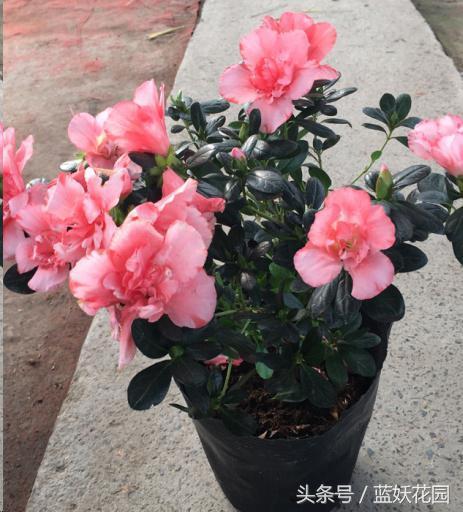
Rhododendron leaves turning black at the tips and yellowing without growing? One trick will fix it
Click [Follow] in the top right corner to follow the Lanyao Garden Toutiao account, and send a private message with "Rose Course" to receive 4 free rose care lessons!
This is day 917 of Lanyao's daily original articles
Yesterday Lanyao shared two basic precautions about repotting, but different flowers often have different situations, so there are naturally more things to pay attention to when repotting.
Those of you who have bought rhododendrons, say something and let Lanyao see! I believe most of you have run into this problem.
After buying a rhododendron and repotting it, nothing seems wrong at first, and it still blooms, but after the flowers finish it slowly starts to go downhill.
The leaves begin to yellow and dry from the tips, then start dropping, and some flower buds wither before they even open.
At first only the leaf tips dry out and fall off, but as it progresses some branches dry up too, and almost all the leaves drop, leaving only a few leaves at the tips of the branches, still somewhat chlorotic and yellowing.
Gardeners who have encountered this situation, please raise your hands!
So why does this happen?
Many gardeners think it is because their potting soil is poor and has become alkaline. Of course that reason can't be ruled out, but for a rhododendron bought just a few months ago, it is not the main cause.
Think about it: why didn't this happen when you bought it? It bloomed nicely too, so why did problems appear right after the flowers finished?
In fact, this is a problem of excessive nutrient consumption.
Why does excessive nutrient consumption occur?
To figure this out, first take your rhododendron out of its pot and have a look.
You will find that the rhododendron has not grown any new roots at all; it is still the same root ball from when you bought it, and there is simply no new growth into the newly added soil.
To put it plainly, although we moved the rhododendron into a bigger pot, its root system did not grow. With no new roots growing, it is no different from not repotting at all.
The original root ball is so small and its nutrients are limited. After the heavy consumption of blooming, there is practically nothing left, and after a few months in our care with repeated watering, the fertility and acidity of the root ball have been more or less washed away, so the rhododendron develops yellow leaves and leaf drop.
You might say, I added base fertilizer when I repotted!
With no new roots growing, the fertilizer in the new soil does nothing for the rhododendron.
So how can this situation be avoided?
To prevent this from happening to rhododendrons, we need to take preventive measures in advance and do a good job of prevention when repotting.
The growing medium of a bought rhododendron is often peat or coir, and the roots outside the root ball are often already dead fibrous roots.
When repotting at this point, we should remove the soil on the outer edge of the original root ball along with those dead fibrous roots.
Prune the roots until healthy, living roots are exposed, and then plant it.
In this way, new roots will quickly grow into the newly added soil.
You may worry: won't this damage the roots and cause the rhododendron's flower buds to drop? Or even kill the rhododendron?
We usually buy rhododendrons in late autumn or early spring, or even in winter. During such periods the temperature is relatively low, the plant's transpiration is relatively slow, and even if the roots are somewhat damaged, the impact on the plant is not particularly great.
This is also why most of our potted plants are repotted in autumn and early spring.
So there is no need to worry at all that root pruning will kill the rhododendron. On the contrary, if you plant it directly without pruning the roots, no new roots will grow, and it will be very hard to keep alive; in the end it will only wither.
The rhododendron is a rather special kind of potted plant, so Lanyao is covering it separately.
Most potted plants do not need this treatment, but it still depends on the situation and must be handled differently. Tomorrow I will continue sharing the common situations and solutions for repotting ordinary potted plants.
Welcome to follow the WeChat public account of the same name: Lanyao Garden (ilanyao) to learn systematic flower-growing knowledge.
Welcome to follow the [Lanyao Garden] Toutiao account, grow faster together, and become a flower-growing expert. If you like my articles, why not give them a like, share them, or save them!