Medicinal herb cultivation boosts farmers' income in Bozhou: over a thousand mu of land yields real gold and silver
In the newly built specialized Chinese medicinal herb market in Bozhou, there is a slogan that goes "Some people daydream, others make so much money they can't walk." The so-called "make so much money they can't walk" refers to those merchants or herb farmers engaged in the Chinese medicinal herb business in Bozhou. During this visit to Bozhou, the reporter found just such a farmer, Wang Minxing, whose family has made a living growing herbs for generations. Starting in 2009, he planted over 1,400 mu of medicinal herbs and hired four to five hundred herb farmers to grow herbs for him professionally. Later, through the form of an agricultural cooperative, he took in more than 200 herb farmer members, specifically purchasing their medicinal herbs, with annual gross profits of three to four million. This is just a microcosm of the many Bozhou herb farmers who "make so much money they can't walk."
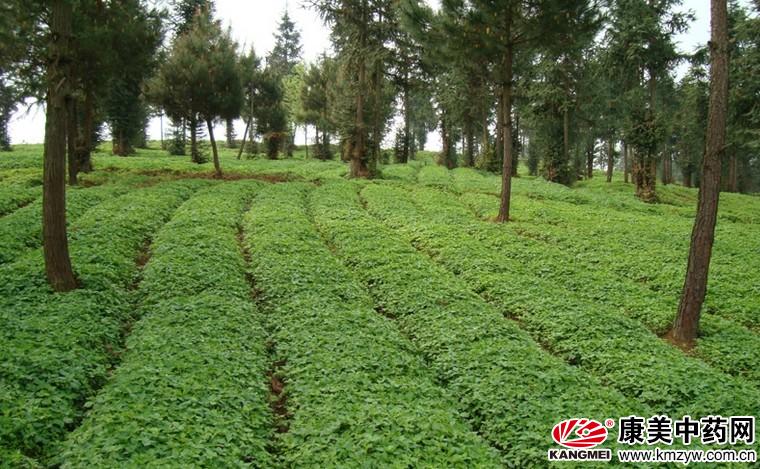
Familiar with a hundred herbs, growing herbs for generations
Reporter: When did you start growing herbs? Wang Minxing: As far back as I can remember, my family has always been growing herbs. Our family is from Shijiu Li Town in Bozhou. My father, grandfather, and great-grandfather all grew herbs. As for exactly when it started, that would have to go back at least to after Hua Tuo (Three Kingdoms period). The tradition of farmers in our Shijiu Li Town growing herbs is just like farmers in other villages growing grain; for generations we have made our living from this.
Reporter: What herbs do you usually grow?
Wang Minxing: Probably several dozen kinds, mainly Atractylodes macrocephala, white peony root, Bozhou chrysanthemum, Anemarrhena asphodeloides, and Arisaema erubescens. Before, I worked alone, growing a little on my own land, and the income was decent. In 2008, when the village carried out land transfer, I contracted over 1,000 mu of land and began growing on a large scale.
Contracting 1,470 mu of land to grow herbsReporter: In 2008, the entire medicinal herb market seemed to be in a downturn.
Wang Minxing: Exactly. At that time, many herb merchants who contracted to grow Chinese medicinal herbs around here lost money, some as much as several million.
Reporter: So how much did you lose at that time?
Wang Minxing: I was relatively lucky, because I was familiar with this market and knew how to grow, how to process, and how to sell, so I didn't lose too much. At that time, land contracting was only 600 yuan per mu, and the cost of growing medicinal herbs was still relatively low. But after 2009 into 2010, the entire medicinal herb market rebounded strongly, and herb prices rose sharply, and not just by a little. Just when I was preparing to go all out, the farmers who had contracted out their land refused to continue.
Reporter: Why?
Wang Minxing: They felt that since herb prices had risen, the land they had rented out was too cheap and not worth it, so they took back the land that had originally been contracted out under signed agreements and grew herbs themselves.
Reporter: So didn't you end up with no land to grow herbs on?
Wang Minxing: Exactly. The contracting agreement had been signed, but they went back on it. We're all fellow villagers, so where could I go to reason with them? Later there was no other way. A relative set up a medicinal decoction piece factory and pulled me in to work together. I then contracted 1,470 mu of land anew in the neighboring Shiba Li Town and started growing herbs.
Inviting experts to teach four times a yearReporter: So for the 1,470 mu of land you contracted, how many herb farmers do you need to help grow the herbs?
Wang Minxing: There are only 3 permanent management staff, but during regular planting and harvesting, I have to hire over 500 herb farmers to help.
Reporter: I heard you later also established a medicinal herb cooperative?
Wang Minxing: Led by the government, I established a medicinal herb cooperative named after myself, and it now has 208 herb farmer members. For the herbs they grow each year, I purchase them at a price higher than the market price.
Reporter: Are these member herb farmers also professionalherb cultivationhouseholds in Shijiu Li Town?
Wang Minxing: Basically all of them are, though some are from other towns. Every year I also pay out of my own pocket to gather the cooperative's 208 member households and more than 500 herb farmers who help, and invite experts to teach them knowledge about scientific cultivation. The expert lectures are fixed, 4 times a year. Sometimes I also teach myself, and when I find some free time I talk with them about it.
A microcosm of "making so much money they can't walk"Reporter: With such a large planting area and so many herb farmer members, can you be considered a major herb grower in Bozhou?
Wang Minxing: (smiles) I probably shouldn't be considered the biggest; there are even bigger ones. In Bozhou there are still 12 medicinal herb cultivation cooperatives like mine. I count as one of the higher-ranked ones.
Reporter: So how much was the profit in one year?
Wang Minxing: A few hundred thousand. If you count gross profit, probably three to four million.