Detailed Explanation of Key Points for High-Efficiency Cultivation Techniques of Bletilla striata
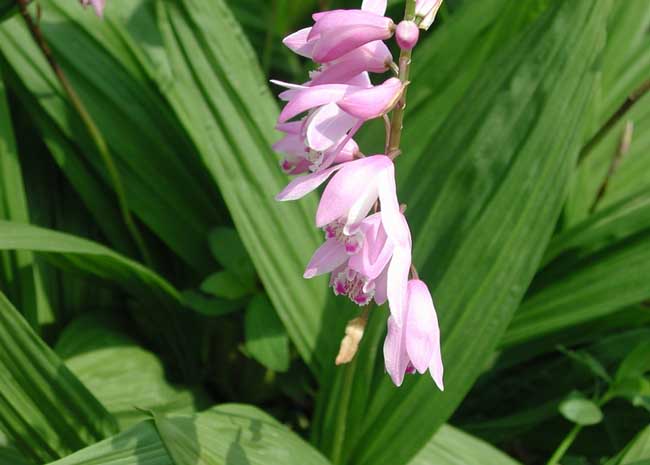
Bletilla striata is a plant of the genus Bletilla in the orchid family (Orchidaceae), also known by aliases such as Lianjicao, Gangen, Baigei, Zhulan, and Zilan. It is a commonly used traditional Chinese medicine with functions such as tonifying the lungs and stopping bleeding, reducing swelling and promoting tissue regeneration. It mainly treats pulmonary tuberculosis with coughing up blood, bronchiectasis with hemoptysis, gastric ulcer with vomiting blood, hematuria, and bloody stools, and is used externally for traumatic bleeding, burns and scalds, and chapped hands and feet. Bletilla striata has an especially good hemostatic effect. Nowadays, the gel film blocks made from Bletilla striata are used in liver and spleen surgery, applied at the incision to replace hemostatic forceps, with excellent results. It has a rapid coagulation effect and can substitute for plasma in many surgical operations. It is mainly produced in Sichuan, Yunnan, Shaanxi, Gansu and other provinces, and is cultivated throughout the country.
Morphological Characteristics
Bletilla striata is a perennial herb, with a plant height of 30-60 cm. The tubers are fleshy, white, with 2-3 forks in a water-chestnut shape, having fibrous roots, often several growing together. The raceme is terminal, usually with 3-8 flowers; the flowers are pale purplish-red, with irregular petals. The capsule is cylindrical, with 6 longitudinal ridges, slightly pointed at both ends. The seeds are tiny and numerous. The flowering period is April to May, and the fruiting period is July to August. There are two types of Bletilla striata; another type has yellow-white flowers and linear-lanceolate leaves, which is Bletilla striata var. angustifolia. Among the purplish-red flowered types, there are further distinctions between large and small varieties, with the large variety having higher tuber yield.
Growth Characteristics
Bletilla striata prefers a warm, cool and relatively shady and humid environment. It is not cold-tolerant and requires fertile, loose and well-drained sandy loam or humus loam. It should be cultivated on shady slopes or relatively shady and humid plots.
Cultivation Techniques
1. Site selection and land preparation: Choose loose and fertile sandy loam and humus loam, in a warm, slightly shady and humid environment; it is not cold-tolerant. When planting on well-drained mountain land, it is advisable to choose a shady slope of virgin land for planting. Plow the soil to a depth of more than 20 cm, apply barnyard manure and compost, with 1000 kg of farmyard manure per mu; if there is no farmyard manure, broadcast 50 kg of NPK compound fertilizer. Then plow again to mix the soil and fertilizer evenly. Before planting, do a shallow plowing once, break the soil up fine, rake it level, and make raised beds 130-150 cm wide.
2. Propagation methods: Bletilla striata is relatively difficult to propagate by seed, but easier by dividing tubers. From early September to November, dig out the Bletilla striata, select medium-sized tubers with many bud eyes and no disease, each piece with 1-2 buds, dip them in plant ash, and then plant. Open furrows with a row spacing of 20-25 cm and a depth of 5-6 cm, place one tuber at a plant spacing of 10-12 cm, with the buds facing upward, cover with soil, firm it down, water, and cover with grass, keeping it moist regularly. Seedlings emerge in March to April. Use 100 kg of planting material per mu.
3. Field management
① Intertillage and weeding: Bletilla striata has very strict requirements for weeding in field management. After planting, spray acetochlor for pre-emergence closure. After the Bletilla striata seedlings emerge completely, in May to June, Bletilla striata grows very vigorously and weeds also grow quickly, so weeding is carried out. Weeding is combined with loosening the bed surface; when weeding, hoe shallowly to avoid damaging the roots.
② Timely topdressing: Bletilla striata is a fertilizer-loving plant. Spray potassium dihydrogen phosphate or dilute human and animal manure once a month. In July to August it stops growing and enters dormancy, but weeds must still be prevented from growing rampantly.
③ Irrigation and drainage: Bletilla striata prefers shade and should be kept moist regularly. Water during drought, and in July to September water once each morning and evening. Bletilla striata is also afraid of waterlogging, so drain promptly after heavy rain to avoid damaging the roots.
Pest and Disease Control
1. Root rot: It mostly occurs in the rainy seasons of spring and summer in the south. Control methods: pay attention to drainage and waterproofing, and dig drainage ditches deep.
2. Cutworms and wireworms: They can be controlled by manual capture and trapping, or by mixing poisonous soil, and applying Dichongjue to the bed. Irrigate the bed with 50% zinc phoxim emulsifiable concentrate at 700 times dilution.
Harvesting and Processing
After Bletilla striata has been planted for 2-3 years, in September to October when the aboveground stems wither, dig out the tubers, remove the soil, and process them. Pick off the tubers individually, select and keep the tubers with new stems for seed use, cut off the stems, soak in clean water for 1 hour, wash off the soil, put into boiling water and boil for 5-10 minutes, take out and dry on a heated bed until completely dry. Remove the coarse skin and fibrous roots completely, and sift out impurities. Generally, 800-1000 kg of fresh product can be harvested per mu, which can be processed into 200-300 kg. Those that are large, plump, white, semi-transparent and solid in texture are considered the best. The tubers of Bletilla striata contain starch, glucose and volatile oil, and the roots contain Bletilla striata glucomannan.
After reading about the cultivation techniques of Bletilla striata, let's take a look together with the editor at how the cultivation prospects of Bletilla striata are!
The tubers of Bletilla striata are a traditional Chinese medicine, and Bletilla striata also has brightly colored flowers, making it a very good ornamental plant. Due to the expansion of market demand, the market demand for Bletilla striata is very strong. In recent years, wild Bletilla striata in most areas of China has been over-harvested, causing its wild natural resources to decrease sharply and face extinction, and it has been listed by the state as one of the key protected wild medicinal plants. Because the wild resources of Bletilla striata have suffered devastating destruction, and the artificial breeding of Bletilla striata is still subject to certain technical limitations, the shortage of goods on the market and the sharp rise in price have become an inevitable trend. To confirm this statement, we will demonstrate from the following aspects.