How to build a chicken coop for free-range native chickens? Keep this reference plan
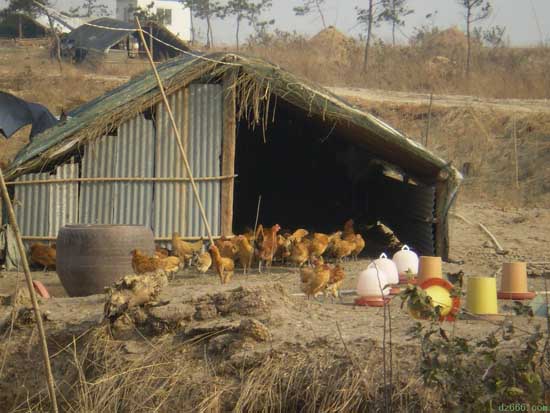
This time, two chicken coops are to be newly built, facing south with their backs to the north, located at the center of the orchard, with a superior geographical environment that is conducive to the chickens going out to forage. The following suggestions are put forward for the construction of the new coops for the leadership's reference.
Construction of a free-range native chicken coop
1. The floor level inside the chicken coop should preferably be 25--35 cm higher than the ground outside the coop; otherwise, the coop floor and litter will become damp, leading to disease outbreaks in the flock. In addition, during heavy rain, rainwater will backflow into the coop.
2. As for the color of the rolling plastic windows of the chicken coop, on the south and north sides, the lower rolling blinds should preferably be dark in color and the upper part should preferably be transparent, and the transparent upper part should account for no more than one third of the window area. The lower part of the upper and lower rolling blinds should be fitted with a device to prevent them from bulging in the wind, so as to help with insulation and prevent drafts from entering.
3. The roof of the chicken coop should be covered with straw for heat insulation and warmth retention.
4. The main door for people to enter and exit the chicken coop should be sturdy and lockable. Eaves should be built above the door and windows to prevent rainwater from blowing in.
5. Windows should be installed on the east and west walls of the chicken coop to facilitate ventilation and cooling in summer.
6. Each small compartment of the chicken coop should have a ground-level window for the chickens to enter and exit, and adjacent ground-level windows should not face the same side.
7. A well should be dug at a suitable spot between the two new chicken coops for drinking water for the flock and washing the coops, etc. If necessary, a fence net should be set up between the two coops to separate them.
8. In the middle of the north side of the chicken coop, starting at a distance of 10 m, simple rain-and-sun shelters 2--2.5 m wide should be built along the north direction extending toward the far end, with a height of 1.5 m, for the flock to shade from the sun and take shelter from heavy rain. Water pipes and automatic drinkers should be installed in the shelters, or an independent rain-and-sun shelter should be built above each automatic drinker. The area of each shelter should be determined according to the situation (according to fruit tree density), and the distance between each drinker should be 10--12 m.
9. The land outside the chicken coop should be properly leveled, and large ditches should be covered so that the chickens can conveniently enter and exit the door and walk outside the coop.
10. Inside the chicken coop, 30 automatic drinkers need to be purchased, and 20 outside the coop, 50 in total. Inside the coop, 60 large feed buckets and 2 sprayers need to be purchased.
11. In winter, the grass and leaves dry up and insects hibernate, so it is not suitable to range the flock. If ranging is required, the chickens must be provided every day with cornmeal, soybean meal, bran, and large amounts of organic waste such as leftover vegetables and vegetable leaves from vegetable greenhouses. At present, the vegetable leaves left after harvesting in the greenhouses can be fed to the chickens.
12. The chicken coop should have dedicated staff on duty, and at least two dogs should be kept for guarding.
13. Roads should be built outside the chicken coop, and water, electricity, partition nets and other facilities should be installed inside the coop. 3—4 energy-saving street lamps should be set up, and a relatively sturdy perimeter net should be set up around the orchard to prevent chickens from being stolen and from escaping.
That is all for the chicken coop construction plan for free-range native chickens introduced by the editor. Next, the editor will continue to introduce what points need attention in free-range native chicken farming. Since native chickens have always been one of the foods people prefer, and their taste is more delicious than ordinary chicken, no matter what kind of chicken, farming requires skill, especially for native chickens. So what points need attention when farming native chickens? Let us take a look together below!
Selection of the environment for free-range native chickens
Choose quiet mountainous land far from village residential areas, slaughterhouses, schools, chemical plants, other farms, industrial and mining areas, and main roads, preferably planted with shrub forests, tea, pine trees, moso bamboo, fruit tree forests, etc., with a slope of 3-40 degrees (the elevation angle between the slope surface and the horizontal plane); small hilly mountainous land is better. There should be clean well water or spring water nearby. Choose flat land sheltered from the wind and facing the sun; sandy loam soil is more suitable, with smooth drainage, fast seepage under normal conditions, and dry terrain. Use hollow bricks to build walls, cement tiles to cover the roof, and building materials such as wood or moso bamboo to build a chicken coop running east-west and facing south with its back to the north. The eave height is about 2 m, the ridge height is 3 m, the length is 50 m, the span is 5-10 m, about 500 sq m, and it can raise 3000-4000 native chickens. Open a door on the south side, leave ground-level windows and a 2 m wide corridor, leave windows in the north wall, and have drainage ditches all around. The chicken coop should be able to ventilate and retain warmth, and the ground should be dry. The ground can be compacted with sand and gravel; there is no need to make a cement floor. On top, bedding such as sawdust and rice husks can be spread, as long as water does not accumulate. Each flock should be 2000-4000 birds. Even if there is surplus funds, a second branch farm can be laid out anew at a place about one kilometer away. It is suitable to range 100-500 birds per mu of mountainous land. For brooding, chicks can be raised in a simple room at the foot of the mountain until they weigh about half a jin, then ranged in the mountain forest. For the first three days, keep them confined and release them little; no fence is needed. Native chickens have a strong homing instinct and will naturally know how to return home.
Since the chicken coop is used for chickens to rest, lay eggs, and shelter from wind and rain, each farm must adopt an "all-in, all-out system" to prevent disease outbreaks.
Selection of breeds for free-range native chickens
Native chickens are also called grass chickens, firewood chickens, local breed chickens, etc. There are many native chicken breeds. Over a long period, our ancestors continuously selected them, and now native chickens with different body shapes, feather colors, and laying performance have formed in different regions.
Relatively high-quality native chicken breeds include Xuanzhou Yellow Chicken from Anhui Province, Liyang Yellow Chicken, Xianju Chicken from Zhejiang Province, Beijing You Chicken, Yunnan Chahua Chicken, Qingyuan Partridge Chicken, Gushi Chicken, Emei Black Chicken, Xiaoshan Chicken, Shouguang Chicken, Taoyuan Chicken, Hetian Chicken, etc. Some are egg-type, and some are meat-type. Most weigh between 2-4 jin, and the number of eggs laid is about 120-180 eggs in 500 days. The required ratio of males to females is 1:8-10. It is better to choose chickens from your own local area, because the consumption resources are certainly based on local habits, and moreover local chickens adapt better to the local climate and environment.