How to raise Putian black pigs? Detailed explanation of breeding technology key points
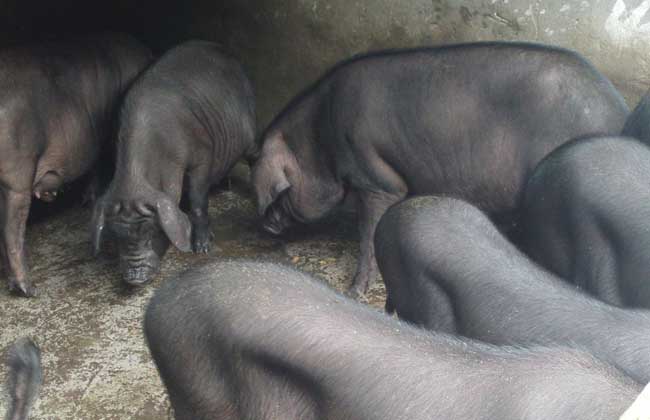
The Putian black pig is a population gradually formed from crossbreeds of the "big-eared pig" introduced from Fuzhou and the "small-eared pig" introduced from southern Fujian through long-term self-breeding and selection. It is mainly produced in the northwest of Putian, Xianyou and Fuqing cities in Fujian Province. It has a medium body size, a relatively shallow and narrow chest, and features such as early maturity, wide adaptability, large litters and strong mothering ability. Let's take a look at Putian black pig breeding technology together below!
Physical characteristics of the Putian black pig
The Putian black pig is medium in size, with a slightly narrow and long head, a slightly concave face, relatively deep forehead wrinkles forming a diamond shape, medium-sized thin ears of peach shape that lean slightly forward and droop, a neck of moderate length, a long body, a relatively shallow and narrow chest, a flat or slightly concave back and loin, slightly sloping rump, underdeveloped hindquarters, a large round and drooping belly, generally no skin folds on the back, loin and sides of the body, relatively high limbs, sparse grayish-black hair, and mostly 7 pairs of teats.
Breed performance of the Putian black pig
The Putian black pig has excellent characteristics such as early maturity, wide adaptability, tolerance to roughage, strong disease resistance, large litters, strong mothering ability, a gentle temperament, and fine, tender and delicious meat. Adult boars have an average body weight of 126.04 kg, body length of 131.5 cm, chest circumference of 120.75 cm, and body height of 79 cm. Adult sows have an average body weight of 77.37 kg, body length of 116.99 cm, chest circumference of 100.37 cm, and body height of 63.9 cm.
Breeding technology for the Putian black pig
1. Pig house construction: The pig house for Putian black pigs should not be built too luxuriously; it is enough to achieve cold protection, warmth retention and ventilation. In summer and autumn, planting plants such as gourds, large melons, pumpkins and sunflowers outside the pig house can provide shade and lower the temperature. In winter, promote plastic warm shed feeding technology.
2. Breed selection: The breed of Putian black pigs should be selected according to market demand. At present, multiple crossbreeding should be promoted, at least three-way crossbreeding, and preferably five-way crossbreeding, such as British PIC pigs, with a five-line combination, fast growth speed, reaching 110 kg in 158 days, a lean meat rate of 66%, and a feed-to-meat ratio of 2.8:1.
3. Breeding density: In winter, 0.8 sq m of pig house raises 1 fattening pig; in summer, 1 sq m of pig house raises 1 fattening pig. High-density pig raising not only requires fewer pens and lower costs, but also makes fattening pigs compete for food. With no activity area, they sleep once full, tend to put on meat, gain weight quickly, and reduce feeding costs.
4. Feed formulation: Feed accounts for 70-75% of pig raising costs. The feed formula should change with market prices and seasons, and should not remain unchanged. For example, in summer when it is hot and pigs eat less, the feed should be formulated to be more nutritious. Feed nutrition should be balanced and appropriate to meet growth needs.
5. Feeding management: Putian black pigs should be raised scientifically, with feed reasonably matched according to the pigs' different uses, different ages and growth needs, management strengthened, hygiene done well, and disease occurrence prevented. Attention should be paid to disinfection, not only to prevent external epidemics, but also to prevent contamination by feces and the spread of disease, and vaccines should also be injected according to the immunization program.
6. Timely marketing: For example, when binary pigs reach 70 kg, internal three-way crossbred pigs 80-85 kg, external three-way crossbred pigs 95 kg, and British PIC pigs 105 kg, these are the appropriate body weights for marketing. In addition, when the live pig market price is high, the heavier the body weight, the better; when the price is low, lighter body weight is better, reducing feed consumption and lowering costs.
7. Timely slaughter: After Putian black pig fattening pigs exceed 90 kg, the daily weight gain speed clearly slows down and fat deposition becomes dominant, so the more they are fed, the less cost-effective it becomes, and the increase in fat makes them difficult to sell. Slaughtering at less than 90 kg, although feed utilization rate is high, has a low carcass yield due to small body weight, and is also not economically cost-effective. Generally, slaughtering fattening pigs at 90-120 kg is most suitable.