Detailed Explanation of Qinchuan Cattle Breeding Techniques and Feeding Management Methods
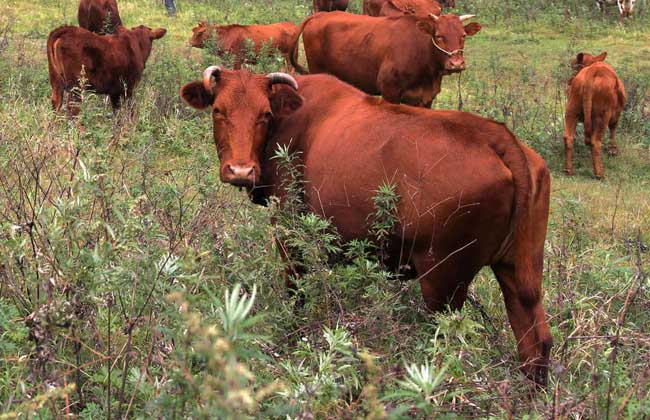
Qinchuan cattle is a famous large dual-purpose (draft and meat) cattle breed in China, originally produced in the Guanzhong Plain area of the Wei River basin in Shaanxi Province. It is an excellent local yellow cattle breed and one of China's five major yellow cattle breeds, with a large build, strong draft capacity, and good meat production performance. It is named after the Guanzhong region of Shaanxi Province in the 800-li Qinchuan plain. Let's take a look at Qinchuan cattle breeding techniques together below!
Breed Performance
Under good feeding conditions, Qinchuan cattle male calves reach 250 kg at 6 months of age, female calves 210 kg, with daily weight gain reaching 1400 g. Under good feeding conditions, bulls can reach 511 kg at one year of age. As a specialized large meat-type cattle, it has good meat production performance, with a dressing percentage generally of 60-70%, and lean meat rate of the carcass of 80-85%. Fattened cows at 16 months of age have a carcass weight of 418 kg, with a dressing percentage of 66.3%. Cows have relatively high milk production, producing 2000 kg of milk per lactation period, with a milk fat percentage of 4.0-4.7%, but this breed has a relatively high rate of difficult calving during purebred breeding.
Warm Barn Fattening
If fattening in a permanent cattle barn or plastic film warm shed barn, barn maintenance should be done well before housing, and holes, gaps and cracks in surrounding walls as well as windows should be sealed tightly. Transparent plastic film should be selected for plastic warm shed barns. Cement or brick floors should be covered with bedding straw that is changed frequently, keeping the temperature inside the shed above 5°C. After April, as the weather gradually warms, the open area of the shed should be gradually increased. Do not remove all the plastic at once, to avoid cattle catching cold.
Disease Prevention and Deworming
1. Newly purchased cattle should undergo a comprehensive examination. Only healthy ones may be injected with foot-and-mouth disease vaccine, brucellosis vaccine, Clostridium welchii disease vaccine, etc. before being admitted to the barn for mixed rearing, and a comprehensive deworming should be carried out before entering barn fattening. Orally administer 4 capsules of Chongkexing per 100 kg body weight (containing 20 mg of active ingredient), or subcutaneously inject 2 ml per 100 kg body weight. Alternatively, administer 5-7 mg of Kangrumin per kg body weight, or 6-8 mg of levamisole, to expel various internal parasites. In areas where liver fluke occurs, drugs such as niclofolan can be used for deworming.
2. For external parasites, spray each cow's body with 0.3% peracetic acid, then wipe all over once with 0.25% mite-killing emulsion. Three days after deworming, use artificial salt or other stomachic drugs to improve digestion. In addition, newly housed cattle are prone to stress reactions due to environmental changes, transport, fright and other reasons. 0.5% salt and 1% brown sugar can be added to drinking water for one consecutive week, and more green grass or green hay should be fed. After two days, feed a small amount of wheat bran, gradually transitioning to feeding fattening feed. During the fattening process, pay attention to observing the feed intake, excretion and mental state of the cattle herd.
Careful Management
The most suitable environmental temperature for Qinchuan cattle is 5-21°C. During the fattening period, a warm, quiet and comfortable environment should be created for the cattle as much as possible. Generally, tethering fattening should be adopted. Except on snowy and windy days, tether the cattle to wooden stakes outside the barn to sunbathe from 8 AM to 3 PM every day. The tethering rope should not be too long, with 0.4 m being appropriate. Brush the cattle's body 1-2 times daily to keep the body clean. Install openable ventilation windows on the barn roof, ventilate once daily at noon for 10-20 seconds. Remove manure regularly every day, keep the barn clean and hygienic, dry and ventilated, and strictly prevent dampness.
Scientific Feeding
1. Early fattening stage: The early fattening stage takes about fifteen days or so. Mainly use ammoniated straw and silage corn straw as roughage, combined with locally available concentrated feed. Ammoniated straw or silage corn straw is fed freely, with adequate drinking water supply. From the second day, gradually increase concentrated feed, then increase rapidly thereafter. By the end of the early stage, daily concentrated feed can reach about 2 kg, or mixed concentrated feed given at 0.8% of body weight, averaging about 1.5 kg per day. The concentrated feed formula is cornmeal 45%, wheat bran 40%, cake-type feed 10%, bone meal 2%, urea 2%, salt 1%, plus two cod liver oil capsules added per kg of feed.
2. Mid-fattening stage: The mid-fattening stage usually lasts about thirty days. During feeding, pay attention to a reasonable combination of roughage. At the beginning of the transition period, the ratio of roughage to concentrated feed is 3:1, in the middle period 2:1, and in the later period 1:1. The feed formula for this stage is corn flour 6%, wheat bran 15.5%, dehulled cottonseed cake 12%, corn stalk powder 25.8%, bone meal 0.4%, shell powder 0.3%, salt 50 g/head, vitamin A 2 IU/head. Feed once each in the morning and evening daily, maintaining 4-5 kg/day per head, and provide drinking water 2 hours after feeding.
3. Late fattening stage: The late fattening stage takes about forty-five days or so. The diet should be mainly concentrated feed, with the amount of concentrated feed accounting for 70-80% of the total diet, and supply high-energy (60-70%), low-protein feed (10-20%), feeding at 1.5-2% per 100 kg body weight, with the ratio of roughage to concentrated feed from 1:2 up to 1:3. Appropriately increase the number of daily feedings and ensure adequate drinking water supply. The feed formula for this stage is corn flour 2-3 kg, sugar residue 20-25 kg, distiller's grains 15-20 kg, silage straw 10-15 kg, salt 50 g, mineral additive 20 g, fed once each in the morning and evening; or corn flour 56%, cottonseed cake 10%, wheat bran 8%, ammoniated wheat straw powder 23.5%, growth hormone 1%, salt 1%, sodium bicarbonate 0.5%, fed 6-7 kg per head per day.