Does the Komodo dragon have any natural predators? Read on and you'll understand
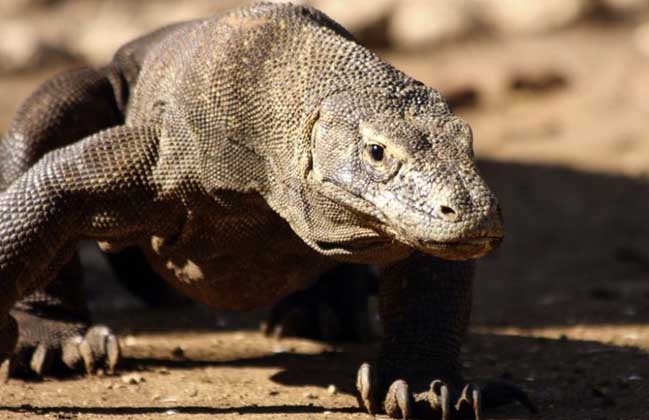
The Komodo dragon is the largest lizard among the species known to exist today, also known as the Komodo dragon, with a fierce temperament. Adults eat the young of their own kind, and sometimes eat other adults. It can move quickly and occasionally attacks humans, but mainly feeds on carrion, coming out of its burrow every day to forage several thousand meters away. Now let's take a look at whether the Komodo dragon has any natural predators!
Does the Komodo dragon have any natural predators?
The Komodo dragon has almost no natural predators. The Komodo dragon is a species that inspires awe and fear. Its mouth contains a great many bacteria, and it also has venom glands in its lower jaw. Any animal bitten by it will die from bacterial infection or the onset of venom, making it a very dangerous animal with almost no natural predators in nature. The Komodo dragon's only natural predator is the Javan tiger, but excessive hunting by humans led to the extinction of the Javan tiger, leaving the Komodo dragon without any natural predators.
What food does the Komodo dragon eat?
As a carnivore, the Komodo dragon feeds on wild boars, deer, monkeys, anacondas and so on on the island, and sometimes also preys on weaker members of its own kind and young, and occasionally attacks humans or scavenges human corpses. By 2010, about 12 people had died from the venom in wounds inflicted by the giant lizard. After finishing a meal, the Komodo dragon lies prone among the jungle, on the beach or on the reefs, sleeping sweetly and basking in the sun. Moreover, the Komodo dragon is a good swimmer and has the special ability to dive underwater to catch fish or stay underwater for several tens of minutes, and can even swim across the ocean.
Is the Komodo dragon venomous?
To deal with huge prey, the Komodo dragon developed its own biological weapon——the venom gland of the Komodo dragon. The venom gland secretes a venom that resists blood clotting and can destroy animals' blood clotting function, causing the animal to bleed continuously until death. Regarding the deadly bacteria in the Komodo dragon's mouth, scientists have already conducted experiments: observing the head of a female Komodo dragon with modern medical machinery, they found that the Komodo dragon has venom glands. This evidence also proves that the Komodo dragon, like venomous snakes, uses venom to attack prey rather than deadly bacteria. However, the venom of the Komodo dragon still awaits further study.
Is the Komodo dragon protected?
The Komodo dragon is one of the world's most precious animals. People once hunted it to obtain its hard, thick skin or captured it for exhibition in zoos, leaving no more than 3000 Komodo dragons. It is a nationally protected animal of Indonesia and a vulnerable species of the International Union for Conservation of Nature. It has been protected in the national park on Komodo Island, and in 1991 Komodo National Park was inscribed as a World Heritage Site. It has been listed in the International Union for Conservation of Nature (IUCN) 2012 Red List of Threatened Species ver3.1——Vulnerable (VU).