Detailed Explanation of Grouper Culture Methods and Technical Key Points
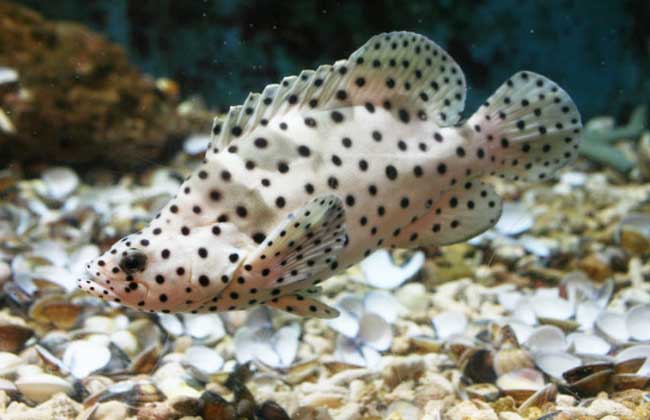
The humpback grouper, also known as the green grouper, mandarin fish, humpback cod, etc., is a fish of the genus Cromileptes in the family Serranidae. It is mainly distributed in the reef areas of the Indian Ocean and can grow up to 50 cm. Because it is easy to keep, it grows very quickly, and provided there is enough space for growth, it can live a long time. In an aquarium it can be fed most different kinds of food. Let us take a look below at the culture methods for the humpback grouper!
Broodstock Rearing
The broodstock of the humpback grouper generally comes from fish caught at sea (they must first be acclimated before mating and fertilization) or from artificial culture. They are fed fresh trash fish meat every day (fish with high protein and low fat are most suitable), with a feeding amount of 5-10% of the total body weight of all broodstock. In addition, to accelerate the maturation of the gonads, Vitamin E (10 mg/kg, once a week) may be added to the feed. To improve the physical strength and health of the broodstock, Vitamin C and B-complex (50 mg/kg, once every two weeks) may be added.
Broodstock Mating
When the egg diameter of female humpback groupers is greater than 5 mm and the number of mature sperm in the males has reached a sufficient level, the broodstock can be prepared for mating. The main preparation work for broodstock mating is to control the hydrological conditions of the broodstock culture pond. The method is to lower the water level at 8-9 a.m. to a water depth of 50 cm, maintain this for 5-6 hours, and then raise the water temperature by 1-3 degrees C. To achieve this condition, start injecting fresh seawater at 2 p.m. to a water depth of 2.5-3 m, and keep the pond water circulating and flowing continuously throughout the night. This treatment method must be continued continuously until the broodstock become sexually excited and mate.
Egg Incubation
1. Collection: Start collecting fertilized eggs with a collection net at 7 a.m., then wash the eggs with clean seawater, and move the washed fertilized eggs into a water tank for counting. The fertilized eggs of the humpback grouper are pelagic eggs and transparent in color. Unfertilized eggs are dark in color and mostly sink to the bottom, making them very easy to distinguish. They must be removed by siphon method so as not to affect the normal eggs.
2. Incubation: When moving the fertilized eggs to the incubation pond, the density is about 10-50 eggs per liter of seawater. At a water temperature of 26-28 degrees C, it takes about 10-20 hours to hatch into larvae. The next day, the unhatched eggs at the bottom of the pond must be removed by siphon method, and the larvae must be carefully moved with a ladle to the nursery pond for rearing. The fertilization rate, hatching rate, and survival rate of the fry of newly hatched larvae are all closely related to the quality of the eggs.