How to keep arapaima? Detailed explanation of the key points of breeding techniques
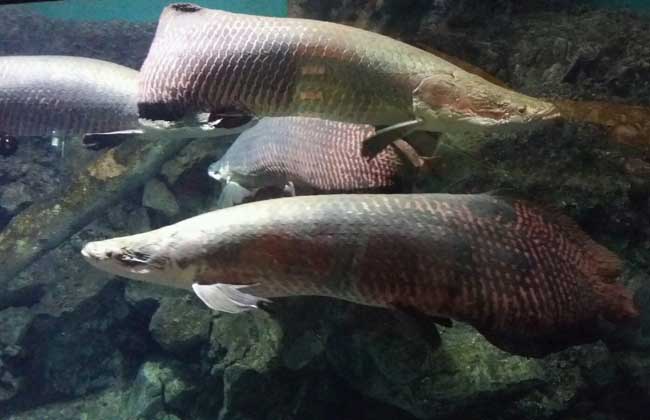
The arapaima is one of the largest freshwater fish in the world, also known as the pirarucu, giant arapaima, warship dragon, etc. It belongs to the surviving ancient freshwater fish species and is native to the Amazon River basin in South America. Its meat can be made into dried or salted products, its teeth can be dried and used as a substitute for files, and live fish can be kept for ornamental purposes. Let us take a look at the breeding techniques for arapaima together!
Living habits of the arapaima
The arapaima lives in the most primitive tropical jungle waters in the world. It mainly feeds on small fish, but occasionally also preys on snakes, turtles, frogs and insects, and even preys on small crocodiles. Because of the extremely hot weather, the oxygen content of the slow-flowing river water decreases, and the arapaima needs to surface from time to time to swallow air in order to breathe. In the dry season, it can also protect itself by burrowing into the mud and sand. It has great brute strength and uses its tail as a weapon, which can easily knock down an adult man and shatter bones, causing massive internal injuries.
Breeding habits of the arapaima
The arapaima spawns on shallow shoals like salmon, gathering in lakes and river channels in August when the water level is low. The breeding season ends from December to March, and about 160,000 eggs are laid each time, in several batches. The eggs hatch in about 3 to 5 days, at which point the female usually leaves alone, while the male stays behind to protect the young fish. The male's tail turns red to protect the eggs and care for the newly hatched young. The young fish have black heads, and the male's head is also black. The young fish often stay around the male's head and are unwilling to leave. The young fish are cared for by their father for about three months. As the floodwaters recede, the adults and subadults separate, and later migrate to lakes and rivers. They reach sexual maturity at 4 to 5 years of age, and captive arapaima live 15 to 20 years.
Breeding techniques for arapaima
1. Fish tank: The arapaima grows rapidly. It is recommended that the aquarium for keeping arapaima be 4.5 m long, 1.5 m wide and 1.5 m high. A 1.5 m fish tank at home can at most only raise an arapaima to about 1 m in length. When stocking it into the fish tank, it is necessary to ensure there is enough rearing space and a broad range of activity for the fish. If the water level in the tank is relatively low, protective measures must be taken at the top of the tank to prevent it from jumping out and causing unnecessary losses.
2. Water quality: The arapaima is a tropical fish and likes weakly acidic water. Its requirements for water quality are not very strict, and the suitable water temperature is between 24°C and 29°C. However, based on breeding experience over these years, as long as the arapaima adapts well, the water temperature can be moderately expanded to between 22°C and 31°C, but the stability of the water temperature is required, and it must not change abruptly.
3. Feed: The arapaima is a carnivorous fish. From juvenile to adult, it must be fed animal-based bait, and feeding live small fish is best. Animal offal easily harms the digestive system and must not be fed. For artificial compound feed, shrimp feed (floating type) is mostly chosen. One reminder is that fish, like people, need various nutrients, so a single type of bait must not be fed. A nutritionally rich menu should be formulated to ensure balanced nutrition.
4. Feeding: When feeding the arapaima, do not hold fish or pieces of meat in your hand for a long time, otherwise the arapaima will rush toward the keeper's arm and cause unnecessary danger. At the same time, when the arapaima is a juvenile, as long as ornamental fish are of similar body size, they can all be kept together with it. After the subadult stage, it will treat other fish as prey, so they need to be kept separately.