Do Ewes Have Horns? A Detailed Explanation of Horn Characteristics in Sheep
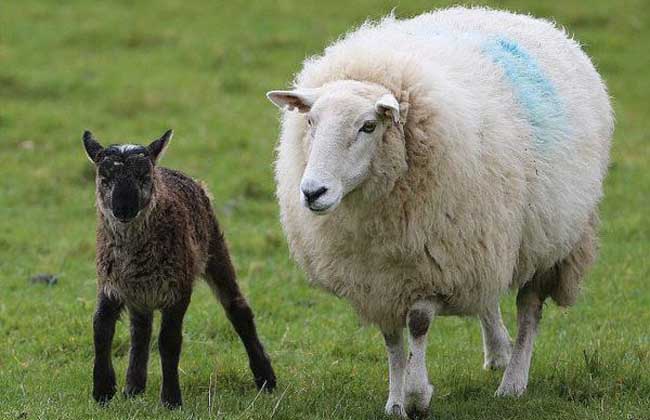
Sheep are common domesticated animals and are now raised all over the world. They have full bodies and dense wool, are both timid and docile, easy to tame, and tolerant of thirst. They can provide humans with products such as meat and hides, and their meat is tender and very tasty. The places in China where the most sheep are raised are Inner Mongolia, Qinghai and other areas. Now let us take a look at whether ewes have horns!
Do Ewes Have Horns?
Most ewes do not have horns, and only a very small number have horns, which are still very small. This is similar to the principle that some people have single eyelids and others have double eyelids. However, logically speaking, sheep with the genotype MM have horns, while ewes with the genotype Mm have no horns and rams have horns. There is now a horned ewe that gave birth to a hornless lamb. In fact, whether sheep have horns has nothing to do with sex, but with breed. Some breeds have horned ewes, and some do not.
Breed Classification of Sheep
1. Fine short-tailed sheep: The tail is thin with no obvious fat deposition, and the tip of the tail is above the hock, such as the Tibetan sheep, Romanov sheep, etc.
2. Fine long-tailed sheep: The tail is thin, and the tip of the tail reaches below the hock, such as ** fine-wool sheep, Lincoln sheep, etc.
3. Fat-tailed sheep: Fat accumulates in the tail into a cushion-like shape, with varying shapes and sizes. Those whose tail tip is above the hock are called short fat-tailed sheep, such as Small-tailed Han sheep, Mongolian sheep, Karakul sheep, etc. Those whose tail tip is below the hock are called long fat-tailed sheep, such as Large-tailed Han sheep, etc.
4. Fat-rumped sheep: Fat accumulates in the rump into a cushion-like shape, with few caudal vertebrae, a short tail, and a “W” shape, such as Kazakh sheep, Gissar sheep, etc.
Use Types of Sheep
1. Fine-wool sheep: Fine-wool sheep are raised mainly for wool production, accounting for about 10% of the world's sheep breeds. The fineness of the whole body's wool is within 25 microns, the count is not lower than 60s, and the wool length is above 7 cm. They are excellent raw materials for making worsted textiles. Due to differences in breeding objectives among countries and local natural conditions, they are further divided into 3 types: wool use, wool-meat dual purpose, and meat-wool dual purpose (see Merino sheep).
2. Semi-fine-wool sheep: Semi-fine-wool sheep are raised mainly for meat production, accounting for about 33% of the world's sheep breeds. The fineness of the whole body's wool is 32 to 58s, and the length is 6 to 35 cm. They can be used to make worsted textiles, knitting wool, overcoat fabric, industrial felt, and carpets, etc. According to wool length, they can also be divided into two categories: medium-wool types and long-wool types.
3. Coarse-wool sheep: The wool fibers of coarse-wool sheep are mixed with fine wool (down wool), coarse wool, heterotypical wool, and kemp, etc., and can only be used for weaving carpets, so they are also called “carpet wool sheep.” They are widely distributed around the world, accounting for about 48% of all sheep breeds. China's Mongolian sheep and Tibetan sheep, Britain's Scottish Blackface sheep, and many local breeds in Africa and Asia all belong to this group. They have large or short fat tails or fat rumps, and some have small tails.
4. Fur sheep: The fur produced by fur sheep has the characteristics of good wool fringe, large skin size, light leather board, attractive finished products, and durability. China's Tan sheep is the best breed in the world for producing fur.
5. Lambskin sheep: Lambskin sheep are slaughtered for skin use within 1 to 2 days after birth. The fur has beautiful curls and patterns and is rich in luster. The lambskin produced by Karakul sheep is famous in the world, and China's Hu sheep lambskin also enjoys a reputation in the international market.
6. Dairy sheep: Dairy sheep are mainly used for milk production, such as the German East Friesian sheep, which can produce 800 to 1000 kilograms of sheep milk in one lactation cycle. Dairy sheep, fur sheep, and lambskin sheep all belong to coarse-wool breeds.
7. Meat sheep: Dairy sheep are mainly used for meat production, such as Suffolk sheep and Dorper sheep. The Suffolk sheep is currently the meat breed with the largest build and body weight in the world, is early maturing, and grows and develops quickly. The Dorper sheep has a large build, a body shape close to a barrel, develops quickly in the early stage, and is a meat sheep breed with a relatively wide distribution.