What is burdock? Get to know the burdock plant
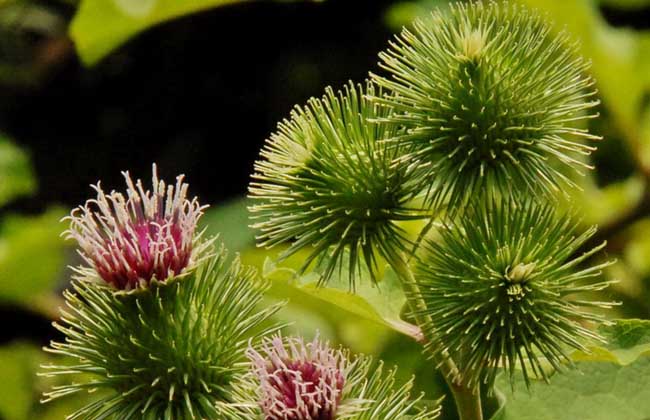
Burdock, also known as Dalizi, Eshi, burdock seed and so on, is a biennial herbaceous plant of the genus Arctium in the Asteraceae family. Its edible value and nutritional value are very high. It can be stir-fried, boiled, eaten raw or processed into beverages. In China it is mainly distributed in Taiwan, China, Shandong, Jiangsu, Shaanxi, Henan, Hubei, Anhui, Zhejiang and other places. Fengxian and Peixian in Xuzhou, Jiangsu Province, and Cangshan in Shandong Province have a long history of cultivation and relatively large planting areas.
Burdock was introduced from China to Japan more than a thousand years ago and improved into a food. When Japan occupied Taiwan, China, it required local farmers in Tainan to plant it in large quantities. The main reason was that Tainan has sandy loam soil along the Zengwen River, a Tropic of Cancer climate, and the extension of the famous Alishan range, which together created the unique preciousness of local burdock. At present, Taiwan, China has used it as a vegetable for many years and is known as the birthplace of burdock.
Burdock has a thick, fleshy taproot, up to 15 cm long, up to 2 cm in diameter, with branching lateral roots. The stem is erect, up to 2 m tall, stout, up to 2 cm in diameter at the base, usually purplish red or pale purplish red, with many raised ridges, and branches that are ascending and numerous. All stems and branches are sparsely covered with papillate short hairs and long arachnoid hairs, mixed with brownish-yellow small glandular dots.
The basal leaves of burdock are broadly ovate, up to 30 cm long and up to 21 cm wide, with sparsely shallow wavy concave teeth or tooth tips at the margin, and a cordate base. The petiole is up to 32 cm long. The two surfaces are different in color: the upper surface is green, with sparse short stiff hairs and yellow small glandular dots; the lower surface is grayish white or pale green, covered with thin tomentum or sparse tomentum, and has yellow small glandular dots. The petiole is grayish white, covered with dense arachnoid tomentum and yellow small glandular dots, but often loses hair in the middle and lower part. The stem leaves are the same shape or nearly the same shape as the basal leaves, with the same kind and amount of indumentum. The leaves near the lower part of the inflorescence are small, with a truncate or shallowly cordate base.
The capitula of burdock are numerous or few, arranged at the tips of stems and branches in loose corymbs or paniculate corymbs, with stout peduncles. The involucre is ovate or ovoid, 1.5-2 cm in diameter. The phyllaries are in many layers and numerous; the outer ones are triangular or lanceolate-subulate, about 1 mm wide; the middle and inner ones are lanceolate or linear-subulate, 1.5-3 mm wide; all involucral bracts are nearly equal in length, about 1.5 cm long, with cartilaginous hooked spines at the apex. The florets are purplish red, the corolla is 1.4 cm long, the slender tube is 8 mm long, the limb is 6 mm long, the outside has no glandular dots, and the corolla lobes are about 2 mm long.
The achenes of burdock are obovoid or obliquely obovoid, 5-7 mm long, 2-3 mm wide, compressed on both sides, light brown, with many fine veins, and with dark brown color spots or without color spots. The pappus is in many layers, light brown; the pappus bristles are hispidulous, unequal in length, up to 3.8 mm long, not connate into a ring at the base, and falling off separately. The flowering and fruiting period is June to September.
Burdock contains inulin, cellulose, protein, calcium, phosphorus, iron and various vitamins and minerals needed by the human body. Among them, the carotene content is 150 times higher than that of carrots, and the contents of protein and calcium rank first among root and stem vegetables. Burdock root contains inulin as well as volatile oil, arctic acid, various polyphenolic substances and aldehydes, and is rich in cellulose and amino acids.
Burdock root contains various amino acids essential to the human body, and their content is relatively high, especially the content of amino acids with special pharmacological effects. For example, aspartic acid, which has a brain-strengthening effect, accounts for 25-28% of total amino acids, and arginine accounts for 18-20%. It also contains Ca, Mg, Fe, Mn, Zn and other major and trace elements essential to the human body.