A Detailed Explanation of Sea Buckthorn Planting Techniques and Management Key Points
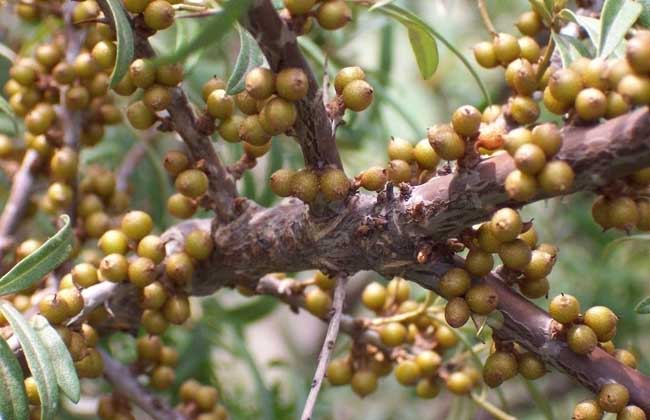
Sea buckthorn, also known as vinegar willow, yellow sour thorn, sour thorn willow, etc., is a deciduous shrub plant of the genus Hippophae in the family Elaeagnaceae. It has extremely high cultivation value, is drought-tolerant and resistant to wind and sand, can survive on salinized land, and is widely used for soil and water conservation. In northwestern China, large quantities of sea buckthorn are planted for desert greening. Its fruit has a high vitamin C content and is known as the king of vitamin C. Now let us take a look at sea buckthorn planting techniques together!
Growth Habits of Sea Buckthorn
Sea buckthorn is a heliophilous tree species that prefers sunlight. It does not have very strict requirements for soil and is distributed on chestnut calcium soil, gray calcium soil, brown calcium soil, meadow soil, and dark loess soil. It can also grow on gravel soil, mildly saline-alkali soil, sandy soil, and even in arsenic sandstone and semi-rocky semi-soil areas, but it does not like overly heavy clay soil. It has certain requirements for precipitation, generally needing an annual precipitation of more than 400 mm, but it does not like waterlogging. It does not have very strict temperature requirements; the extreme minimum temperature can reach -50°C, and the extreme maximum temperature can reach 50°C. The annual sunshine hours are 1500-3300 hours.
Propagation Techniques for Sea Buckthorn
1. Sowing: Before spring sowing, soak the seeds until swollen, sow in rows with a row spacing of 10-15 cm and a depth of 3 cm. Seedlings emerge after 1 week. When the first pair of true leaves appears, begin thinning; when the fourth pair of true leaves appears, thin for the second time, keeping a plant spacing of 5 cm. Autumn sowing should be carried out in late autumn. After sowing, cover the seedbed surface, water in winter to seal in freezing, and seedlings emerge the following year.
2. Cuttings: Select moderately mature growing branches for cuttings. The best cutting period is from mid-June to the end of August. When inserting, the row and plant spacing is (10-15) × (5-10) cm. Transplant in the second spring, with a row and plant spacing of (30-60) × (15-17) cm. Use 1-2 year old vegetatively propagated seedlings for afforestation; dense planting is preferable, with a row and plant spacing of 4 × 2 m.
Sea Buckthorn Planting Techniques
1. Growth cycle: The growth of sea buckthorn is divided into four stages: seedling stage, fruiting stage, full fruiting stage, and decline stage. Within two years after planting, underground growth dominates, while aboveground growth is slow. Growth becomes vigorous at 3-4 years, and it begins to flower and bear fruit. An adult sea buckthorn tree is 2-2.5 m tall with a crown width of 1.5-2 m. It enters the full fruiting stage in the fifth year, and generally enters the decline stage after 15 years of tree age.
2. Planting density: About 220 sea buckthorn trees are planted per mu, with a plant and row spacing of 1.5 × 2 m. Sea buckthorn is dioecious, so attention should be paid to a reasonable ratio of female to male plants when planting. Generally, 8 female plants are paired with 1 male plant. The size of the planting hole depends on the size of the seedling, generally 35 cm in diameter and 35 cm deep. Two-year-old softwood cutting seedlings are preferable.
3. Tree shape pruning: Sea buckthorn trees should be promptly cleaned and pruned of diseased branches and dead branches, and diseased bark should be scraped off. Apply healing and antiseptic film promptly to the cuts made by knives and shears to promote wound healing and prevent invasion and infection by pathogens. At the bud stage, young fruit stage, and fruit expansion stage, spray fruit-strengthening pedicel agent to thicken the fruit pedicel, prevent flower drop, improve pollination ability, increase fruit set rate, and accelerate expansion speed.
4. Promoting flower differentiation: The alternate bearing of sea buckthorn trees causes an imbalance in the tree's load, which affects both balanced returns and orchard tree health. During the annual flower bud differentiation period, apply flower-promoting king No. 2 once around the trunk, which can greatly promote flower bud differentiation, increase flowering and fruit set rates, suppress excessive shoot growth, and thoroughly balance alternate bearing.
5. Disease control: The main disease of sea buckthorn is shrinkage disease. When planting, disease-resistant varieties should be selected, and field management should be strengthened with regular loosening of the soil to enhance soil permeability and improve the plant's disease resistance. Chemical control begins in late April by opening holes and pouring 500 times diluted 40% carbendazim suspension or 800 times diluted thiophanate-methyl, once a month for 3-5 consecutive times.
6. Pest control: Common pests of sea buckthorn include spring cankerworm, apple small leafroller, sea buckthorn aphid, and trunk-boring pest willow bat moth. During the occurrence period of spring cankerworm and apple small leafroller, spray 2500 times diluted 25% fenvalerate or 3000 times diluted 20% sumicidin. To control sea buckthorn aphid, spray 2500-3000 times diluted 10% imidacloprid.
7. Timely harvesting: The maturity period of sea buckthorn fruit is marked by its distinctive color and fruit size, and the harvest period is determined accordingly. Because it has many thorns, small fruits, thin skin that breaks easily, and short fruit stalks that do not fall off naturally, harvesting brings many difficulties, so the labor used for harvesting accounts for almost 90% of the labor in sea buckthorn cultivation.
8. Fresh-keeping technology: The storage conditions for sea buckthorn fruit are very strict. If freshly harvested sea buckthorn fruit cannot be sold temporarily, it must be stored for a short time. Stored fruit must be kept in an environment with low temperature, ventilation, and the ability to remove harmful gases. The storage temperature is preferably 1-5°C, and the relative air humidity should be maintained at 90-95%.