How are finger citron (Buddha's hand) seedlings cultivated? A full breakdown of the detailed method
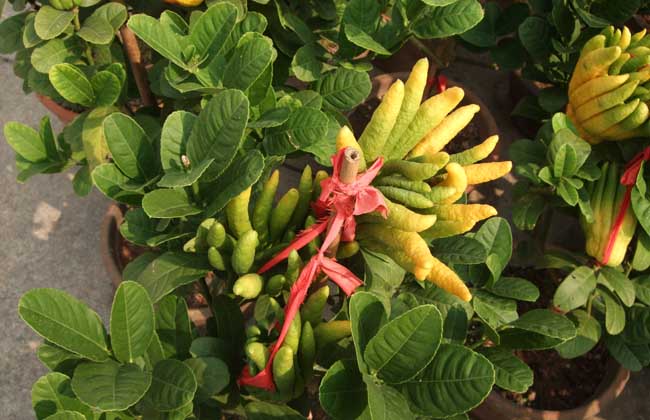
Finger citron (Citrus medica var. sarcodactylis) is a shrub or small tree of the genus Citrus in the family Rutaceae. It is a tropical and subtropical plant that prefers a warm, humid environment with plenty of sunlight. It is grown in various places south of the Yangtze River in China, and in the southern provinces and regions it is mostly cultivated in courtyards or orchards. It is usually used as a traditional Chinese medicine, or grown as an ornamental plant because of its peculiar fruit shape, and it has extremely high cultivation value. Let's take a look below at how finger citron seedlings are cultivated!
Air layering
Air layering propagation of finger citron is suitable for carrying out from May to July. Select a vigorous, over-tall branch or a branch that has already set fruit firmly, and make an upward-slanting cut on the underside of the branch, deep enough to reach the pith. Place the cut branch into a felt tube, tie the lower part tightly, fill the tube firmly with soil, tie the upper part tightly, and set up a support. Water every day. When the temperature is high and there is enough moisture, roots can form in 20-30 days. If there is a finger citron fruit on the layered branch, you must wait until the fruit ripens and turns yellow, about 90 days, before it can be cut away from the mother plant.
Grafting propagation
1. Approach grafting: Carry this out in early August to September. For the rootstock, select a vigorous 4-5 year old plant with a stem diameter of 2-3 cm. At the base of the stem, cut away the branches below the branching point, leaving only one branch, then shave off some bark on one side of the spot where the branch was removed. Then select a branch that emerged in the previous spring or autumn as the scion, similar in thickness to the rootstock, 5-7 cm long. Also shave off part of the bark on the lower side of the scion, then press the cut surface of the rootstock against the cut surface of the scion so that the two surfaces fit closely together, bind the middle tightly with plastic film, and after about one week they will heal together.
2. Side cleft grafting: In early to mid-March, cut the rootstock flat at 5-7 cm above the ground, smooth it with a grafting knife, and choose a smooth part slightly into the wood to make a slanting cut, 1-1.5 cm deep. The scion should retain 2-3 buds, and its lower end should be cut into a wedge shape 1-1.5 cm long. Then align one side of the rootstock cut with the scion's cut bark, insert it tightly into the rootstock cut, and bind it with plastic film. Generally after half a month it heals and sprouts and grows. At this point, loosen the soil and remove weeds. After 45-60 days, it begins to send out shoots; at this time the binding material must be removed, otherwise the new shoots are prone to bending.
Cutting propagation
1. Cuttings: Before cutting, select a vigorous 7-8 year old mother tree, cut off vigorous, pest- and disease-free old healthy branches, remove the leaves and the tender tips at the top, and cut them into cuttings 17-20 cm long. The survival rate of cuttings is over 90%, and the seedlings grow very vigorously. Cuttings from young trees or water sprouts must not be used, because such branches often do not easily bear fruit after planting.
2. Land preparation: For the finger citron cutting bed, it is best to choose sandy soil with a relatively thick soil layer, so that the seedlings can be lifted later. After the cutting site is chosen, plow deeply and harrow finely, and at the same time apply human and livestock manure water, then make high beds 1.3 m wide, usually with furrow ditches about 30 cm wide and about 20 cm deep.
3. Cutting: Cuttings can be taken in spring from February to March and in autumn from August to September, and autumn cutting is best. When inserting, open horizontal trenches on the bed, with a trench spacing of 23-27 cm, and insert the cuttings into the trenches at a plant spacing of 15-17 cm. Never insert them upside down. Usually about 12,000-15,000 cuttings are needed per mu. After inserting, cover with soil and press firmly so that one bud at the tip is exposed above the soil surface, and water if the soil is dry.
4. Management: After cutting, finger citron must be watered and irrigated at any time, and a shed must be built for shade. When there is a lot of rain, drainage work must be done well. When the seedlings are 7-10 cm tall, remove the clustered weak seedlings and keep only one strong seedling per plant. Weed in time, and apply light human and livestock manure water or ammonium sulfate 3-4 times as a top dressing. After one year of cultivation, they can be transplanted.