A Detailed Guide to Sunflower Planting Techniques and Management Methods
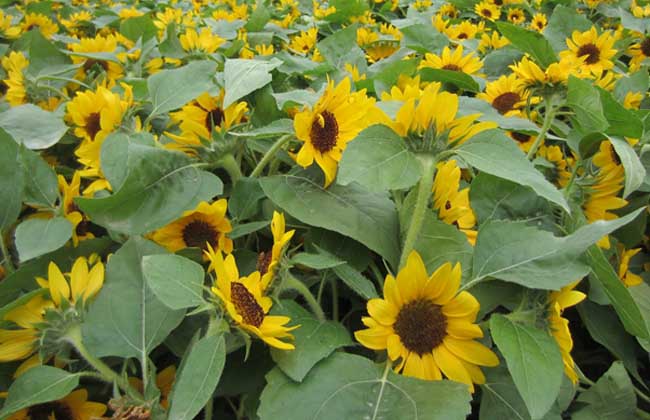
Sunflowers originated in South America. The domesticated species was brought from North America to Europe by the Spanish in 1510, initially for ornamental purposes, and was introduced back to North America from Russia at the end of the 19th century. They are cultivated throughout China and have very high cultivation value. The seeds are often roasted and eaten as a snack, and can also be pressed for sunflower seed oil, while the oil residue can be used as feed. Let's take a look at sunflower planting techniques below!
Sunflower Planting Conditions
1. Temperature: Sunflowers are a temperature-loving yet cold-tolerant crop, with strong adaptability to temperature. The seeds have very strong tolerance to low temperatures. When the soil temperature is stable above 2°C, the seeds begin to germinate; at 4-5°C they can sprout and take root; when the soil temperature reaches 8-10°C, it can meet the needs of seed germination and emergence. Throughout the entire growth process, sunflowers can grow normally as long as the temperature is not lower than 10°C.
2. Water: Sunflowers are a relatively water-consuming crop. The plants are tall with many dense leaves, and their water uptake is 1.74 times that of corn. However, because their growth and development mostly coincide with local rainfall and heat, the contradiction between water supply and demand is not prominent. Water requirements differ greatly at different growth stages. From sowing to budding, water demand is not high; from budding to flowering is the peak water demand period; from flowering to maturity, water demand is also relatively high.
3. Light: Sunflowers are a short-day crop and are not particularly sensitive to day length. They like ample sunlight, and their seedlings, leaves and flower heads all have strong phototropism. With ample sunlight, the seedlings grow strong and can be prevented from becoming leggy. Ample sunlight in the mid-growth period promotes vigorous stem and leaf growth, normal flowering and pollination, and improves the seed-setting rate. Ample sunlight in the late growth period results in plump, full seeds.
4. Soil: Sunflowers have low soil requirements and can grow in all types of soil, from fertile soil to dry land, poor soil and saline-alkali land. They not only have strong saline-alkali tolerance but also have salt-absorbing properties. At the same time, sunflowers have a well-developed root system and strong drought resistance. Moreover, the roots and stems of sunflowers have well-developed aerenchyma, making them very tolerant of waterlogging.
Sunflower Growth Cycle
1. Seedling stage: The period from emergence to budding in sunflowers is called the seedling stage, generally requiring 35-50 days, or 28-35 days for summer sowing. This period is the stage of leaf and flower primordium formation and floret differentiation. The seedling stage is when sunflowers have the strongest drought resistance. Above-ground growth is slow, while underground root growth is faster, quickly forming a strong root system.
2. Budding stage: From budding to flowering, sunflowers generally need about 20 days. This is a period when vegetative growth and reproductive growth proceed together, and it is also the most vigorous stage of their life. This period has the greatest demand for fertilizer and water, accounting for about 40-50% of the total fertilizer and water demand. If the need for water and fertilizer cannot be met in time, yield will be seriously affected.
3. Flowering stage: For a single sunflower head, the period from the opening of the ray florets to the completion of the opening of the tubular florets generally takes 6-9 days. From the second to the fifth day is the full bloom period. The flowers mostly open at 4-6 a.m. and are pollinated the next morning. Unpollinated stigmas can remain viable for 7-10 days, but the seed-setting rate from self-pollination is only about 3%, while the seed-setting rate from cross-pollination is high.
4. Maturity stage: The maturity stage of sunflowers refers to the period from flowering to maturity, which is 25-55 days for spring sowing and 25-40 days for summer sowing, with differences among varieties. About 15 days after flowering and pollination is the seed formation stage. The maturity stage of sunflowers requires clear weather, a relatively large temperature difference between day and night, and suitable soil moisture.
Sunflower Planting Techniques
1. Land selection and preparation: For sunflower cultivation, choose a plot with level land, medium fertility, convenient irrigation and drainage, and relatively low soil clay content. Continuous cropping should be avoided. They reproduce by seed, and peat soil is suitable for sowing. Before sowing, mix the seeds with New High-fat Film, which can repel underground pests, isolate viral infections, and improve the seed germination rate.
2. Timely sowing: The sowing time for sunflowers is generally March to April, and the suitable temperature for sowing is 18-25°C. Usually, they sprout about 5-7 days after sowing. The basic principle for choosing the sowing period is to sow appropriately early or late according to the patterns of saline-alkali occurrence, so that the seedlings avoid saline-alkali damage. Spring or summer sowing is carried out according to the growth period of the variety.
3. Field inspection and replanting: Sunflowers are a dicotyledonous crop, and pushing through the soil to emerge is relatively difficult. In addition, poor land preparation or sowing quality, surface soil crusting after rain following sowing, or damage by diseases, insects, rodents and birds can easily cause missing plants and gaps in rows. To ensure full emergence after one sowing, fields and rows must be checked one by one during the emergence period, and replanting must be done promptly where plants are missing in large patches or rows.
4. Thinning and final singling: In sunflower cultivation, thinning should be done early to prevent seedlings from crowding each other, which affects the cultivation of strong seedlings and even later yield. For saline-alkali land and plots with severe pest damage, the time for final singling can be appropriately postponed. At the same time, sunflowers should also be singled early, which helps cultivate strong seedlings and also benefits flower head development. Final singling should be carried out when there are 2 pairs of true leaves.
5. Intertillage and weeding: Sunflowers generally require 2-3 intertillages, which serve to weed, loosen the soil, break up crusting, conserve water, reduce evaporation, and alleviate saline-alkali damage. The first intertillage is carried out at the 1-2 pairs of true leaves stage together with thinning and final singling; the second intertillage is carried out 1 week after final singling; the third intertillage is completed before row closure together with furrowing, hilling and fertilizing.
6. Furrowing and topdressing: Sunflowers are relatively fond of fertilizer. Furrow topdressing is usually carried out at the third intertillage, mainly with nitrogen and phosphorus fertilizer, applying 5 kg of diammonium phosphate and 10 kg of urea per mu, mixed evenly and applied into the soil. Furrowing and hilling can effectively ensure the growth and development of secondary roots, prevent lodging, and reduce basal branching below the cotyledon node.