How to Grow Ornamental Sunflowers? Detailed Planting Methods
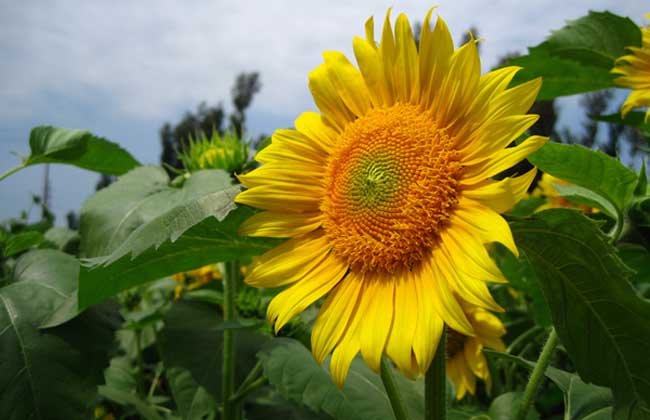
Ornamental sunflowers are annual flowers of the genus Helianthus in the Asteraceae family, with plant heights of 90 to 300 cm and a flowering period from July to September. Flower colors include golden yellow, red and bicolor, and they are generally planted in large drifts. When in bloom, the golden yellow is dazzling, offering both a wild charm and a highly spectacular sight. They are widely used for cut flowers, potted flowers, dyed flowers, courtyard beautification and flower border creation, and other fields. Now let us take a look at how to grow ornamental sunflowers!
Growth Habits
Ornamental sunflowers originate from North America and prefer a warm, slightly dry and sunny environment. They are drought-tolerant and can be grown in pots or in the open field. When grown in the open field, long light exposure often leads to slightly earlier flowering, and a temperature difference of 8-10°C is most favorable for stem and leaf growth. Most are single-petal varieties, though there are also double-petal varieties. Taking dwarf potted varieties as an example, it takes 50-60 days from sowing to flowering.
Propagation Methods
Ornamental sunflowers are propagated by sowing. Sowing is generally carried out in April, and the optimum temperature for germination is 15 to 18°C. They can be sown in shallow pots or shallow boxes, and the medium should be loose, have good water retention and be sterile. Sowing is best done by dibbling, with 2 seeds per hole. After sowing, cover with 1 to 2 cm of medium to maintain the moisture needed for germination, increase stability during the seedling stage and reduce the occurrence of seedlings with shells still attached. Germination generally occurs 7 to 14 days after sowing. After emergence, pay attention to ventilation and cooling, control humidity, and gradually expose them to light.
Timely Planting Out
After the ornamental sunflower seedlings have all emerged, thin them out gradually, leaving 1 plant per hole. They can be planted out when the seedlings are 7 to 8 cm tall. The potting soil should preferably be sandy soil rich in humus and well-drained. When planting out, apply sufficient base fertilizer at the bottom of the pot. When digging up the seedlings, keep as much soil around them as possible and damage the roots as little as possible, so that the plants recover faster.
Planting Management
1. Light: Plenty of sunlight is needed throughout the entire growth and development period. If there is continuous overcast rain or long-term growth in a semi-shaded environment, the stems will not be upright, the leaves will be soft, drooping and yellow-green, and the flower heads will be small and irregular.
2. Temperature: The optimum growth temperature is 21-27°C during the day and 10-16°C at night. If the temperature is on the low side, growth will be slow and flowering time will be affected. If the temperature exceeds 30°C, the stems and leaves tend to grow leggy and the flowering period is shortened.
3. Water: Ornamental sunflowers have large plants but relatively little medium, so they must be watered in time during the growing period, otherwise the leaves easily dehydrate and wilt. However, they should not be too wet; if humidity is too high, the lower leaves easily turn yellow.
4. Fertilizer: During the growing period, fertilize ornamental sunflowers once every 20 days, usually alternating applications of various compound fertilizers diluted in water at 800 times. However, before flowering, apply 2 to 3 topdressings of thin phosphorus and potassium fertilizer to promote flowering.
5. Cultivation: For potted plants, do not pinch out the growing tip; single flowers are preferred. For tall varieties, 20 days after germination, a 0.25-0.4% B9 solution can be sprayed on the leaves to control plant height. For flower bed display, pinching out the growing tip once can produce 4-5 flowers.