A Detailed Guide to the Control Methods for Tea Tussock Moth in Tea Gardens
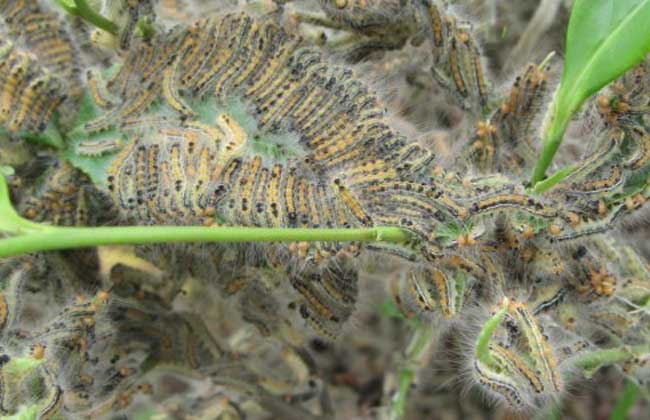
The tea tussock moth is an important pest in China's tea-growing regions. It is an insect of the genus Euproctis in the family Lymantriidae of the order Lepidoptera, also known as the tea yellow tussock moth and head-swinging worm. It is found in every tea-producing province in China and mainly damages tea leaves, but can also harm camellia oleifera and citrus. When outbreaks are severe, tea leaves can be completely eaten bare. Let's take a look below at the control methods for the tea tussock moth.
Morphological Characteristics of the Tea Tussock Moth
The adult body is about 6-13 mm long, with a wingspan of about 20-35 mm. The female moth is slightly larger, with a yellowish-brown body and wings. The male moth is slightly smaller and brownish. There are 2 pale yellow transverse bands in the middle of the forewing, and 2 black spots in the pale yellow area at the wing tip. The female moth has a yellow hair tuft at the end of its body. Eggs are laid in masses; the egg mass is oval and covered with yellow fuzz. The mature larva is about 20 mm long and yellowish-brown. The three thoracic segments are slightly smaller. Each body segment has 8 yellow (in the early stage) or black hair tubercles, bearing yellowish-brown stinging hairs. The whole body is also densely covered with yellow stinging hairs of uneven length. The pupa is yellowish-brown, about 9 mm long, enclosed in a thin soil-yellow silken cocoon about 12-14 mm long.
Occurrence Pattern of the Tea Tussock Moth
The number of generations of the tea tussock moth varies by region. In Hunan, it has 3 generations a year, overwintering as egg masses on the undersides of old leaves. The larval damage periods of each generation occur from April to May, June to July, and August to October respectively, generally with severe outbreaks in spring and autumn. After the larvae mature, they spin cocoons and pupate under the fallen leaves or on the soil surface around the base of the tea bush. The female moth lays eggs on the undersides of old leaves. The larvae have 6-7 instars and are gregarious; before the 3rd instar they are strongly gregarious, often gathering in dozens to hundreds on the undersides of leaves to feed on the lower epidermis and mesophyll, leaving the upper epidermis as a translucent yellow-green membranous film. After the 3rd instar, they begin to disperse in groups to cause damage, chewing the leaves into notches. After the larvae mature, they crawl to under dead branches and fallen leaves or into shallow soil around the base of the tea bush to spin cocoons and pupate. The adults are phototactic.
Control Methods for the Tea Tussock Moth
1. Manual capture: From November each year to April of the following year, remove overwintering egg masses, protect parasitic wasps, and kill larvae.
2. Timely pupa elimination: Eliminate pupae in a timely manner in combination with intertillage and earthing up.
3. Trapping and killing adults: Use light traps for moths and sex pheromone traps.
4. Chemical control: It is best to carry out before the larvae reach the 3rd instar. You can use 90% crystal trichlorfon or 50% malathion emulsion, 25% phosmet emulsion, 50% fenitrothion at 1000-2000 times dilution, or 80% dichlorvos emulsion at 2000-3000 times dilution, or soapy water at 150 times dilution for spraying and killing.
5. Biological control: Spray 500 times dilution of Bacillus thuringiensis powder (containing 15 billion spores per gram).