You can still grow flowers on a balcony with poor light; master the techniques and it will still be full of fragrance
Most plants are sun-loving plants that need to grow in places with plenty of light, but some friends may have balconies that do not get very good light. If you do not choose the right flower varieties, they may very well not survive or not grow well. So which plants are suitable for growing on a balcony or indoors with poor light?
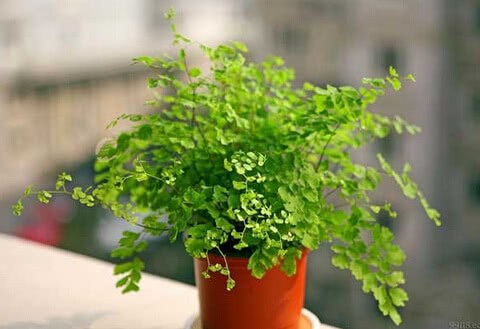
Venus hair fern
The stems of Venus hair fern are slender and similar in color to iron wire, hence the name Venus hair fern. Venus hair fern fears strong light and dryness. Wild Venus hair fern mostly grows on cliffs beside streams, so when growing it in pots you must also pay attention to creating a cool, moist environment for it and place it somewhere that direct sunlight cannot reach for care. Venus hair fern is highly adaptable and easy to grow. Its leaflets are delicate and dense, with strong ornamental value. It is a common indoor greenery plant and is very suitable for indoor potted display. Potted plants can be large or small, and can be used to decorate tabletops as well as windowsills and walkways.
Venus hair fern
Swiss cheese plant
The Swiss cheese plant originates from Mexico and is also known as Penglai banana, Swiss cheese banana, and electric wire orchid, among other names. Because its leaf shape is unusual, with a split, cracked appearance that closely resembles a turtle shell, it is called Swiss cheese plant. Its stems are thick and strong, crisscrossing like electric wires. Its leaves are relatively large, evergreen year-round, thick and leathery, pale green and glossy on the surface, and greenish-white on the underside. The Swiss cheese plant often grows to 1 m in length, producing pale yellow flower spikes. It has a full, lush form and is also a very common ornamental green plant. The native environment of the Swiss cheese plant is in forests, and it likes cool, moist conditions. It has a strong purifying effect and is very helpful for improving indoor air quality, so it is suitable for indoor cultivation. It can be used to decorate a bedroom and can also be placed on a balcony with slightly weaker light.
Swiss cheese plant
Jade plant
The leaves of the jade plant are thick and fleshy, with an unusual leaf shape. Its stems are fleshy and grayish-white. The leaves are fleshy, ovate, and grayish-green. Its crown is elegant, smooth, and jade-like. In summer and autumn it blooms with umbrella-like inflorescences, very fresh and refined. The jade plant is not cold-tolerant and fears strong light, and it prefers a fertile soil with good drainage as its growing medium. Propagation of the jade plant is very simple and straightforward; basically, a single leaf dropped into a pot can take root and sprout and grow into a new potted plant, making it very suitable for cultivation in places with poorer light.
Jade plant
Peace lily
The peace lily is a perennial herbaceous plant, about 30 to 40 cm tall, with oblong leaves shaped somewhat like lance heads and dark green in color. In spring and summer it blooms with white or pale green flowers that stand upright and rise above the leaf cluster, with creamy-yellow spadix inflorescences. The flowering period is very long, and with proper care it can bloom for more than 3 months. The peace lily likes high temperatures and high humidity, tolerates shade, and fears strong light, but it also needs some diffused light to bloom. A fertile, airy humus soil is best.
Peace lily
Gloxinia
The gloxinia has short stems, with the plant about 25 cm tall, small and exquisite. The whole plant is covered in white fuzz, and the leaves are thick and fleshy, lush and emerald green, opposite and serrated. The flowers are mostly terminal or lateral, rich in color, with many varieties, commonly pink, red, white, blue, violet-blue, and so on. The flowers are very large and very beautiful. Gloxinia likes a warm, humid environment and most fears direct strong light. A fertile, slightly acidic sandy soil is best.
Gloxinia
Fuchsia
Fuchsia is also known as lantern flower and hanging bell begonia. It is a perennial subshrub. Because its flower shape is unusual and extremely elegant, it is very suitable for decorating balconies, windowsills, studies, and so on, and can also be hung in corridors and outside windows. Fuchsia likes a cool, humid environment and fears high temperatures and strong light. In winter it requires a certain amount of light and an environment not lower than 5°C.
Fuchsia