How to cultivate onions for pollution-free, high-yield results? Selected technical Q&A
Tianbao Agricultural Technology Service Platform: a professional social service platform built for agricultural input distributors, agricultural cooperatives, planting bases, family farms, and ornamental garden growers.
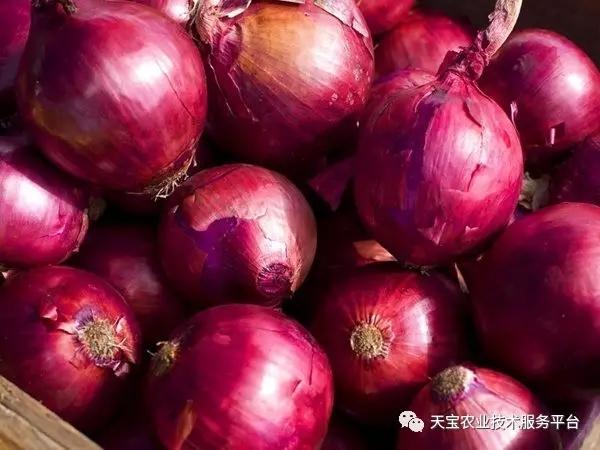 1. What types of onions are there?
According to the characteristics of bulb formation, they can be divided into common onions, tillering onions, and top-setting onions; according to the requirements of bulb formation for day length, they can be divided into 3 ecological types: long-day, short-day, and long-short-day. Early-maturing varieties are mostly short-day types, while late-maturing varieties are mostly long-day types. Common onions are further divided into red-skinned onions, yellow-skinned onions, white-skinned onions, etc. Currently, onion varieties for export include: Dabao, Earth, Hongyedan, Beijing Huangpi, Tianjin Dashuitao, Quanzhou Zhonggaohuang, Huangjin Dayucong, etc.
2. When should onions be sown? How should seeds be treated before sowing? How should strong seedlings be cultivated?
In various parts of Shandong, sowing is generally best from early to mid-September. Sowing too early makes bolting easy; sowing too late results in small, weak seedlings before overwintering, making overwintering difficult and leading to low yield. This is because if onion seedlings have 5 leaves and a pseudostem diameter exceeding 0.6 cm, after 2°C-5°C low temperature for 50-60 days they can pass through the vernalization stage, and after turning green in spring they will show premature bolting, affecting yield. The requirements for age-appropriate strong seedlings are: at transplanting time (late October to early November) or before overwintering, the seedlings have 3-5 leaves, plant height 2-15 cm, pseudostem diameter not exceeding 0.6 cm, and the bolting rate the following spring is controlled at 1%-5%; this is suitable seedling age.
Follow the WeChat public account [Tianbao Agricultural Technology Service Platform] to enter the mall or search the Taobao store [Jiamei Water-Soluble Fertilizer] to make purchases.
Welcome to add the Tianbao Agricultural Technology Service Platform fruit and vegetable group WeChat ID: 15910877966 to exchange and learn more about professional fruit and vegetable planting techniques.
Before sowing, use a dedicated seed soaking and dressing agent, add it to 2.5 kg of 50°C warm water, stir evenly, then add onion seeds (the amount used should be enough for the diluted solution to submerge the seeds), soak for 3-5 hours, remove and air-dry before sowing. Never seal the seeds to promote germination.
To cultivate strong seedlings, the seedling bed should be deep-ploughed 25 cm, and while ploughing, spread 3000 kg of high-quality decomposed barnyard manure and 30 kg of potassium sulfate compound fertilizer per 667 sq m. Rake fine and evenly, make flat beds, bed width 100-120 cm, length 20 m; the bed surface must be level. After irrigation, sow seeds evenly; 4-5 kg of seeds are needed per 667 sq m. After sowing, cover with fine soil 1-1.5 cm thick. Water after the seedlings emerge uniformly, and weed carefully. Later, according to the moisture of the seedling bed and the growth of the seedlings, appropriately irrigate with light water 2-3 times, and combine with watering to apply a small amount of Jiamei Neijiade to promote seedling growth. If the seedlings grow too vigorously, fertilizer and water must be controlled to prevent the seedlings from becoming too large and causing premature bolting.
3. How can onion frost damage be prevented?
(1) Suitable planting time: in western Shandong and inland areas of the peninsula, transplant from late October to early November. Before overwintering, the seedlings can recover from transplanting, restore root growth, send out 3-4 new roots, and form strong seedlings. In the coastal areas of eastern Shandong such as Qingdao, Weihai, and Yantai, spring planting is also possible, and transplanting can be done around the Spring Equinox.
(2) Spray Jiamei Jindian: after onion seedlings are transplanted, spray 800-fold Jiamei Jindian, once every 10-15 days, for 2 consecutive sprays, to promote rooting, improve the plants' cold resistance, disease resistance, and adaptability, and prevent frost damage.
(3) Strengthen pre-winter management: after planting, first water to help the seedlings recover. After 2-3 days, carefully hoe the soil to promote root recovery and growth. Before freezing, irrigate overwintering water again, then carefully hoe the soil. After hoeing, use the hoe blade to smooth the surface soil, raise ground temperature and preserve moisture, and spread soil manure or wheat bran, chopped straw, etc. on the ground or cover with plastic film for protection to ensure safe overwintering.
4. How should fertilizer and water management be carried out when planting onions?
Onion is a biennial vegetable crop with a relatively shallow root system, poor absorption capacity, a growth period of more than 200 days, and high yield; therefore, it requires a large amount of fertilizer. According to research, for every 1000 kg of bulbs produced, about 2.4 kg of nitrogen, 0.9 kg of phosphorus, and 4.1 kg of potassium are absorbed.
For planting onions, choose fertile loam or sandy loam soil with relatively high organic matter content. After the previous crop is cleared, immediately deep-plough about 30 cm and sun the soil clods for 30-45 days. While deep-ploughing, apply 5000 kg of high-quality barnyard manure, 15 kg of potassium sulfate, 50 kg of superphosphate, and 30 kg of ammonium bicarbonate per 667 sq m. Note that the above chemical fertilizers must first be added to the organic fertilizer, mixed evenly, and composted for 10-15 days before use. After deep-ploughing, repeat harrowing after every sunny day, at least 3-5 times, rake fine and evenly, then carefully prepare the land. Before planting, prepare beds, bed width 120-150 cm, length 20-30 m. While preparing the beds, spread 100 kg of organic biological bacterial fertilizer per 667 sq m, then rake carefully, and then transplant.
After overwintering, when the temperature begins to rise, remove the covering grass to raise ground temperature. When the onion seedlings begin to turn green, apply topdressing together with watering, applying 10-12 kg of Jiamei Neijiade per 667 sq m. When dry soil appears on the surface, hoe immediately, and while hoeing clear the soil around the roots so that the rhizomes are exposed, which helps bulb growth. Around Qingming, the leaves enter a period of vigorous growth; water and apply topdressing again, applying 10-15 kg of Jiamei Yinglilai per 667 sq m. Note that this fertilizer and water amount should not be too large, and afterward appropriately restrain seedling growth for about 10 days to avoid excessive leaf growth affecting bulb growth.
After Guyu, when the temperature reaches about 20°C, the bulbs begin to expand, and topdressing should be applied again together with watering, applying 10-12 kg of Jiamei Neijiade per 667 sq m. After Lixia, the bulbs enter a period of rapid expansion; again together with watering, apply 10-15 kg of Jiamei Yinglilai per 667 sq m, plus one bag of Hongli, to help loosen the soil, and increase the number of waterings, once every 3-5 days, until stopping 7 days before harvest.
At the same time, foliar nutrition should also be sprayed in a timely manner, once every half month. For the first 2 times, spray 800-fold Jiamei Jindian; after Qingming, spray 800-fold Jiamei Nao Baijin; after Guyu, drench and spray 800-fold Jiamei Hongli, which can increase yield by more than 30%.
5. What are the common onion diseases? How can they be controlled?
Common onion diseases include downy mildew, purple blotch, gray mold, and anthracnose, etc.