Shiitake mushroom cultivation has become a distinctive industry for prosperity, lifting the entire village out of poverty
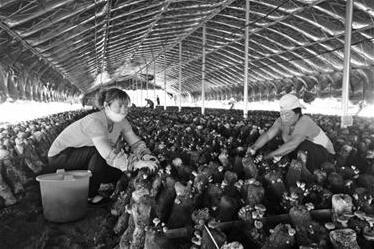
At the shiitake mushroom base in Beitazi Village, Lianhe Town, Longcheng District, Chaoyang City, 56-year-old Zhou Xilan is picking shiitake mushrooms. She came here to work a few months ago and earns 1,500 yuan per month. For her impoverished family, this money basically solves the problem of having enough food and clothing.
Beitazi Village is a provincially designated poverty-stricken village. Through the efforts of the Longcheng District Committee and District Government, all eight indicators for the entire village met the standards in 2016, and the whole village was lifted out of poverty.
Barren land and dry climate
Beitazi Village has 7 villager groups, 336 households, and 1,113 people. There are 82 registered poor households with 185 people, accounting for 16.7% of the population.
The village is naturally characterized by scattered residents distributed across gullies and branches. The cultivated land area is 3,453 mu, mostly hillside fields.
Due to poor transportation, barren land, and very backward production and living conditions, the area is also very dry, and grain output depends largely on the weather.
Under the leadership of the Longcheng District Committee and District Government, by integrating forces from all sectors of society to focus on poor villages and poor households and implementing poverty alleviation policies, 51 households with 117 people were lifted out of poverty in 2015, and 31 households with 68 people were lifted out of poverty in 2016. All eight indicators for the entire village met the standards, and the whole village was lifted out of poverty.
Financial poverty alleviation
In recent years, Beitazi Village has achieved whole-village poverty alleviation through multiple measures, one of which is financial poverty alleviation.
To effectively solve problems such as enterprises not meeting financing conditions and poor households lacking the ability to escape poverty, Longcheng District adopted a five-in-one financial poverty alleviation model of "government + enterprise + bank + insurance + poor households," enabling poor households to escape poverty through shareholding dividends.
Through Liucheng Village and Township Bank, each poor household received a loan of 50,000 yuan as principal to buy shares in a certain company. The district government used poverty alleviation funds as risk compensation guarantee money to enhance credit, leveraging credit funds from Liucheng Village and Township Bank in batches at a ratio of 1:10. The insurance company, bank, and district government bore credit risks at a ratio of 7:2:1. The company was responsible for repaying principal and interest and paid each poor household a dividend of 1,500 yuan per year. Through this measure, 30 households with 66 people in Beitazi Village were lifted out of poverty.
Industrial poverty alleviation
Another measure is shiitake mushroom cultivation, implementing industrial poverty alleviation.
Beitai Village, with assistance from the Provincial Department of Science and Technology, implemented the first phase of the shiitake mushroom industry project, cultivating 200,000 shiitake mushroom sticks annually. On this basis, it implemented the second phase of the shiitake mushroom industry cultivation project, investing 800,000 yuan in project funds and building 19 mushroom incubation and cultivation demonstration greenhouses, with a production capacity of 3 million shiitake mushroom sticks per year. In 2016, the promoted cultivation area reached 200 mu, 600,000 mushroom sticks were produced, and poor households benefited across the board. The third phase of the shiitake mushroom cultivation project is currently in full swing and is expected to produce 800,000 mushroom sticks.
The edible fungi production base of Beitazi Village's shiitake mushroom industry covers 20,000 sq m and is equipped with infrastructure including a mushroom stick production workshop, modern production lines, cultivation demonstration greenhouses, and cold storage. At present, the promoted cultivation area has reached 200 mu, 10 skilled shiitake mushroom cultivation technicians have been trained, employment needs for more than 100 villagers have been met, farmers' income can be increased by 3 million yuan, and it has already radiated to surrounding villages, becoming a distinctive prosperity-creating industry for Beitazi Village.
Among them, Zhou Xilan from Majiagou Group in Beitazi Village, female, 56 years old, has 5 people in her household. Her husband has been ill year-round and cannot work. Zhou Xilan worked at the shiitake mushroom base in 2016, earning about 1,500 yuan per month, working about 6 months per year. For the rest of the time, her family has 6 mu of cultivated land, which basically solves the family's problem of having enough food and clothing.
Li Gerile from Majiagou Group in Beitazi Village, female, 46 years old, has 5 people in her household. Her daughter has had autism for many years, and her husband Du Guangcun has lumbar disc herniation and cannot do heavy physical labor. Li Gerile worked at the shiitake mushroom base in 2016, earning about 1,500 yuan per month, working about 6 months per year. For the rest of the time, her family has 5 mu of cultivated land. Her daughter has already been enrolled for the minimum living allowance.
Dialogue with the village Party secretary: keep working hard for a better life
Village Party secretary Sun Haiping shared his feelings about the changes in Beitazi Village in recent years.
Reporter: What is Beitazi like now?
Sun Haiping: In 2016, the whole village was lifted out of poverty, and infrastructure was also improved a great deal. Among other things, to solve the difficulty of people's travel, the village-stationed work team coordinated 1 million yuan in funds, paved 4 km of hardened cement roads, repaired 16 km of autumn harvest vehicle operation roads, and solved the travel problem for more than 500 people. It also installed 105 solar street lights worth about 800,000 yuan, with lighting lasting 8 hours, illuminating the "last kilometer" of the small mountain village.
Reporter: The village square is quite beautifully built. When was it built?
Sun Haiping: This was when leaders, together with relevant provincial departments, secured 1 million yuan in project funds from the provincial beautiful village construction project for Beitazi Village. They built a cultural square and a cultural corridor on core socialist values, installed fitness equipment, and implemented road, housing, and toilet renovation projects, improving the village's appearance.
Reporter: What changes have there been in the villagers' lives?
Sun Haiping: Overall, the level of food, clothing, housing, and transportation has improved, but we have only just escaped poverty and still lag behind wealthy areas. We must continue to work hard, and everyone must strive together for a better life.
Related article: Black peanuts have become the "black pearls" that enrich farmers