Yangling technology achieves results on the Yijun mountain ridges, Walking Out of Yangling to See Demonstration, Part Six
In mid-June, we entered the Tangnihe plastic-film corn base of the agricultural science and technology demonstration and extension project of the Yangling Demonstration Zone in Yijun County. Standing on the viewing platform, although the height of the corn had already made it impossible to see the visual impact of the plastic film spread across the terraced fields like white silk ribbons, one could still take in the grand scene of Yangling's improved corn varieties widely planted in the fields of Yijun on the terraces. Here, the 500-mu Tangnihe industrial integrated technology demonstration area radiates and drives plastic-film corn planting across 100,000 mu. At the same time, this is also the core area connecting Yijun's corn industry development to Yangling technology externally and demonstrating and driving it internally.
Yangling technology brings warmth to Yijun's corn industry
During the interview, He Yaqing, director of the Yijun County Agricultural Technology Extension Center, said that starting in 2009, Northwest A&F University, based on Yijun's actual conditions, selected 27 corn varieties to carry out new variety trials locally. In 2010, "Shandan 609," bred by Professor Xue Jiquan's team at Northwest A&F University, stood out. In 2012, "Shandan 609" began to be promoted on a large scale in Yijun. "Yijun County has 500,000 mu of cultivated land. Last year, the planted area of 'Shandan 609' in Yijun reached 372,000 mu, with a total output of 186,000 tons," He Yaqing said.
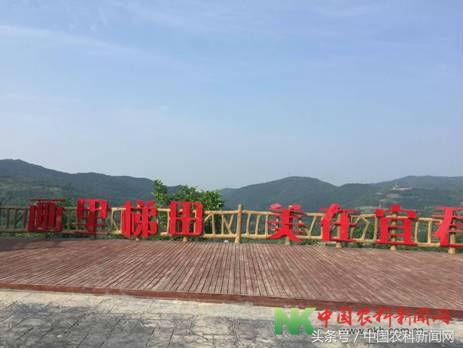
The photo shows promotional slogans put up at the Tangnihe industrial integrated technology demonstration area in Yijun County.
"'Shandan 609' has good density tolerance, hard stalks, strong lodging resistance, a thin cob axis, deep and long kernels, good color, excellent variety quality, and good yield stability. It increases yield by at least 400 jin per mu compared with the original varieties," Yang Bangmin, a senior agronomist at the Yijun County Agricultural Technology Extension Center, told reporters during the interview as he detailed the variety advantages of "Shandan 609."
It is understood that in addition to support with improved varieties, in order to give play to the radiating and driving effect of the science and technology demonstration and extension base, experts from Northwest A&F University also exported technology by training local "science and technology relay runners," promoting the matching of improved varieties and improved methods in Yijun and helping farmers increase production and income. These technologies include plastic-film mulching, soil testing and formula fertilization, rational close planting, mechanized wide-and-narrow row sowing, unified pest and disease control, and straw return to the field. "We want to realize at Tangnihe the 'five modernizations' model of integration of key technologies, unified supply of agricultural materials, package-style formula fertilization, integration of agricultural machinery and agronomy, and ecological farming environment," Yang Bangmin said.
The photo shows the Tangnihe plastic-film corn base of the agricultural science and technology demonstration and extension project of the Yangling Demonstration Zone in Yijun County.
"Now most of what we plant here is 'Shandan 609.' Plastic-film mulching has doubled the yield compared with the varieties planted before, reaching 1,400-1,500 jin per mu," said Yang Shuqin, a villager of Tangnihe Village.
Yangling technology fission drives the momentum of industrial chain development and boosts farmers' incomes
In addition to doing a good job in corn planting, Yangling technology has also produced a fission effect here.
In recent years, relying on agricultural development and following the extension model of "technical departments + cooperatives + large growers + farmers," Yijun County has, by cultivating a change in the way of thinking of demonstration households, guided farmers around the Tangnihe industrial integrated technology demonstration area to follow the idea of developing from traditional agriculture to modern sightseeing agriculture, promoted agricultural transformation, and driven the integrated development of agriculture's secondary and tertiary industries. At present, the Tangnihe industrial integrated demonstration area has become a comprehensive demonstration base integrating agricultural integrated technology research and development, farming culture dissemination, and rural tourism, with obvious demonstration effects.
The photo shows villagers of Tangnihe Village making straw weaving in their spare time from farming.
"Our demonstration base currently has the Tangnihe folk culture area, the Farming Impression Museum, the Meng Jiangnu Culture Square, and the plastic-film corn sightseeing and photography area, truly forming an industrial innovation model of 'agriculture + ecology + tourism + folk customs.' Through plastic-film corn planting as the foundation, we have turned an ordinary agricultural industry into a richly combined characteristic industry, extended the industrial chain, and also raised farmers' incomes," He Yaqing said.
Now, when entering Tangnihe Village, many former farming households have opened agritainment businesses, and many other farmers use their spare time from farming to do straw weaving to increase household income.
The photo shows handmade crafts made by farmers sold in the Tangnihe homestay culture area.
"In addition to the income from planting more than 7 mu of corn each year, my family's agritainment business can earn more than 30,000, and family members also use their spare time to work outside, earning 50,000 to 60,000 a year," said Yan Qinghong, a villager of Tangnihe Village.
During the interview, Yang Bangmin told reporters that after "Shandan 609" was extended locally, Professor Xue Jiquan often braved the scorching heat to go to the fields to observe the growth of the variety. In addition, Professor Xue also provided them with several varieties this year for trial planting. "Thank you to the Yangling experts, and thank you to Yangling technology for the changes it has brought us," Yang Bangmin said.
(The article was interviewed and reported by Zhao Yun, chief reporter of Agricultural Science and Technology News and China Agricultural Science News Network)
Editor: Ren Jing