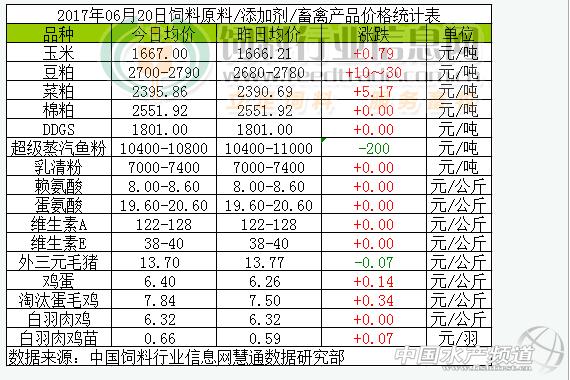
Domestic market prices on June 20, 2017 for 11 feed ingredients including fishmeal, soybean meal and corn
The volume of old-crop grain arriving at northern ports tends to keep increasing, and current old-crop prices have already moved close to the cost of auctioned grain, so prices will mainly stay stable in the later period.
Overnight US soybeans closed lower as weather improved and corn fell. Today's opening saw declines on the electronic session and gains in Dalian soybean meal, while spot soybean meal mostly held steady, with small increases in some regions. Recently spot transactions have picked up, and crushers have long suffered losses, giving them a mentality of holding prices firm; however, since downstream demand recovery is limited, it will be difficult for trading volume to keep expanding. At the end of June, USDA's actual planted area is about to be released. To guard against possible bullish effects, low soybean meal inventories carry a certain risk, so adjust your own inventories accordingly.
Domestic spot soybean meal prices have risen slightly for several consecutive days, boosting rapeseed meal prices to stay firm with a slight upward bias. Canadian rapeseed meal at coastal areas and ports has followed gains relatively closely, but the spread between soybean meal and rapeseed meal is narrow, the comparative advantage of rapeseed meal has declined, and the amount substituted by soybean meal has increased, with overall spot transactions performing average.
As the old crop runs out before the new one arrives, cottonseed prices have risen, and cottonseed meal inventories are tightening, supporting traders in holding prices firm; however, the spread between soybean meal and cottonseed meal remains too narrow, demand from the livestock sector is limited, and end-user transactions have shown no improvement, so the cottonseed meal market is mainly steady with consolidation.
Recently domestic corn ethanol plants have had poor shipments, but DDGS inventory pressure is not great, and aquaculture demand is set to pick up, keeping quotes firm.
The domestic fishmeal market is weakening, with fewer inflated quotes. At present, Peruvian super prime fishmeal in southern regions is priced at 10,400 yuan/tonne, while prices in northern regions are 10,600-10,800 yuan/tonne, with actual transactions mainly negotiated. Recently most of southern China has been hit by heavy rainfall, threatening shrimp farming, so in the short term domestic fishmeal demand is unlikely to show peak-season characteristics; moreover, many end-user feed companies have already done periodic restocking and taken delivery, and are now mostly drawing down inventories, which has constrained fishmeal shipments. Next, some southern ports in China will receive new-season fishmeal arrivals, so the fishmeal market will continue to come under pressure, and the downturn will be hard to reverse at this stage.
US market prices fluctuated and pulled back, domestic livestock consumption is weak, farmers buying piglets externally are mired in losses, and distributors cut quotes to boost transactions, so the whey powder market remains weak.
After manufacturers sharply cut quotes earlier, orders were relatively good. This week some manufacturers gave no quotes; CJ's 98-content quote is 8.5 yuan/kg and its 70-content quote is 5 yuan/kg. Strict environmental protection and approaching maintenance provide support to the market, and distributor quotes are steady with a slight upward bias.
Following price increases by Novus and Sumitomo, this week Evonik raised its quote to 21 yuan/kg and Ziguang raised its quote to 20.5 yuan/kg. Market attention has increased, transactions have improved, and distributor quotes have risen slightly.
With export volumes declining and domestic demand weak, the VA market has fallen rapidly this year, and prices have now dropped back to a low level. Strict environmental protection and the approaching high-temperature maintenance period have increased market attention somewhat. European market quotes have declined, with VA1000 quotes mostly in the 28-29.5 euro/kg range.
As new capacity is gradually released, VE manufacturers' quotes have continued to decline since the Chinese New Year, and domestic and international market quotes have fallen accordingly. Prices are currently in the bottom range. Recently, environmental inspections have been launched in various provinces and the high-temperature maintenance period is gradually approaching, so downstream companies' willingness to build positions has strengthened. The European VE market is weak, with quotes in the 4.5-4.6 euro/kg range.
Although farmers are holding prices firm, it is hard to support the market. Slaughterhouses have a strong desire to push prices down, and a trend of pig prices falling again has already emerged. Short-term pig prices are expected to fluctuate with a weaker bias.
Nationwide egg prices continued to be mainly rising, but the gains were smaller than in previous days. Today egg prices in parts of Henan saw a pullback. This round of price increases is gradually nearing its end, and short-term egg prices are expected to stall and stabilise.
Recently egg prices have soared wildly, which is bullish for culled laying hen prices and has pushed them up sharply again, with the average price already rising above 7 yuan/kg. It is expected that as egg prices continue to rise, laying hen farming will return to profitability, farmers' willingness to cull will weaken, supporting culled laying hen prices all the way up, and most regions have already risen into the 4 yuan/jin range. Later, as egg prices stall and stabilise, the rise in culled laying hen prices is expected to slow, with overall steadiness prevailing.
Recently the volume of live chickens sent to market has continued to decline, and the supply side remains bullish for the live chicken market. With slaughterhouse operating rates recovering, quotes for live broilers are supported in continuing to fluctuate in the 6 yuan/kg range; however, on the demand side, chicken product sales are still lacklustre, and insufficient demand remains the most important factor preventing live chicken prices from rising sustainably.
Currently chick output continues to decline from earlier levels, and large breeding farms have a relatively strong desire to hold prices firm, supporting a slight rise in chick prices; however, farmers' restocking volume in summer is relatively small, limiting the upside for chick prices, and in the short term chick prices will mainly continue to fluctuate in line with live chicken prices.
Note: The cut-off time for quotes of each variety in the daily market summary is 11:30, and differences in statistical timing may cause slight variations in prices for the day.