Good rice starts with planting it yourself: Liang Guilin, Chief Agronomist of Jiabei Agriculture
Original work. Reproduction without authorization is prohibited.
Farming is one of the earliest skills mastered by humankind. Farming not only fed humanity itself, but also gave rise to culture and shaped character. In rice cultivation, the Chinese people mastered planting techniques 7000 years ago.
But we know far too little about it. Is the best rice the Wuchang Daohuaxiang mentioned in "A Bite of China"? How do you tell indica rice, japonica rice and glutinous rice apart, and which kind are we eating?
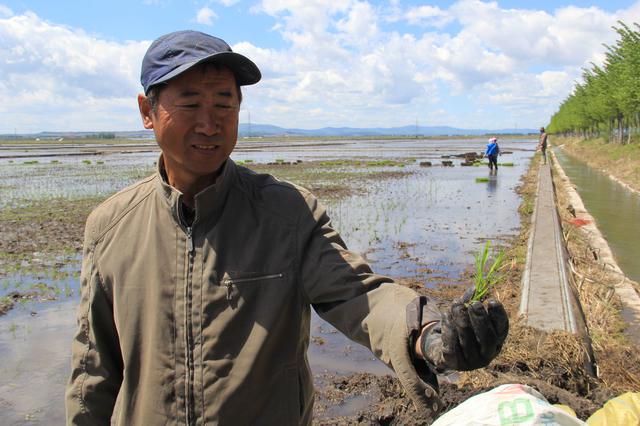
By the shores of Jingpo Lake, at the Xiangshui rice base, we met agricultural extension researcher Liang Guilin, which gave us a deeper understanding of "rice" and stirred a warm, intimate feeling toward it. Our questions about rice were answered one by one.
Growing rice: a dialogue between lives
Liang Guilin, an agricultural extension researcher, has worked in agricultural production for 42 years. A former deputy director of agriculture at Farm 853, he has experience managing 1.3 million mu of agricultural production and is an expert in the large-scale production and intensive management of modern, mechanized agriculture.
"Rice plants are alive, and growing rice is a dialogue between lives," Liang Guilin said. In the morning, when Liang Guilin goes to the greenhouse, he sees a bead of water perched on every leaf tip, and all around him drifts the distinctive fragrance of the original Daohuaxiang seed stock. Yes, the seedlings already carry the aroma of cooked rice.
When the seedlings reach the three-leaf-one-heart stage, it is time to transplant them. To damage the seedlings as little as possible, Liang Guilin uses traditional manual transplanting.
The leaves of the seedlings speak. When fertilizer was applied, when pests struck - you can see it all. This is not book-learning; you need to go and look - look at the water, look at the leaves, look at the weather. You also have to adjust according to the farming season, the growth condition and the temperature, just as you would care for a child. Only by understanding the rice plant's cold and warmth can you cultivate it better.
Rice seedlings raised by Liang Guilin, once transplanted into the paddy field, have no setback period, because the original seed stock has strong stress resistance, the seedlings are vigorous and adapt well, and they gain more growing time than other seedlings - something that is extremely precious for rice in cold regions.
Like the local Korean ethnic elderly farmers, Liang Guilin works in the fields almost all day long. Wearing water boots and gloves, he shoulders the seedlings and carries them to the paddy field.
Good seedlings mean half a year's grain. He plants the seedlings he raised from original seed stock into the field by hand, keeping the spacing at 9*3 cun. To achieve precise spacing, he and his colleagues use the simple device shown in the picture above to run the guide lines.
Practical skill, and practice brings true knowledge. Having traveled to many places and eaten many kinds of rice, Liang Guilin says that when it comes to which rice tastes good, it is hard to suit every taste. Many people mix personal emotion and more sentimental memories into what they consider delicious.
The south grows indica rice, while the northeast grows japonica rice. Indica rice is slender; when cooked, the grains stay loose, with poor stickiness and a hard, gritty bite. Japonica rice is short and plump, sticky, with good palatability - soft and springy. Northeast rice is single-season rice, japonica rice, produced only once a year, so it absorbs ample nutrients. Here the ground beneath is stone slab; it feels warm underfoot, and the rice grown here contains 7 amino acids that the human body cannot synthesize.
The field we saw grows Northeast Daohuaxiang rice. Apart from Wuchang, this is the only place in the northeast where it can be grown. The Daohuaxiang variety has high accumulated-temperature requirements. In the northeast, mornings are cold, the midday high-temperature period is short, and temperatures drop quickly at night, so it is actually not suited to Daohuaxiang's growth. But both the Wuchang area and this place have a small-basin climate, and together with the heat retention of the volcanic rock, this satisfies the growing conditions for Daohuaxiang rice.
The Daohuaxiang here is still different from that of Wuchang, with differences in taste and nutrition. Xiangshui's Daohuaxiang rice contains 7 amino acids that the human body cannot synthesize. The porridge it makes is clearer; after sitting for a while, a skin of rice forms along the edge of the bowl that you can lift with chopsticks, and its fragrance is slightly lighter than Wuchang's.
Leaving a grain of good rice for our descendants
Human activity and industrial pollution are rapidly encroaching on our vast land. The grain and vegetables we eat no longer taste as they once did. Liang Guilin and his colleagues once conducted an experiment testing mushrooms grown in a greenhouse 300 m from the roadside, and vehicle exhaust pollutants were detected in them.
Guarding this precious land for the motherland and making it produce good grain has always been what Liang Guilin and his colleagues insist on. Lenovo Jiabei has four major bases of its own: the Xiangshui base, where the land is volcanic stone-slab field and the water source is Jingpo Lake; the Wuchang base, with humus black soil and the Longfengshan Reservoir as its water source; the Yanbian base, planted in a small mountain basin with the Hailan River as its water source; and the Xingkai Lake base, with cold-region peat black soil and Xingkai Lake as its water source. Liang Guilin travels among the four bases, so that his descendants can eat clean, good rice grown from good mountains and good water.
"The northeast has 13 million mu of black soil, but there are far too few people who know how to farm. The local farmers we now find to transplant rice are all over 45 years old; the young ones have gone to the cities to work. In 10 years, the methods of farming may be lost."