Artichokes look like lotus lanterns. What are the prospects for growing them?
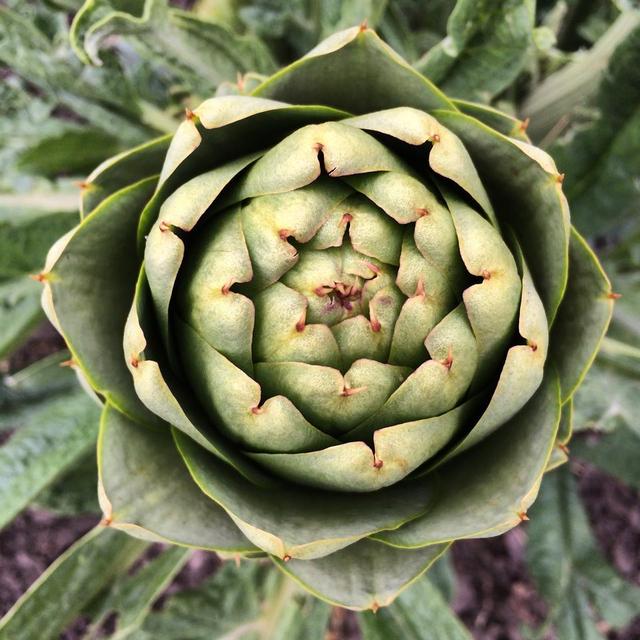
It is not a novelty. Everyone may have heard of artichokes, but few have actually seen one, let alone eaten one.
In East Asia, the artichoke has a distinctive name, "Korean artichoke" (Chaoxian ji), though it has nothing to do with Korea; the name was given by the Japanese.
Artichokes are rarely seen in Chinese markets and restaurants, but in Europe and the United States they are a household ingredient. Their sweet, delicate flavor, somewhere between peas and asparagus, made them a mainstay of Mediterranean cuisine in the first half of the year. Some people compare their taste and nutritional value to the "hairy crab" of the West.
An artichoke farm in California, USA
However, artichokes have high requirements for soil and climate conditions. They need fertile, slightly alkaline, well-drained soil and a frost-free subtropical climate. Few regions worldwide are suitable for growing them. At present, they are mainly grown in Naples, Italy, France, Spain, and California in the United States, with small amounts also grown in Peru and South Africa. The total area does not exceed 1.5 million mu.
In China, the main growing areas are Yimen County in Yuxi, Yunnan; West Dongting in Changde, Hunan; Zhejiang; and Guangxi. The total area does not exceed 50,000 mu.
Data shows that stable market demand in Europe and the United States is more than 2.3 million tonnes, equivalent to a growing area of more than 2.3 million mu. The key point is that China's huge consumer market has not yet started, so it is predicted that within the next 10 years, global consumer market demand will expand to 3.3 million tonnes.
Artichoke growing tips:
1. This is a plant in the genus Cynara of the Asteraceae family. The harvest period lasts more than one month. After each harvest, new shoots emerge within a few days and grow new artichokes.
2. It is a perennial plant and can be harvested for up to 5 years.
3. The best companion plant for artichokes is peas (which fix nitrogen); sunflowers, tarragon, and cabbage are also suitable. For questions about growing techniques, you can consult the Yunzhongyang app, where experts provide one-on-one free answers.
4. Plant 600-700 plants per mu. Internationally, the yield of edible flower buds is about 1,000 kg per mu; in China it is estimated at 800 kg.
Artichokes are very large. If space is limited, it is best not to plant other crops.
5. The labor intensity of growing them is low, less labor is needed, and there are relatively few pests and diseases. It also avoids the busy farming season, but harvesting must be done by hand.
6. Artichokes are a high-input, high-output, high-technology crop, and at present they are almost entirely exported. Therefore, when governments or production bases introduce them, they should reasonably control the scale and supporting processing facilities.
7. Deep-processed products that can be developed include artichoke tea, beverages, effervescent tablets, instant artichoke extract powder, pickled artichokes, artichoke heart tea, canned artichokes, and seasoning sauce.
6. Foreign shopping websites show that 100 artichoke seeds sell for 9 US dollars, and farms sell one artichoke directly for 3 US dollars.
7. The two reasons artichoke cultivation fails are summer drought and winter waterlogging of the soil, so the planting plot must maintain both water-holding and drainage capacity.
8. Artichokes must be harvested in time. Once the bud opens, it can no longer be eaten and can only be used as an ornamental plant or for other purposes.
The artichoke's flower heart is very beautiful.
[Yunzhongyang - the essential agriculture app for farmers in the new era, solving problems in agricultural technology, buying and selling agricultural products, farmer networking, and new farmer education]