Green rice worth ten times as much; knowing how to grow a few mu of it beats raising cattle and sheep
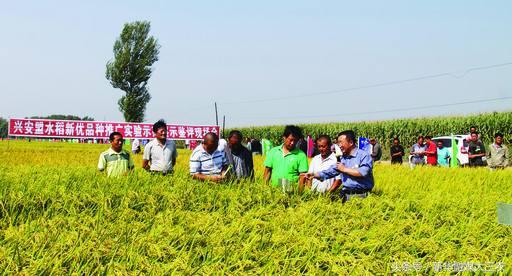
As a major agricultural and livestock region, Inner Mongolia is promoting green production methods and advancing the sustainable development of agriculture and animal husbandry, a topic that cannot be ignored. As the green development path of agriculture and animal husbandry has basically taken shape in recent years, all parts of the region are vigorously pursuing green planting and green breeding. Total grain output and livestock inventories have ranked among the top in the country for many consecutive years, making it an important national production and processing base for agricultural and livestock products. At present, as the wave of modernising agriculture and animal husbandry arrives, Inner Mongolia is hurrying to complete its transformation toward green development and improved quality and efficiency.
In this development, Jarud Banner in Inner Mongolia already has 8 green and organic certified enterprises, with 26 organic products having obtained certification certificates, and the organic product planting area reaching 1.26 million mu. It has 12 league-level enterprise brands and 2 regional-level enterprise brands. Trademarks such as "Chuole Yinzhu", "Chuoer Mengzhu" and "Bao'an Zhao" have been rated as famous trademarks of Inner Mongolia, and "Bao'an Zhao" and "Chuole Yinzhu" have won gold awards multiple times at international agricultural product trade fairs. It is also focusing on developing 600,000 mu of green organic rice, 600,000 mu of miscellaneous grains and beans, and 600,000 mu of special crops, including 80,000 mu of stevia, 60,000 mu of sugar beet and 50,000 mu of Chinese herbal medicine, planting 150,000 mu of silage corn and forage grass, with the comprehensive utilisation rate of straw reaching over 90%. In animal husbandry, it actively "stabilises sheep, increases cattle and expands pigs", raising the proportion of high-quality livestock, with improved-breed livestock reaching over 90%, striving to enter the ranks of the region's major livestock breeding counties.
Today's Jarud Banner, from large-scale breeding farms full of cattle and sheep to lush green facility agriculture parks, from bustling farmers' markets to rumbling agricultural and livestock product processing enterprises, all reflect the unique charm of modern agriculture and animal husbandry in this "granary beyond the Great Wall". If you drive all the way to Jarud Banner and see greenhouses everywhere along the way, you cannot help but exclaim that facility agriculture in Jarud Banner is rising strongly, and it is working to designate the geographical indication area for "Jarud rice" and enhance the visibility of its distinctive agricultural and livestock products.
And when it comes to rice cultivation in Inner Mongolia, one must mention Ordos's "unconventional" innovative planting - growing rice on saline-alkali land with good yields per mu. In Dalad Banner, 300,000 mu of land has been abandoned due to salinisation. To effectively address the problem of land salinisation, Dalad Banner uses large amounts of fresh water for leaching, washing harmful salts and alkalis out of the soil, thereby reducing salinity and soil pH and making the root environment suitable for rice growth. Through the model of "treating alkali with rice", it has brought prosperity to the local people. This year, to improve rice quality, Dalad Banner also applied organic blended fertiliser to 1,600 mu of rice fields.
Now efforts are being made to build rice brands, launching rice brands such as "Ergouwan", "Sicun" and "Zhaojun Chuanqi", and market sales channels are constantly expanding. Today, there are more and more rice growers in Dalad Banner, the scale of rice cultivation is expanding year by year, and incomes are constantly rising. The poverty-alleviation model of "treating alkali with rice and getting rich with rice" has achieved good results. In particular, "Ergouwan" rice, with its excellent quality, plump grains and good taste, is deeply favoured by consumers, selling for 4 to 5 yuan per jin, with net income per mu reaching 2,500-3,000 yuan.
Ji was drawn back to his hometown by rice in just this way. This year, through cooperation with science and technology-based agricultural and livestock enterprises to carry out scientific soil testing and fertiliser formulation, he implemented full-process monitoring of more than 300 mu of rice from transplanting, growth and care to harvesting, and the problem of soil salinisation has been basically solved.