Detailed Explanation of Soilless Cultivation Techniques for Ornamental Bromeliads
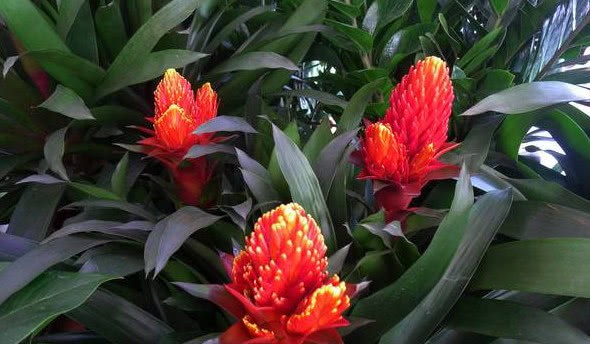
Those who know ornamental bromeliads surely know that an ornamental bromeliad blooms only once in its lifetime, but its leaves are glossy and its flowers are brilliantly colored, with a long ornamental period, making it widely loved by consumers and in great demand in the market. This article will introduce the soilless cultivation techniques for ornamental bromeliads.
1. Variety Selection
For large-scale commercial soilless cultivation of ornamental bromeliads, propagation is mainly carried out through tissue culture. Select varieties that are disease-free, with good plant form and good growth vigor. Based on factors such as market demand, cultivation environment and time to market, determine the ordering time, and purchase tissue-cultured plantlets with five true leaves and uniform growth.
2. Substrate
The roots of bromeliads need a large amount of air during growth. Because bromeliad roots require abundant air during growth, special attention must be paid when selecting soilless cultivation substrates. Substrates with good air permeability, water retention, drainage and good chemical stability should be chosen, such as coconut coir, volcanic rock, vermiculite, ceramsite, perlite, rock wool and peat soil. The substrate needs to be sterilized before use.
3. Planting
Before planting bromeliads in soilless culture, wash the seedlings clean, do not let them carry substrate, and place them on a sterilized seedling bed. When planting, fill the substrate up to the root crown; too deep or too shallow will affect the survival rate and growth speed of the bromeliad. Be careful not to get substrate into the leaf cups, and water thoroughly after planting.
4. Repotting
Repotting is needed after three to four months of planting. When repotting, water thoroughly one day in advance, water thoroughly again after repotting, and fertilizer can be applied one month later.
5. Temperature
During the seedling stage of soilless cultivation of ornamental bromeliads, the temperature is generally controlled at around 20 to 30 degrees; after three months the temperature can be appropriately lowered to 18 to 28 degrees. In the early stage, the day-night temperature difference should not be too large; in the later stage, the temperature difference ratio can be appropriately increased. In winter, the lowest temperature should not be lower than 10 degrees; if necessary, use heating equipment to warm the greenhouse and keep the temperature above 10 degrees.
6. Humidity
In their place of origin, bromeliads generally grow in tropical rainforest areas, preferring high temperatures and high humidity. In soilless cultivation, the suitable air humidity is between 60 and 80 percent; excessively high humidity can also easily trigger diseases. During the seedling stage, humidity should be controlled between 70 and 80; as growth progresses, it can be controlled between lost and 80. During the growth process, pay attention to maintaining ventilation to reduce the chance of pests and diseases.
Cultivation Precautions
Ornamental bromeliads prefer a semi-shaded environment; in winter, keeping them warm above 12°C is sufficient, and they can accept direct sunlight. In summer, be sure to avoid exposure to the scorching sun! To extend the flowering period, be sure to ensure the optimal care conditions: sufficient light, appropriate watering, warmth and ventilation.
The above are the soilless cultivation techniques for ornamental bromeliads. Friends who want to cultivate them can refer to these key points to safeguard their own economic benefits.