Chili Peppers and Kiwifruit Pave the Road to Prosperity in Wujia Village, Zhaogong Town, Fufeng County
This year's abundant rainfall caused large-scale lodging of wheat in the Fufeng County area, and Wujia Village, with a population of more than 2,000, was no exception.
"The wheat lodged, and the yield dropped a lot compared with previous years!" 72-year-old Ma Xiping lamented to a Huashang Daily reporter. Even so, Ma Xiping believes the impact on Wujia Village is not great, because Wujia Village is now moving away from a model of relying on a single traditional crop for income. Apples and nursery stock have become the village's leading industries, and kiwifruit cultivation is also beginning to show results. Sun Hongru, Party secretary of Wujia Village, said traditional grain farming in Wujia Village is being marginalized into a "sideline."
A Huashang Daily reporter learned through a stay-in-village investigation that, in fact, since the introduction of the household contract responsibility system, the farmers of this village have been repeatedly struggling with the topic of increasing income and getting rich. From the earliest efforts to find ways to increase grain yields, to later becoming a locally famous "chili pepper village," to then every household planting apple trees, and now nursery stock and kiwifruit beginning to be accepted by farmers, the development course of Wujia Village is in fact a microcosm of rural China.
The Rise and Fall of Chili Pepper Prices
Let Villagers Feel the Cruelty and Excitement of the Market
Just after the household contract responsibility system was introduced, the people of Wujia Village were single-mindedly thinking about how to double grain output. After more than a decade of struggling, many villagers found that although grain output had increased somewhat, money still came in very slowly, and household income simply would not rise.
Around 1991, the "get-rich" trend of growing chili peppers swept into Wujia Village. At that time, the purchase price of one jin of wheat was less than 3 mao, while one jin of chili peppers could sell for 8 mao. So for a time every household in Wujia Village grew chili peppers, and of the village's more than 4,000 mu of land, half was planted with chili peppers. Unfortunately, chili pepper prices were not good in 1994, which dealt a heavy blow to many pepper farmers and led to a decline in the village's chili pepper planting area the following year. Unexpectedly, chili pepper prices then rose, at one point even reaching 8 yuan per jin. From 8 mao to 8 yuan, the people of Wujia Village felt for the first time, and intensely, the cruelty and excitement of the market.
In 1997, the chili pepper planting area in Wujia Village began to shrink drastically. The reason was that the market had been artificially damaged. Many years later, many villagers admitted that the market had been damaged by the villagers themselves. Some villagers, seeing that chili pepper income was good, secretly sprinkled water on the chili peppers the day before selling them in order to increase their weight. This practice led to the merchants who bought chili peppers no longer coming to Wujia Village the following year. The road by which the people of Wujia Village relied on growing chili peppers to "get rich" thus came to an abrupt end.
Slow Sales of Apples Gave Rise to
"Wujia Village's First E-commerce Entrepreneur"
Around the time chili pepper cultivation ended, a call for villagers to plant apple trees came down from above to Wujia Village. Although apples have now become the main source of income for local people, promotion back then was very difficult. "For thousands of years farmers have made their living by farming. To suddenly stop growing crops and grow apples instead was unacceptable to most people," recalled 59-year-old Bi Wanli.
To encourage villagers to plant apples, and also to complete tasks assigned by higher authorities, village cadres came up with a crooked trick to "shift responsibility" - anyone who carried apple saplings home would be rewarded 100 yuan. The "crooked trick" worked very well, and villagers began carrying saplings to their homes.
Village cadre Sun Hongru later discovered that although the apple saplings had been taken home, the villagers still showed no sign of planting them. After the information was reported back to Fufeng County, the government once again introduced incentive policies: the government would subsidize the money for digging holes to plant apple trees, the auxiliary bamboo poles needed would be provided free by the government, and the agricultural department would also send technicians to the village to provide free guidance.
Encouraged by multiple preferential policies, some people in Wujia Village began planting apple trees with a try-it-and-see attitude. Bi Wanli was one of those "first to eat crabs." Facts proved that his choice was very correct. A few years later, the maximum income from his family's 3 mu of apple land reached 70,000 yuan. Also benefiting from planting apples was 65-year-old Bi Jianguo, whose family's gross apple income in 2015 reached more than 90,000 yuan. After selling his apples that year, the first thing Bi Jianguo did was call a few old buddies and go to Xi'an to buy himself a "Buick" car. From not even daring to dream of owning a walking tractor to now driving a car to the fields every day to tend his apples, Bi Jianguo feels like he is dreaming. He said that some time ago he made a rough count, and of the 528 households in Wujia Village, nearly 60 currently have bought cars. "It is basically all driven by the apple industry. Without apples, today's life would be unimaginable!"
In 2016, apples in the Fufeng area suffered slow sales due to overproduction. Fruit growers were extremely anxious, including Wujia Village resident Ma Huilu. 55-year-old Ma Huilu was the first villager in Wujia Village to build a two-story house. What he is most proud of is that his family produced three university students. His younger sister and two sons were all supported by him alone and now all work away from home. After the apples suffered slow sales, Ma Huilu called his two sons working in Wuhan for help. The brothers discussed it and decided to open an "e-commerce" store online for their father to help him sell apples. Ma Huilu not only sold all of his own apples within one month, but also helped neighbors such as Bi Xinjun and Ma Dongping sell all of their apples. From then on, Ma Huilu was called by the villagers "Wujia Village's first e-commerce entrepreneur."
Nursery Stock Becomes Wujia Village's Second-Largest Industry
When it comes to nursery stock in Wujia Village, 46-year-old woman Wang Xiling, who has already been lifted out of poverty, is someone who cannot be left out.
Wang Xiling was once a major pig farmer in the village and was quite well off financially. But a serious illness in 2011 not only used up all her savings but also left her 110,000 yuan in debt. In 2013, Wang Xiling planned to make a comeback, but her husband then died unexpectedly. The double disaster plunged Wang Xiling's family into extreme difficulty, and that year their family was identified as an impoverished household receiving the minimum living allowance.
Afterward, Wang Xiling also considered planting apple trees, but in the end she chose nursery stock. This was because the apple cycle is too long - from planting to fruiting takes at least five years - while the nursery stock cycle is relatively shorter. More importantly, before 2013 the development of nursery stock in Wujia Village was a blank. Wang Xiling acted as soon as she decided. She borrowed money from relatives and friends and planted 3.5 mu of nursery stock including whitebark pine, cherry blossoms, and five-pointed maple, and hired people to work while she mainly provided technical guidance. Three years later, in 2016, the 3.5 mu of nursery stock helped her pay off her debts, and the scale of her nursery stock planting had grown to 30 mu. In October 2016, Wang Xiling voluntarily submitted an application to the village committee requesting to withdraw from the ranks of impoverished households. She also became the first villager in the entire Zhaogong Town to voluntarily apply to withdraw from poverty.
Driven by Wang Xiling, in just two years, nursery stock planting in Wujia Village has grown to more than 30 households today. Wang Xiling also helped lead and assist impoverished households such as Bi Xinjun in building nursery stock plots. Nursery stock is currently becoming Wujia Village's second-largest industry.
Kiwifruit Is Becoming a New Highlight for Income Growth
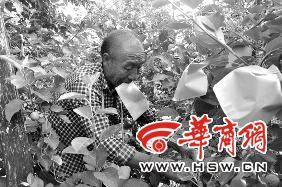
In addition to apples and nursery stock, kiwifruit is also becoming a new highlight for income growth for the people of Wujia Village. 47-year-old Chen Guaicui is a laid-off worker from an agriculture and forestry enterprise and also a daughter-in-law of Wujia Village. Four years ago, after returning to the village from the city, Chen Guaicui took a fancy to a plot of collective land in the village, contracted it, renovated it, and planted kiwifruit.
The news that Chen Guaicui was planting kiwifruit caused a big stir in Wujia Village. Many villagers were not optimistic about this industry, believing that kiwifruit could not be grown north of the Wei River. Chen Guaicui ignored this. She raised funds from relatives and friends and took out bank loans, and after more than three years of effort finally established a 30-mu kiwifruit orchard.
In 2016, Chen Guaicui's kiwifruit orchard bore fruit and was harvested for the first time. The 30 mu of kiwifruit was snapped up by merchants in less than half a month, with income exceeding 300,000 yuan. The villagers of Wujia Village were astonished! For the same farming, the income from one mu of apples equals that from growing 10 mu of wheat, and the income from one mu of kiwifruit is even higher than that from apples.