The lack of agrochemical services: what kind of professional services do modern farmers need?
With the large-scale promotion and application of integrated water and fertilizer technology, the fertilizer structure is facing rapid adjustment, traditional fertilizers are facing transformation and upgrading, and water-soluble fertilizers, as supporting products for integrated water and fertilizer technology, have ushered in development opportunities. Compared with traditional fertilizers, water-soluble fertilizers have higher utilization rates and more comprehensive nutrients. However, water-soluble fertilizers face various challenges in the process of market promotion. The reason is that many farmers, in the process of using water-soluble fertilizers, use inaccurate methods and dosages, resulting in results that fall short of expectations. The essence of agrochemical services lies in discovering and solving technical problems in farmers' planting process. Based on market experience in promoting liquid fertilizers, this article shares with readers how to solve a series of technical problems in the fertilization process through agrochemical services.
In many fruit tree and vegetable growing areas in the south, drip irrigation and sprinkler irrigation facilities are currently not widely popularized. For these farmers, liquid fertilizer is a noble fertilizer, expensive not only in price but also in labor cost. If improper use causes direct and indirect waste of fertilizer, the fertilizer effect will be insignificant, thereby further increasing farmers' comprehensive costs and ultimately causing farmers to lose confidence in liquid fertilizers. Therefore, to rapidly promote liquid fertilizers, the following problems must be solved: First, how to help farmers choose efficient tools to apply liquid fertilizers and reduce fertilization costs; Second, how to solve various problems in farmers' fertilization process through agrochemical services and guide them to correctly apply liquid fertilizers; Third, how to resolve farmers' doubts through technical training so that they have a correct understanding of liquid fertilizers. In response to the above problems, we adopted the following measures.
I. Development and promotion of supporting fertilization tools
As is well known, in some areas of large-scale planting, modern irrigation and fertilization equipment such as sprinkler irrigation and drip irrigation are the best carriers of integrated water and fertilizer technology. However, in many areas of our country, farmers still plant in a scattered manner, the plots are small, and traditional fertilization methods are still used. Under such conditions, installing sprinkler and drip irrigation systems is unrealistic. In the process of promoting liquid fertilizers, many farmers reported that the effect was good, but the efficiency of manual fertilizer application was too low, and they gradually lost interest in applying liquid fertilizers, eventually returning to granular compound fertilizers. Therefore, to smoothly promote liquid fertilizers, we must first think through for farmers how to apply liquid fertilizers easily and efficiently, so the fertilization tool is the key factor. We must, according to farmers' crops, terrain, and fertilization habits, create a set of simple, efficient, and practical liquid fertilizer application tools.
1. Boat-type irrigation and fertilization machine
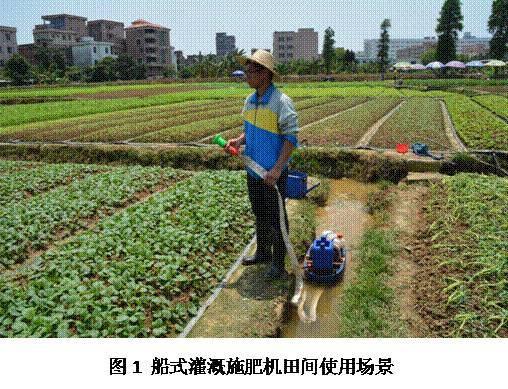
In many fruit tree and vegetable areas in South China, there are regular ditches between fields, and farmers usually first broadcast compound fertilizer, then drag a boat-type sprinkler irrigation machine to spray water. This method of irrigation and fertilization is relatively cumbersome, and water and fertilizer are not supplied at the same time, reducing the utilization rate. To make it easier for farmers to apply liquid fertilizer, we made a simple improvement to the boat-type sprinkler irrigation machine in farmers' fields, making it into a boat-type sprinkler irrigation machine that can apply fertilizer (Figure 1). We only need to add a fertilization bucket to the original boat-type sprinkler irrigation machine, and the fertilization bucket is connected to the water inlet of the boat-type sprinkler irrigation machine. When fertilization is needed, liquid fertilizer is put into the fertilization bucket, and the liquid fertilizer flows along the fertilizer outlet pipe to the water suction port. The boat-type sprinkler irrigation machine sucks up fertilizer and water at the same time (Figure 2), and sprays them evenly mixed onto the roots of the crops, making fertilization light and efficient.
2. Knapsack-type ladle mixing fertilization device
South China has abundant water sources, and for convenience in irrigation, farmers fill the furrows in the fields with water. The traditional method of irrigation and fertilization is to first broadcast granular compound fertilizer on the ridge, and then use a water ladle to pour water from the furrow onto the ridge (Figure 3). This method of carrying out fertilization and irrigation separately not only increases labor cost and labor intensity, but also, because water and fertilizer are not synchronized, significantly reduces the nutrient utilization rate of the fertilizer. To solve the above problems, we designed a knapsack-type ladle mixing fertilizer applicator (Figure 4). Remove the pesticide outlet pipe of the knapsack sprayer, first connect it to the bucket with a short PE pipe, then connect a section of PVC pipe, and connect a water ladle to the end of the PVC pipe. When farmers apply fertilizer, they first put liquid fertilizer into the sprayer bucket, then output a small amount of liquid fertilizer manually or electrically into the water ladle, and finally scoop a ladle of water from the furrow, so that water and fertilizer are quickly mixed to reach the established dilution concentration, and then pour the water and fertilizer onto the crop ridge (Figure 5). This fertilization mode completes the two traditionally separate processes of irrigation and fertilization in one step, significantly improving fertilization efficiency while also achieving integrated water and fertilizer application.
Figure 3 Conventional furrow irrigation and fertilization
3. Knapsack-type fertilization gun
For some crops grown under plastic film, if under-film drip irrigation or water spray tape is not installed, later-stage topdressing is very difficult, and the later stage is often the peak period of crop nutrient demand. If timely water and fertilizer supply cannot be obtained, it easily leads to nutrient deficiency and yield reduction. To resolve this contradiction, we designed a knapsack-type fertilization gun (Figure 6). Remove the pesticide outlet pipe of the knapsack sprayer, first connect it to the bucket with a short PE pipe, then connect a fertilization gun, and the end of the fertilization gun has several water outlets, which can be directly inserted into the soil layer for targeted application of water and fertilizer. On the one hand, this solves the problem that crops grown under plastic film cannot be topdressed; on the other hand, it achieves precise fertilization and greatly improves water and fertilizer use efficiency. When farmers apply fertilizer, they first dilute the liquid fertilizer according to a certain ratio and put it into the sprayer bucket, then insert the fertilization gun near the crop roots for targeted fertilization (Figure 7).
In some fruit tree growing areas, this tool can also be used to apply water and fertilizer. According to the size of the tree canopy, determine several fertilization points and inject water and fertilizer into the soil layer where the roots are densely distributed (as shown in Figure 8). This can reduce the labor intensity of fertilization and also improve water and fertilizer use efficiency.