Detailed Explanation of Planting Environment, Site Selection and Management Measures for Ginkgo biloba
How to choose the planting environment and site for Ginkgo biloba? Planting management measures for Ginkgo biloba
1 Planting techniques
1.1 Selection of planting environment and site. Ginkgo biloba is a warmth-loving, sun-loving species, so it is suitable for planting in soil or sandy soil with sufficient sunlight, deep soil layers, relatively loose texture, fertile soil and adequate moisture. Because Ginkgo biloba grows slowly and has a long lifespan, when used in landscaping, a site with relatively high terrain, convenient transportation and good drainage capacity should be chosen. Since Ginkgo biloba has strong adaptability to the external environment, some acidic and alkaline soils can also be planted with Ginkgo biloba after certain modifications.
1.2 Planting techniques. Before planting Ginkgo biloba, a simple shaping prune should be carried out without affecting the original tree form. When planting Ginkgo biloba, there are also certain requirements for the tree pit: if the tree has a root ball, the tree pit should be about 80 cm larger than the diameter of the root ball of the Ginkgo biloba to be planted; if the tree does not have a root ball, the tree pit should be about 50 cm larger than the diameter of the root system of the Ginkgo biloba to be planted. When planting trees, for Ginkgo biloba with a root ball, when establishing the planting position, the tree should be held upright and aligned, and fine soil should be used to firm the area around the root ball, with the depth preferably covering more than 10 cm above the surface of the root ball; for Ginkgo biloba without a root ball, when establishing the planting position, the root system of the tree should be ensured to spread naturally within the pit, then the tree should be held upright and aligned and firmed with fine soil, with the depth preferably covering more than 10 cm above the root crown with soil.
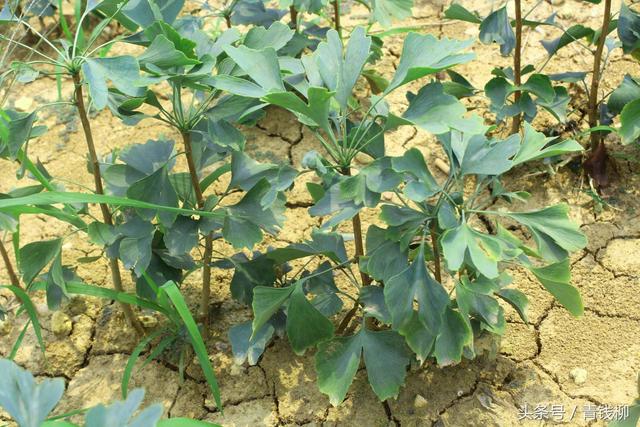
2 Management measures
2.1 Irrigation. After planting Ginkgo biloba, attention should be paid to watering. The first watering is deep root watering and must be thorough. If there is a water shortage, water thoroughly once every 5 d. After Ginkgo biloba survives, it does not need frequent watering. In northern regions, water once after the ground thaws and before the trees bud; in June, when the weather is dry, which is the peak growth period of Ginkgo biloba in the year, water once; the second peak growth period in Ginkgo biloba's annual growth is in late August, when it can be watered once more.
2.2 Fertilization. The best seasons for fertilization are generally spring and summer. Dig trenches beside the trees, mix the fertilizer evenly with the topsoil, and then fill it in. If too much fertilizer is applied in spring, once a year is enough; otherwise, apply fertilizer once more in late August.
2.3 Pruning. As an ornamental tree, Ginkgo biloba must be pruned appropriately and promptly to maintain its beauty. When pruning in winter, remove some dead branches, thin branches, overlapping branches, upright branches and diseased or pest-infested branches. After pruning, paint is usually applied to the pruning cuts to prevent moisture loss.
2.4 Cold and freeze protection. In northern winters, straw ropes are usually wrapped around the trees, and old newspapers are used inside the straw ropes to wrap the trees for cold protection. Nowadays, with the emergence of more and more new materials, colors that match the tree environment can be chosen for cold-protection wrapping. The method of whitewashing the trunk can also be used to keep the trees warm. This method generally uses salt-added limewater or lime-sulfur mixture to whitewash the trunk in autumn, and at the same time uses the principle of reflection to reduce the trunk's absorption of solar radiation, thereby reducing the day-night temperature difference on the trunk so that the trees will not freeze. This method can also remove some pests that damage the trees.
3 Pest and disease control
3.1 To prevent the invasion of pests and diseases in Ginkgo biloba, scientific production should be carried out in all aspects such as seed collection, seedling raising and later management, cutting off all sources of pests and diseases.
3.2 When sowing, do a good job in the treatment of seed and soil sterilization and disinfection.
3.3 Timely remove wild pest hosts inside and outside the garden, and isolate external sources of insects.
3.4 Apply more phosphorus and potassium fertilizers to enhance the immunity of Ginkgo biloba branches to pests and diseases.
3.5 Before establishing the planting position for Ginkgo biloba, clear away the residues of various diseased plants, and afterward keep Ginkgo biloba in an environment with ventilation and light.
3.6 When pruning branches, cut off the damaged branches and then clear them away.
3.7 When eliminating insects, use pesticides reasonably and try to catch insects manually.