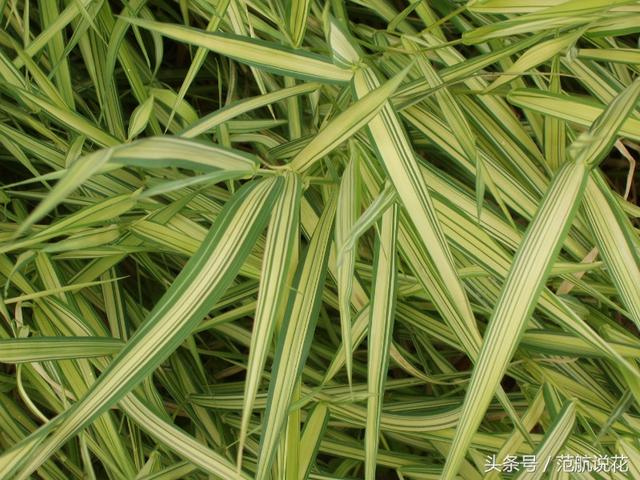
Pleioblastus fortunei: the smallest bamboo variety, it looks great whether planted in pots or in the courtyard
Pleioblastus fortunei, Poaceae, genus Pleioblastus
Native to Japan, it was successfully introduced and cultivated in the Xi'an area.
An ornamental ground-cover bamboo, clump-forming, internodes hairless, each node of the culm bearing 2 to several branches or the lower part with 1 branch. Leaves narrowly lanceolate, with yellow-white longitudinal stripes on a green background. Margins have culm hairs, both surfaces nearly hairless, with distinct small transverse veins, petiole extremely short, leaf sheath light green, one side of the margin with distinct culm hairs, the sheath mouth with several white marginal hairs. Shoot period April to June.
Prefers a warm and humid climate, shade-tolerant and relatively cold-tolerant, avoids blazing sun, suitable for planting in fertile, loose, well-drained sandy soil.
Mainly propagated by division. In February to March or September to October, dig up the grown mother plant together with its underground rhizome and soil, divide it along the natural growth direction into several plants, and plant them as soon as they are dug up.
The plant is low-growing with elegant leaves, often planted in courtyards for viewing; it can also be used as ground cover or arranged beside rockeries, and in the north it is also commonly seen in pots, with a distinctive refined charm. It is a rare and precious variety among ornamental bamboos.