Rape/Corn/Soybean Rotation Planting Increases Both Yield and Income
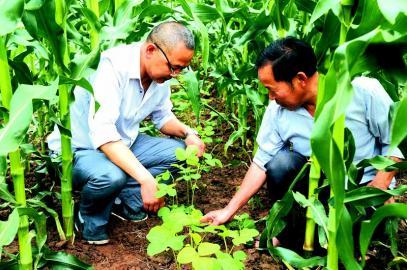
Agricultural technician inspecting soybean growth in Chen Jialiang's (right) field and providing technical guidance.
□Special Correspondent Tang Mingping Text/Photo
On June 18, the author observed in the field of Chen Jialiang, a villager of Sihua Village, Dayi Town, Yilong County, that soybeans intercropped in spring corn fields were growing well and particularly eye-catching.
Chen Jialiang said that in order to improve land utilization and increase income, under the guidance of the town's agricultural technology station, he replaced wheat with rape and sweet potato with soybean, and actively promoted the "rape/corn/soybean" annual cyclic high-yield planting technology. Compared with other dryland planting models, rape and soybean are important sources of edible oil and protein, and both are soil-nourishing crops, which help prevent soil fertility decline and improve the multiple cropping index.
Chen Jialiang told the author that his two mu of dryland had adopted the "rape/corn/soybean" annual cyclic high-yield planting technology since 2014. According to yield measurements, rape yield reached over 150 kg per mu, corn over 600 kg, and soybean over 130 kg, with income per mu exceeding 3000 yuan, showing significant increases in both yield and income. After crop harvest, straw is directly returned to the field to cover the empty rows, which can increase soil fertility, control weeds, and reduce the application of chemical fertilizers and pesticides. The main techniques are as follows --
Crop Rotation Arrangement and Variety Selection
Corn is raised as seedlings and transplanted, with seedling raising from March 15-25 and transplanting from April 5-15. Soybean is sown from late May to early June and harvested in mid-to-late September. Rape is raised as seedlings from October 5-10, transplanted from November 1-15, and harvested in mid-to-late April of the following year.
For rape, select double-low rapeseed varieties with strong growth vigor at the seedling and bolting stages, easy to promote early development, and with an early growth period. For corn, select varieties with short stalks and a wide sowing window; for soybean, select shade-tolerant high-yield varieties.
Corn/Soybean Cultivation Techniques
Prepare 1500 kg-2000 kg of fully decomposed farmyard manure per mu, mix evenly with 70 kg of calcium magnesium phosphate fertilizer, and pile for about 30 days before use. After the previous crop is harvested, carry out deep plowing of 25 cm-30 cm in a timely manner to sun the beds, and before sowing, break up the bed surface finely and level it. For seedling raising and transplanting, prepare 7 sq m-10 sq m of seedbed per mu, making the seedbed with high ridges and low furrows to retain moisture and resist drought.
Sowing specifications: Corn is transplanted in wide and narrow rows, with narrow rows of 40 cm, wide rows of 160 cm, plant spacing of 18-20 cm, and 4000-4500 plants per mu. Transplanting requires transplanting young seedlings with the seed, generally after 5-7 days of seedling raising, from the one-leaf-one-heart to two-leaf stage. In the wide rows, intercrop 2 rows of soybean, with plant spacing of 35 cm, row spacing of 36 cm, 6000 hills per mu, 3-4 seeds per hill, ensuring uniform seedlings.
Apply seed fertilizer: Apply 10 kg of urea per mu, 5 kg of potassium sulfate or 40 kg of corn-specific compound fertilizer, applied in the transplanting furrow during transplanting. For soybean, apply 25 kg of ordinary calcium superphosphate per mu. After applying fertilizer, cover with a thin layer of soil so that seeds and transplanted seedlings do not directly contact the chemical fertilizer. After transplanting is completed, cover the hills or apply in furrows with piled decomposed farmyard manure, leaving fine ash manure mixed with 3 kg of potassium sulfate per mu to cover soybean hills.
Seedling-promoting fertilizer: At the 4-leaf to 5-leaf stage of corn, apply 10 kg of urea per mu in combination with intertillage and weeding.
Jointing fertilizer: At the large trumpet stage of corn, apply 25 kg-30 kg of urea in combination with intertillage and hilling. Grain fertilizer: At the tasseling and silking stage of corn, apply 3 kg of urea as a top dressing.
Management: Before applying the seedling-promoting fertilizer to corn, thin and fill seedlings. Keep one seedling per corn hill, and timely replant where seedlings have died; keep 2-3 seedlings per soybean hill, and timely reseed in missing hills to ensure sufficient basic seedlings.
Pest and disease control: At the large trumpet stage of corn, use 48% Lorsban at 1000-1500 times dilution to control borers and armyworms; use 50% carbendazim to prevent northern and southern leaf blight and also control rust. At the tasseling and silking stage of corn, use 10% imidacloprid at 4000 times dilution to control aphids twice, and use 75% chlorothalonil to control diseases once.
Rape Cultivation Techniques
Prepare 10 sq m of seedbed per mu of main field, turn over and expose to the sun. Before seedling raising, break up finely and level. For a 10 sq m seedbed, mix 3 kg of rape-specific ternary compound fertilizer with 30 kg of decomposed pen manure and 0.2 kg of borax, apply evenly to the seedbed, level the bed surface, sow 0.3 kg of rapeseed per mu of main field, cover with a thin layer of soil after sowing, and spray deltamethrin to prevent insects.
Seedling stage management: After emergence, timely spray deltamethrin to prevent insects. Thin seedlings 10-15 days after sowing, pulling out overcrowded and weak seedlings. Apply 60 kg of clear manure water per 10 sq m once every 10 days, taking care that the manure water does not burn the seedlings. Before transplanting, control water and fertilizer to harden the seedlings.
Transplanting specifications: Transplant in cut furrows, with row spacing of 35 cm, plant spacing of 15 cm, single-plant transplanting, and 6000 plants per mu.
Apply base fertilizer: At transplanting, apply 30 kg of calcium superphosphate, 8 kg-10 kg of urea, 5 kg of potassium sulfate or 50 kg of rape-specific compound fertilizer, and 2 kg of borax as furrow application.
Seedling-promoting fertilizer: About 10 days after rape transplanting survives, apply 5 kg of urea per mu diluted in water; at an interval of 10-15 days, apply 10 kg of urea per mu diluted in water once more.
Bud and bolting fertilizer: When rape enters the bolting stage (mid-to-late December), apply 30 kg of rape-specific compound fertilizer, 1 kg of borax, and 5 kg of urea per mu diluted in water. At the initial flowering and full flowering stages of rape, spray 0.2% borax and potassium dihydrogen phosphate aqueous solution on the leaves 2-3 times.
Intertillage management: Rape fears waterlogging early and drought later; pay attention to opening furrows for drainage at the seedling stage. Irrigate once each at the bud and bolting stage, full flowering stage, and grain-filling stage. At the same time, carry out chemical weeding of field weeds.
Pest and disease control: At the bud and bolting stage, use downy mildew control agent once to prevent downy mildew. Control aphids 3 times at the initial flowering, full flowering, and pod-setting stages.