Beijing restores cultivation of old-flavor vegetables: 3 eggplant varieties and persimmon-cake winter melon
June 22, 2017 - The "eggplant jerky" eaten by Granny Liu in "Dream of the Red Chamber" was made with seven-leaf eggplant, and the persimmon-cake winter melon most loved by old Beijingers... The reporter learned from the Agricultural Technology Extension Station of the Beijing Municipal Bureau of Agriculture that Beijing's lineup of excavated and cultivated old-flavor vegetables has gained "new members," mainly four old-flavor vegetables: six-leaf eggplant, seven-leaf eggplant, nine-leaf eggplant, and persimmon-cake winter melon.
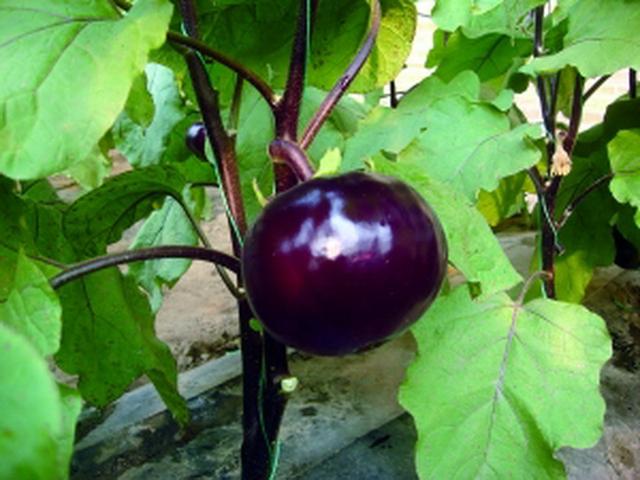
Reference image of six-leaf eggplant
The vegetable greenhouses of Beijing Jingchao Garden Agricultural Development Center can be called a gathering place for old-flavor vegetables. The top of the fruit-laden "apple-green tomato" has already turned pink, and the stem end is the same color as a green apple; when broken open, sandy flesh is visible. Walking further, one can see the "Beijing autumn cucumber" in greenhouse No. 1 and the "Beijing thorn cucumber" in greenhouse No. 2, while greenhouses No. 6, No. 7 and No. 8 respectively grow the "six-leaf eggplant," "seven-leaf eggplant" and "nine-leaf eggplant" varieties newly restored to cultivation this year.
"The seven-leaf eggplant gets its name because the eggplant grows at the seventh leaf. Its flesh is delicate, and it is the best ingredient for the famous old Beijing dishes 'braised eggplant' and 'boiled salted eggplant.' The 'eggplant jerky' that Granny Liu ate when she entered the Grand View Garden in 'Dream of the Red Chamber' was cooked with seven-leaf eggplant produced in Caihu Camp, Fengtai." Cao Hua, a vegetable expert at the Beijing Agricultural Technology Extension Station, told the reporter that among these three eggplant varieties, the six-leaf eggplant is the earliest to mature and fears heat but not cold; the nine-leaf eggplant matures late and fears cold but not heat; while the seven-leaf eggplant fears neither cold nor heat and has the best quality. At present, these three kinds of eggplant are grown at vegetable bases such as Jingchao Garden, Xiedao and Xiangju Lou in Changping District. Planting and picking both follow the seasons, so residents have eggplant to eat for 9 months of the year.
The reporter learned that in addition to the 3 eggplant varieties, this restoration of cultivation also includes the "persimmon-cake winter melon" deeply loved by old Beijingers. The total area restored to cultivation for the four varieties is more than 50 mu. Cao Hua told the reporter that the "persimmon-cake winter melon" is named for its flat, round shape like a persimmon cake, has a rich flavor, and has been tested to contain relatively high levels of minerals and vitamins. Every year from May to July and from September to October is when the persimmon-cake winter melon is at its best quality, and the yield per mu can reach as high as 2,500 kg. It is currently grown at Xiangju Lou in Changping District and the Yanhe specialty vegetable base in Shunyi. Old Beijingers most like to use this kind of winter melon to make "mutton stewed with winter melon," and the dish "stuffed winter melon" is also very distinctive.
According to the person in charge of the Beijing Agricultural Technology Extension Station, the work of excavating and restoring old-flavor vegetable varieties in Beijing has now lasted 8 years. In 2009, the "mosaic-leaf heart beauty radish," which has a cultivation history of more than a hundred years in Beijing, was restored. After that, in 2010 to 2011, "large walnut-pattern cabbage" and "small walnut-pattern cabbage" were restored one after another. From 2012 to 2015, varieties such as "Beijing thorn cucumber," "apple-green tomato," "Beijing autumn cucumber," "whip-pole red carrot" and "five-color chives" were also restored successively. As of this year, including these 4 old-flavor vegetables, the city has restored more than a thousand mu of cultivated "old-flavor" vegetables.
Source: Beijing Evening News, reporter Sun Wenwen, correspondent Ke Nanyan