From traditional planting to green prevention and control: the transformation
Special correspondents Feng Xinghan, Ma Fuxian
"The average yield of the demonstration base was 522.6 kg, an increase of 87.2 kg, or 20.02%, over the 435.4 kg of the surrounding farmers' own planting areas." These figures bear witness to the results of Tanghe County's development of a green grain industry.
Since May 2016, when Tanghe County was designated by the Ministry of Agriculture of the People's Republic of China as a national demonstration county for the integration of specialized unified pest control and green prevention and control of crop diseases and pests, a revolution in the grain industry with green leadership as its main theme has swept across Tanghe. Exploring the rise of Tanghe's green grain industry, one green practice after another stands out——
New action:
Sounding the call for green creation
Tanghe's swift action in building a green grain industry is evident to all.
Tanghe took the lead in completing 5 green prevention and control trials. Among them, two were arranged by the provincial plant protection station: the seed dressing agent trial and the trial of the preventive effects of different pesticides on fusarium head blight; two were self-designed: the preventive effects of different pesticides on fusarium head blight and the preventive effects of different application periods on fusarium head blight; and one was carried out jointly with Nanjing Agricultural Technology Co., Ltd. on the preventive effects on fusarium head blight.
At the same time, 3 demonstration and extension projects were completed: first, a comparison demonstration of treated versus untreated Hengguan 35; second, a comparison of treated versus untreated Baihan 207; third, a demonstration jointly carried out with Hebei Weiyuan, Suyan, Nongxin and Yancheng Shuangning on the preventive effects of new pesticide products on fusarium head blight.
The project technical team, after carefully studying and grasping the main spirit of the "Notice on Issuing the Plan for the Integration Demonstration of Specialized Unified Pest Control and Green Prevention and Control of Crop Diseases and Pests" issued by the Planting Industry Department of the Ministry of Agriculture of the People's Republic of China and the "Notice on Strengthening the Work of the Integration Demonstration of Specialized Unified Pest Control and Green Prevention and Control of Crop Diseases and Pests" issued by the Henan Provincial Department of Agriculture, and on the basis of extensive investigation and verification according to the natural conditions, ecological conditions and actual agricultural production of Tanghe County, formulated the "Plan for the Integration Demonstration of Specialized Unified Pest Control and Green Prevention and Control of Wheat Diseases and Pests in Tanghe County." The Plan made detailed arrangements for the project's guiding ideology, objectives and tasks, selection of demonstration areas, demonstration content and safeguard measures, providing technical support for the implementation of the project.
Active cooperation to achieve win-win results. First, actively cooperating with some large pesticide manufacturers to introduce new product trials and demonstrations; this year, while cooperating with some enterprises, cooperation density with Guangxi Tianyuan, Hebei Weiyuan and others increased. In this way, on the one hand, the enterprises' local visibility was enhanced through demonstrations, and on the other hand, production costs were reduced. Second, actively cooperating with service organizations that provide good service and have high credibility to demonstrate and extend advanced pesticide application equipment. In this regard, Tanghe mainly cooperated with the county's Hejian Agricultural Plant Protection Professional Cooperative; in the early stage, their self-propelled boom sprayers were used for pesticide application, which was fast and effective, and in the middle and late stages, plant protection drones were used for pesticide application, which was fast and caused little damage to wheat.
Reform gathers momentum, seeking change within "green." County Party Secretary Li Decheng said: "Building the 'Dabie Mountains Revolutionary Old Area Green Development Pilot Zone and Central China Modern Agriculture Demonstration Zone' is Tanghe's brand-new positioning. To achieve this goal, we must make the grain industry 'green,' provide safe and high-quality grain products, accelerate agricultural supply-side reform, break the industry's predicament of sluggish grain prices, and unswervingly fulfill the political responsibility for national food security."
New connotation:
Grasping the thread of green leadership
On the basis of high-yield creation, Tanghe County added the thread of "green leadership," enriching the new connotations of green and high efficiency. Focusing on carrying out agricultural technology research and integrating green, high-yield and high-efficiency models, through the construction of the "three zones" of the research zone, demonstration zone and radiation zone, it built an upgraded version of green, high-yield and high-efficiency grain creation, demonstrating and leading the quality and efficiency improvement and transformation and upgrading of the planting industry.
Along with rational thinking, Tanghe carried out swift action. Centering on the linkage of the "three zones" and the leadership of standardized fields, it established a 100-mu research zone dedicated to breaking technical bottlenecks; built a 10,000-mu demonstration zone to extend integrated supporting technical models; and built a 100,000-mu radiation zone to enhance its driving capacity. The construction of the "three zones" changed conventional planting methods, adopting measures such as unified variety, unified mechanical ploughing and land preparation, unified soil testing and formula fertilization, unified sowing period and sowing rate, unified prevention and control of diseases, pests and weeds, unified straw return to the field, unified irrigation and drainage, unified technical services and unified mechanical harvesting, reducing the use of pesticides, chemical fertilizers, seeds and water resources, improving the use efficiency of water, fertilizer and pesticides, raising planting benefits, and achieving the unity of green wheat production with high yield and high efficiency.
New system:
Doing a good job at the gate of quality and safety
The No. 1 Central Document clearly proposed that in deepening the structural reform of the agricultural supply side, improving the quality of agricultural supply should be the main direction of reform. Along this path, Tanghe's modern grain industry began to shift toward the pursuit of green, ecological and sustainable development.
The results of this shift were immediate. In 2016, Tanghe sampled and tested more than 3,000 agricultural product market samples and more than 600 base samples, with a pass rate of 99%, and the overall quality of agricultural products was safe; the county had cumulatively built 26 pollution-free agricultural product bases and 1 organic agricultural product base, producing 20 categories of pollution-free agricultural products, with 32 certified products, 6 organic conversion products, 1 certification certificate for organic processed products and 1 geographical indication product, and the total area of "three products and one label" product bases exceeded 600,000 mu. The supervision rate of pollution-free agricultural product bases in the county reached 100%, and the pass rate of sampled and tested pollution-free base samples reached 100%.
In order to make the production process "green," over the past year Tanghe cumulatively completed more than 34,000 household biogas units, completed 3 comprehensive utilization demonstration sites, and built 30 rural biogas service outlets, providing organic fertilizers such as biogas residue and biogas slurry for the development of the green grain industry. At the same time, it completed soil sample testing for the general survey of heavy metals in 918 soils; the use rate of thickened plastic film reached 32%, and the film recovery rate reached 25%; the county's pesticide application amount decreased by 3%, and chemical fertilizer use decreased by 3 kg per mu (converted to pure nutrients); soil testing and formula fertilization was carried out on more than 1 million mu, 100,000 tons of formula fertilizer were extended, and a yield increase of 13.4% per mu was achieved.
At present, vegetation is lush and full of vitality. On Tanghe's flat and fertile fields, it is another year of green autumn grain, and the busy figures of grain farmers and the high-profile roar of autumn field management machinery set off the county's new hope for a bountiful harvest in the green grain industry. The golden autumn harvest season has become the new expectation of this major green grain-producing county! 2
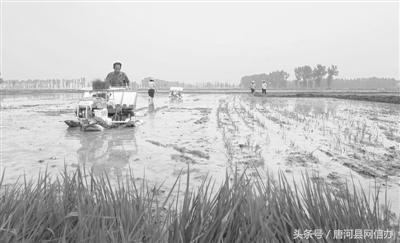
Above: In the thousand-mu rice demonstration field in Zangang Township, Tanghe County, rice transplanting has been fully mechanized
Photo by Guo Tianqiang, reporter of this newspaper