One Village, One Product Activates Rural Specialty Industries: Going to the Grassroots to See Development
On June 15, in the Yulinglong large cherry base in Xiansheng Village, Xiansheng Township, Xifeng District, bright red cherries hung all over the branches, and small groups of tourists picked and tasted cherries while taking out their phones to take photos as souvenirs. "This base was built in 2012. At present, the cherry planting area is 500 mu, with a total of 7 varieties. Since the orchard opened this year, we have sold through on-site picking, online platforms, and other methods, and the income has been quite good," said Yang Jie, head of the Qingyang City Linying Planting Professional Cooperative.
According to Liu Yongwei, Party secretary of Xiansheng Village, in recent years the village has actively adjusted its planting structure, attracted merchants through investment promotion to transfer land in the village, and driven villagers to develop the cherry industry. At present, the village has built 11 cherry demonstration orchards, and the cherry planting area has reached 3,123 mu. "After these cherry orchards were built, they absorbed 80% of the village's surplus labor force."
This is a microcosm of Xifeng District promoting industrial development based on "One Village, One Product." In recent years, with the goal of "increasing agricultural efficiency and farmers' income," Xifeng District has actively changed its development concepts, vigorously promoted the "One Village, One Product" specialty development model, and adopted measures such as policy promotion, demonstration-driven development, and leadership by leading enterprises, combining each village's development advantages to develop industries according to local conditions. In developing industries, it has continuously increased infrastructure construction, introduced and cultivated famous and superior varieties, carried out scientific and technological training, and developed and trained new-type farmers who understand technology, know how to operate, and are good at management... Through implementing a series of active and effective measures, it has accelerated the development of specialty agriculture, cultivated a number of villages with specialty industries, and activated rural economic development.
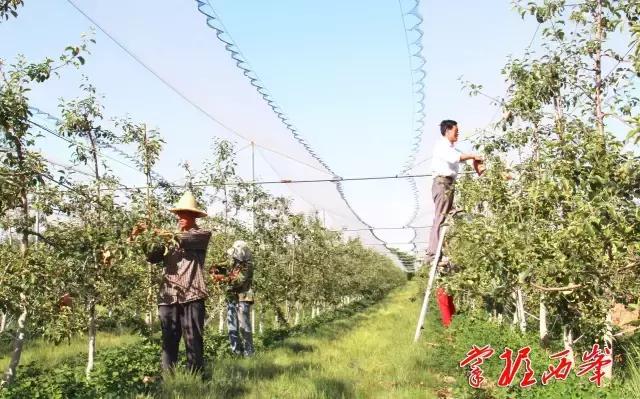
"Here is a 300-mu cherry orchard. Ahead there are also peach orchards and apricot orchards. While making the apple industry bigger and stronger, we guide farmers to plant miscellaneous fruits and develop leisure picking tours..." Recently, in Mibao Village, Wenquan Town, village director Zhang Jianxue introduced to reporters that the village mainly develops the forest and fruit industry. At present, the planting area of various fruit trees in the village is more than 4,000 mu, and there are more than ten cooperatives operating the fruit industry. "In the past two years, our village has not only gradually expanded the fruit tree planting area, but also developed related industries such as agricultural materials sales, fruit packaging, and transportation. The annual output value of the fruit industry is around 20 million."
Xinxing Village, Shishe Township, located in the river valley area, uses its uniquely favorable agricultural production conditions to turn resource advantages into economic advantages and actively develop the melon industry. This year, 335 steel-frame greenhouses and 71 skeleton greenhouses were planted with melons, and the total output value is expected to exceed 2 million yuan. Melon planting is gradually moving toward industrialization and has become a pillar industry for increasing local farmers' income. "This year I planted 4 greenhouses of melons. Now the road is open, so I don't have to go to Xifeng; I can sell all the melons in the village, and I can earn fifty or sixty thousand a year," said villager Wang Jinfa with joy on his face when talking about the income brought by melon planting.
Each village has also accelerated the cultivation of market entities for "One Village, One Product" development and advanced the process of agricultural industrialization through measures such as expanding the ranks of capable people who can lead others to prosperity and developing farmers' professional cooperatives. Party members and cadres in Zhuangziwa Village, Dongzhi Town, took the lead in establishing the Xinguang Fruit Tree Planting Farmers' Professional Cooperative. Following the development model of collective land transfer, unified planning, and contiguous planting, they built more than 1,500 mu of new orchards. This year the orchards have fully borne fruit, and by the end of the year the village's per capita income will exceed 8,000 yuan. Zhaozui Village, through methods such as investment promotion, has cultivated 5 farmers' professional cooperatives including Dexinyuan, Ruyifa, and Shengcaoyuan, developed more than 10 large breeding and planting households, and driven the continuous expansion of the village's breeding of cattle, sheep, chickens, and other livestock and poultry as well as the planting scale of apples, seedlings, forage grass, and more.
Roses in Kongyuan Village, flowers and bonsai in Wangling Village, organic vegetables in Yanqiao'ao, free-range local chickens in Xialiu Village, millet in Xinzhuang, nectarines in Ruiling Village, eco-tourism in Maosi Village... Today, "One Village, One Product" has blossomed everywhere across Xifeng's townships, and the industrial pattern of "villages with specialty industries and households with projects to get rich" has initially taken shape. The development of the "One Village, One Product" industry has not only promoted the rapid and healthy development of the rural economy, but also filled farmers' pockets. In the first quarter of this year, Xifeng District's agricultural added value reached 65.768 million yuan, a year-on-year increase of 5.6%, and the per capita disposable income of farmers reached 2,678.1 yuan, a year-on-year increase of 7.1%. (Pan Xiaomei, Liu Tingting)
Source: Zhangwo Xifeng